
Winter is the perfect time for an easy iceberg density experiment that explores density, icebergs, and water! Did you know ice floats because it is less dense than water? What happens in saltwater? Let’s set up the experiment below to learn more!

Iceberg Density Experiment
This hands-on experiment will help students of all ages understand physical properties like buoyancy, and melting points—all while making connections to climate, ocean science, and the North Atlantic!
💡This is an excellent addition to your Winter Science Lesson Plans! Or find more density experiments for kids here.
Recommended Grade Level: Grades 4 and older
What You’ll Learn:
Try This Iceberg Density Experiment!
This density experiment is perfect for classroom or home use with a super easy setup.
Materials Needed:
Freezing the Iceberg:
- 1-2 cups of water (240-480 mL) in a small container, bowl, or plastic cup
- Blue food coloring (optional) for better visibility
- Freezer (overnight freezing)
Experiment (Controlled Water Amount):
- 4-6 cups (1-1.5 liters) of water in a large clear bin
- This ensures enough space for the iceberg to float and be observed.
Saltwater Variations:
- Use the same 4-6 cups of water for each test.
- Add different amounts of salt to test its effect on iceberg buoyancy.
Testing Different Saltwater Concentrations
1️⃣ No salt (Control Group) – Use plain water to see how the iceberg behaves in freshwater.
2️⃣ 1 tablespoon of salt per cup of water – A low-salt solution, similar to brackish water.
3️⃣ 3 tablespoons of salt per cup of water – A moderate salt level, like some ocean waters.
4️⃣ 6 tablespoons of salt per cup of water – A high salt concentration, similar to the Dead Sea.
Predictions & Observations

🔎 Iceberg Density and Buoyancy Science Information
Why Does More Salt Make Water Denser?
Salt dissolves in water, making the liquid more packed (higher density). The more salt you add, the more buoyant the iceberg becomes, making it float higher. This explains why people float more easily in the ocean than in a freshwater lake!
Water behaves uniquely compared to many other substances. Most materials become denser when they change from liquid to solid, but water does the opposite!
Why Does Ice Float?
All matter is made of tiny particles called molecules, and these molecules behave differently depending on temperature.
Water molecules in liquid water move freely and stay close together, giving water its greater density than ice. When water freezes, the molecules slowly spread out, forming a solid structure with more empty space. This expansion makes ice less dense than liquid water, so ice floats instead of sinking!
💡 Fun Fact: Water is the only known non-metallic substance that expands when it freezes!
What Objects Will Sink or Float?
Everything has density, which measures how much matter is packed into a certain amount of space (unit volume).
- Objects with greater density than water sink (like a rock).
- Objects with less density than water float (like ice cubes or wood).
- The more tightly packed the molecules, the denser the object!
- Salt water increases density, which affects how icebergs behave in the ocean.
🔎 Try this simple test: Drop different objects into a cup of water (like a penny, a cork, and an ice cube). What happens? Free Printable Sink Float Experiment here.
How Does Salt Water Affect Icebergs?
The ocean is full of salt, which changes how water behaves! Saltwater has a higher density than freshwater because the dissolved salt adds more mass to the same amount of water. Since higher-density materials sink, icebergs in salt water float slightly higher than in pure water.
In polar regions, melting Antarctic ice sheets release freshwater into the ocean, reducing the density of seawater, which can affect ocean currents and climate patterns!
Why Is This Important?
- Climate scientists study how icebergs melt and how sea-level rise is affected by the density of ocean water.
- Meteorologists track how ice and water interact to predict weather patterns.
- Engineers and ship designers consider density and buoyancy when designing boats, submarines, and icebreakers!
This experiment helps us understand real-world science and how water molecules, temperature, and density affect icebergs, oceans, and our climate!
🔍 A Common Misconception: Many think icebergs are completely above water, but due to the ratio of the amount of matter to unit volume, they are mostly submerged!
More Winter Science Fun!
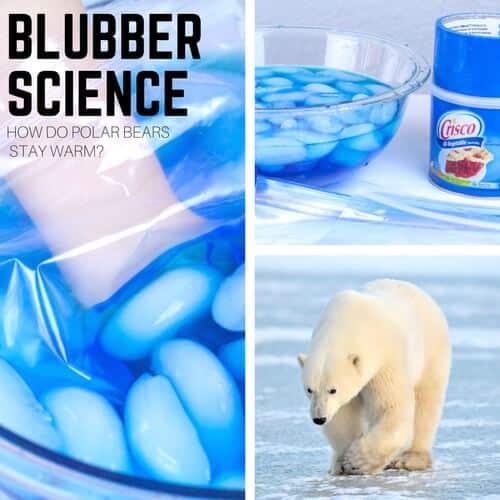
- Blubber insulation experiment – See how Arctic animals stay warm
- Ice and salt bridge challenge – Explore how freezing point changes
- Does hot water and cold water mix? – Explore what happens when hot meets cold
- Slippery or Sticky Ice Experiment – Is ice always slippery?
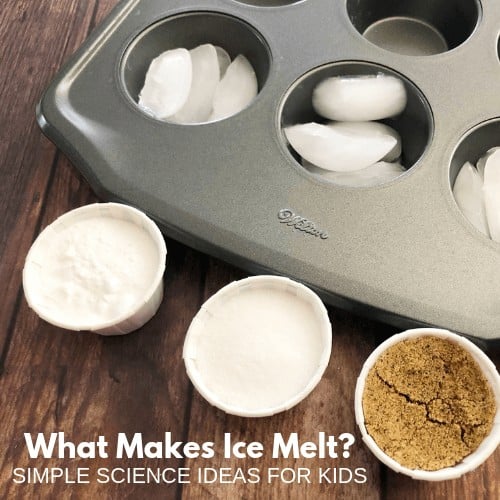
- Melting Ice Cube Race – Explore how ice melts faster on some surfaces than others.


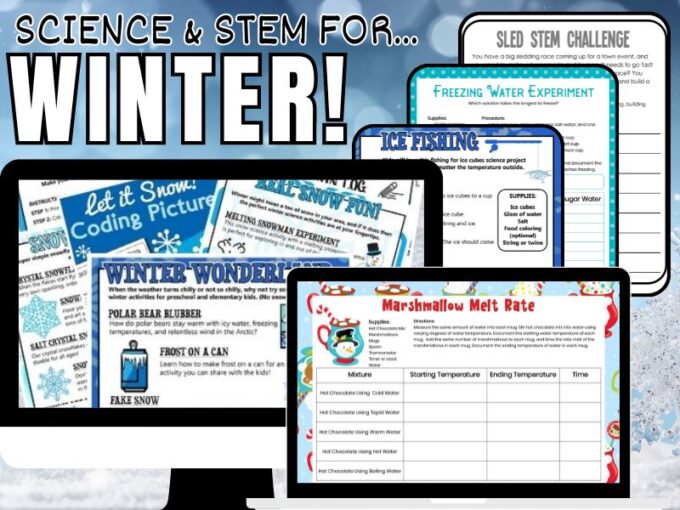
Printable Winter STEM Pack
Even if you don’t live in a snowy winter climate, there are many ways to explore the season!
WHAT’S INSIDE? You’ll find 250+ Pages of Winter theme projects for STEM!