
This saltwater density experiment will help kids explore how different liquids affect the ability of objects to sink or float. Let’s explore density, salt water, and what happens when we change a liquid’s properties! A fantastic science experiment for kids!

What Is Salt Water Density?
Have you ever wondered why some objects float while others sink? Or why it’s easier to float in ocean water than in a swimming pool?
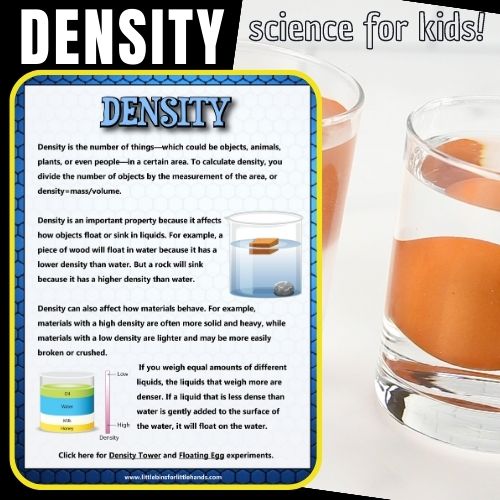
Density is how much “stuff” (particles) is packed into a certain space. A higher density means more particles are squeezed together, making it harder for objects to sink. A low density means fewer particles, allowing objects to float more easily.
This is why it’s easier to float in seawater or the Great Salt Lake—both have a lot of sodium chloride (salt) dissolved in them!
Recommended Grade Level: Grades 3 and older
💡 For younger students, start with our sink or float experiment in water.
Supplies:
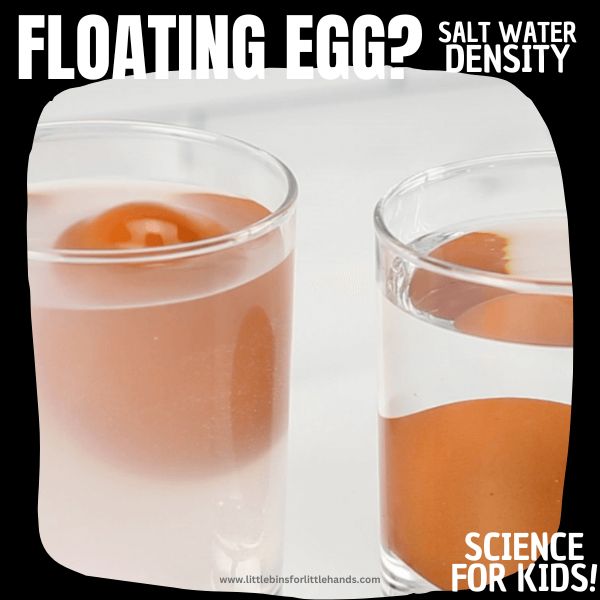
🔎 NOTE: If you are interested in the Floating Egg Experiment, you can read more here.
- Clear cups or plastic cups (one per liquid)
- Measuring spoons (tablespoons of salt, tablespoons of sugar, and a teaspoon)
- Water (tap or cold water)
- Soda water (contains tiny carbon dioxide bubbles)
- Drops of food coloring (optional, for fun layers)
- Different objects to test:
- Grapes
- Oranges (peeled vs. unpeeled)
- Small plastic jewels
- Jar lid or bottle cap
- Cornstarch (to observe its reaction in water)
- Small test tube or graduated cylinder (for older students)
- Stirring sticks or spoons to mix
- Notebook and pencil for observations (use our free science journal pages below)

Salt Water Density Experiment Set Up


Use The Scientific Method
You can also follow the scientific method to explore this density experiment, which is perfect for older kids.
💡Learn more about the scientific method, writing a hypothesis with kids, and choosing variables in science!
Ask a Question
- Why do some objects float while others sink?
- How does adding salt, sugar, or bubbles change water’s density?
Make a Hypothesis
A hypothesis is an “if/then” statement that predicts what will happen.
- Example: “If we add tablespoons of salt to water, then an egg will float because the water becomes a more dense solution.”
- Kids’ guesses: What do you think will happen if we add sodium chloride (table salt) to water? Will objects float better in salt water than in regular water?
Experiment: Setting Up the Test
- Label each cup for different liquids:
- Regular water (control)
- Salt water (add 3 tablespoons of salt)
- Sugar water (add 3 tablespoons of sugar)
- Soda water (contains tiny bubbles)
- Stir well until the salt dissolves or sugar disappears.
- (Optional) Add a few drops of food coloring to see the layers of water.
- Test each object in all four cups. Place each one carefully at the top of the cup and observe whether it floats or sinks to the bottom of the cup.
Observations & Variables
💡Read more about variables in science here.
Independent Variable
- The type of liquid you have. Eg salt water, regular water, soda or sugar.
Dependent Variable
- Whether the object sinks or floats in the liquid.
Controlled Variables
- The amount of liquid in each cup.
- The object you use to test density in each cup.
Salt Water Density Science Information



Check out our STEM Projects Bundle
The STEM Project Bundle includes a variety of hands-on packs designed to engage kids ages 5-12 in exploring science, technology, engineering, and math. Packed with activities for all age levels, it’s perfect for both home learning and classrooms.