

Jumping Tinsel Static Electricity Experiment for Kids
Can you make Christmas tinsel jump without touching it? This easy jumping tinsel static electricity experiment uses a balloon and a few lightweight pieces of tinsel to explore how static electricity works.
It’s a fun Christmas science activity for kids that takes just minutes to set up. Rub a balloon against your hair, hold it near the tinsel, and watch what happens!

Christmas Static Electricity Experiment
Static electricity is a fun science topic to explore during the holiday season. You don’t need any complicated equipment, and kids can see the results almost immediately.
👉 This Christmas science experiment is perfect for elementary classrooms, small groups, or an afternoon at home. Looking for more holiday experiments? Explore our favorite Christmas science activities using simple supplies.
You’ll explore:
- How static electric charges build up.
- How a charged balloon attracts lightweight objects.
- Which materials work best for creating static electricity.
👉 You can also try more of our static electricity experiments for kids throughout the year.
Jumping Tinsel Experiment
Supplies Needed
- 1 or 2 balloons
- Lightweight Christmas tinsel
- Hair, wool, or fleece for rubbing the balloon
- A table or flat work surface
Tip: Choose thin, lightweight tinsel strands. Heavy decorations and thick pieces of garland won’t move as easily.
Safety: Adult supervision is recommended. Keep uninflated or broken balloons away from young children, and don’t leave loose tinsel where children or pets might swallow it.
How to Make Tinsel Jump
STEP 1. Prepare your tinsel.
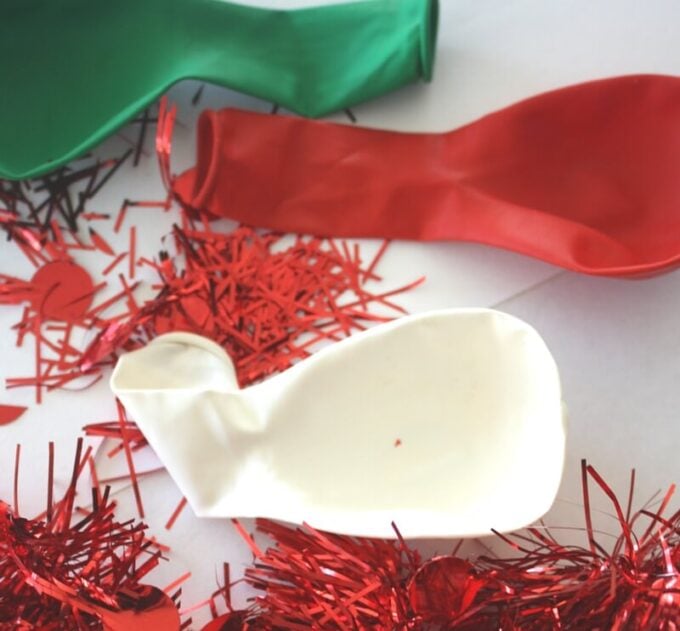
Cut a few short pieces of lightweight Christmas tinsel and spread them out on a dry table. If your tinsel contains a wire or stiff center, remove it so you are working with the lighter strands.
STEP 2. Charge your balloon.
Blow up your balloon and tie it closed. Rub the balloon against dry hair, wool, or fleece for about 10–15 seconds to build up a static electric charge.
💡 Tip: We found that rubbing the balloon against hair worked especially well!

STEP 3. Make the tinsel jump!
Slowly bring the charged balloon close to the tinsel without touching it. Watch carefully. Do the pieces move toward the balloon? Can you make them lift off the table?
Try moving the balloon away and bringing it closer again.

STEP 4. Try a few variations.
Once you’ve made the tinsel move, experiment with different materials and conditions.
- Does a larger piece of tinsel move as easily as a smaller one?
- What happens when you rub the balloon against fleece instead of hair?
- Can you attract tiny pieces of tissue paper?
- How far away can you hold the balloon and still make the tinsel move?

Why Does the Tinsel Jump?
The jumping tinsel experiment works because of static electricity.
When you rub a balloon against your hair or another suitable material, tiny charged particles called electrons can transfer between the two surfaces.
The balloon usually gains extra electrons, giving it a negative electric charge. When you bring the charged balloon near the tinsel, the electric charges in the tinsel respond to the balloon’s electric field.
This can create an attractive force that pulls the lightweight tinsel toward the balloon, even though the balloon hasn’t touched it.
Because the tinsel is so light, the movement is easy to see! Sometimes the tinsel may also stick to the balloon. After touching it, pieces may become charged and can even move away from the balloon.
🔎 The big science idea: Static electricity can cause objects to attract or repel each other without being pushed by your hands.
👉 Want to learn more? Visit our static electricity experiments for additional hands-on examples.
What If Your Tinsel Doesn’t Jump?
Static electricity experiments work best when the conditions are right. If your tinsel isn’t moving, try these simple adjustments.
- Use lighter tinsel. Thin strands move more easily than thick or heavy pieces.
- Try a dry room. Humidity can make it harder for static charges to build up and remain on the balloon.
- Rub the balloon again. Add more charge before testing.
- Experiment with materials. Dry hair, wool, and fleece are all worth testing.
- Bring the balloon closer. Move slowly until you notice the tinsel react.
💡 You can also try small pieces of tissue paper if your tinsel isn’t cooperating.
Get Your FREE Christmas Science & STEM Starter Guide!
Make holiday learning easy with our FREE Christmas Science & STEM Starter Guide! This printable mini pack includes a week of hands-on science and STEM ideas, plus two ready-to-use activities for your classroom or home.
Perfect for elementary classrooms, STEM centers, and holiday learning at home!
🎄 Grab your FREE Christmas Science & STEM Starter Guide below!
More Christmas Science Experiments
Keep exploring with these fun Christmas science projects!
- Fizzing Christmas Trees – Explore a colorful baking soda and vinegar reaction.
- Dissolving Candy Canes – Investigate how candy canes dissolve in different liquids.
- Santa’s Magic Milk – Watch colors swirl in a simple surface tension experiment.
- Grow Gingerbread Crystals – Explore crystal formation with a Christmas twist.
- Reindeer Toothpaste – Discover an exciting chemical reaction.
- Christmas Science Activities – Browse even more Christmas experiments for kids.
Get the Christmas STEM Project Pack
Want a collection of holiday projects with directions and supporting printables? Explore our paid Christmas STEM Project Pack for Christmas-themed science investigations and STEM challenges.
Choose projects for your classroom or home and print the pages you need.
Explore the Christmas STEM Project Pack.




awesome!!
Thank you for your collection of STEM activities!! They are going to help us stay in routine during Christmas Break from school! He loves science so we’re doing a Christmas STEM Camp (at home) this year along with maintaining a few academic skills..it’s just what we need to do during breaks:) I’m using many of your ideas in the next 10 days. Thank you for the blessing!