
Did you know you can classify everyday materials using just your senses? This fun and interactive activity on observable properties will have students observe, explore, and discover the properties of the materials around them—just like real scientists in a lab!

What are Observable Properties?
Understanding the properties of materials is an essential science skill that helps young learners make sense of the world around them. Students can observe, describe, and group materials using their senses based on texture, color, shape, flexibility, and transparency.
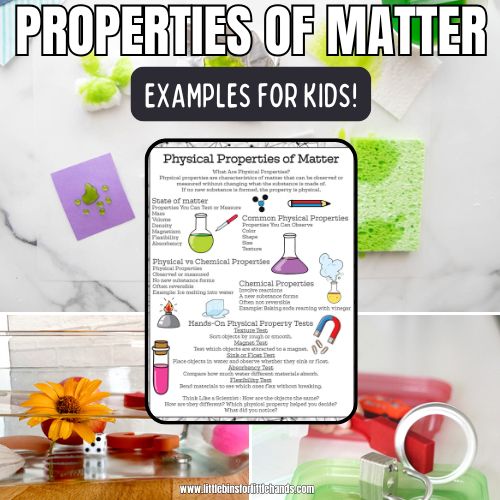
Observable properties are physical properties that can be seen or measured, which are explained in our Physical Properties of Matter for Kids post.
Grade Level Recommendation: This activity is ideal for grades K-2. Still, it can easily be adapted for younger learners with more guided observations or for older students by diving deeper into material properties and their practical uses.
Supplies:
- A collection of various materials (e.g., plastic cup, metal spoon, wooden block, fabric swatch, sponge, rubber band, glass jar, rock, etc.)
- Worksheet (provided below)
- Magnifying glass (optional)
- Pencil or marker
- Bonus Activity: Winter weather materials: snow, ice cubes, salt, mittens, gloves, plastic container or tray. Bonus printable here.
Observable Properties Experiments
Set up this easy experiment for observable properties with everyday materials. Plus, find a bonus option to try during winter season relating to weather and climate.
Observe and Record
- Pick up each object and use your senses to observe its properties:
- Color: What color is the object?
- Texture: Is it rough, smooth, bumpy, or prickly?
- Shape: Is it round, square, or irregular?
- Transparency: Can you see through it?
- Flexibility: Can the object bend without breaking?
- Write your observations in the provided worksheet.
Classify the Objects
- Group objects based on specific properties:
- Texture: Place rough materials in one pile and smooth ones in another.
- Color: Sort objects into piles based on similar colors.
- Flexibility: Separate flexible objects from rigid ones.
Discuss Findings
- Discuss your results as a group:
- Why did you group the items?
- What property did you use to decide?

Bonus: Winter Weather Observable Properties ❄️
Observe snow and ice for their unique properties: Bonus printable here.
- Texture: How does snow feel? Is it powdery, clumpy, or soft? How does ice feel—slippery, smooth, or rough?
- Temperature: Are snow and ice cold to the touch?
- Transparency: Can you see through the ice? Is snow opaque or clear?
- Change over time: Leave snow or ice out at room temperature. What happens to its shape and texture as it melts?
- Effects of salt: Sprinkle salt on ice or snow and observe how it changes. Does it melt faster? Why?
In the winter weather extension, snow and ice provide an excellent opportunity to explore the states of matter and how external factors, like temperature and salt, can cause changes.
Snow and ice exist as solids, but they transition to liquids as they melt. Adding salt lowers the freezing point of water, speeding up this transition. These concepts connect to real-world applications, such as understanding how salt is used to melt ice on roads during winter.
Free Observable Properties Journal Sheets

Additional Science Information
Observable properties of materials, such as color, texture, flexibility, shape, and transparency, can be identified without altering the material itself. These properties help scientists, engineers, and inventors select materials for specific purposes.
💡 For example, smooth and transparent materials like glass are used for windows, while flexible materials like rubber bands have specific uses due to their ability to stretch.
Related Observable Properties Activities
Material Scavenger Hunt
Take the investigation outdoors or around the classroom to find materials with specific properties, such as rough, flexible, or transparent.
Melting Snow Observation
Collect snow in a plastic container and leave it in different locations (inside, outside, in the sun). Observe how long it takes to melt and why.
Recycled Art Project
Use your collected materials to create art, emphasizing different textures and colors.
Magnifying Science
Use a magnifying glass to closely examine the textures of snowflakes, ice, and other materials.


NGSS Alignment
NGSS Alignment: This activity aligns with the Next Generation Science Standards (NGSS) for K-2: PS1.A: Structure and Properties of Matter and K-ESS2.D: Weather and Climate. It encourages students to make observations about materials to describe patterns and changes, building their understanding of the natural and designed world.
Printable Science Packs for Kids
Visit our SHOP for easy-to-print STEM and science lesson plans for the whole year. Or join us in the Little Bins Club.