
Here are some super simple preschool measuring activities that you can do individually or with a group of young kids! Early math skills start with lots of playful opportunities that don’t even have to be planned ahead of time. Encourage mathematical investigation for kindergarten and preschool with these simple measuring activities. Make sure to check out all our preschool math activities!
How To Teach Measurement
When teaching measurement to 3 to 4-year-olds, the focus should be on basic, foundational ideas that they can grasp through hands-on activities and play. Here is what you want to focus on, and the vocabulary to teach to kids.
1. Understanding Size and Length
- Big vs Small: Recognizing and comparing the size of objects.
- Tall vs Short: Understanding and comparing the height of objects.
- Long vs Short: Comparing the length of objects.
2. Comparing Quantities
- More vs Less: Identifying which group has more or fewer items.
- Equal: Understanding when two groups have the same number of items.
3. Using Non-Standard Units
- Measuring Objects: Using items like blocks, hand spans, or footsteps to measure length or height.
- Counting Units: Counting how many non-standard units it takes to measure an object (e.g., “This table is 5 blocks long”).
4. Volume and Capacity
- Full vs Empty: Understanding when a container is full or empty.
- More and Less: Comparing the amount of liquid in different containers.
5. Weight and Balance
- Heavy vs Light: Comparing the weight of different objects.
- Balance: Using simple balance scales to see which side is heavier or lighter.
Hands On Measurement Activities For Preschoolers
1. Measuring with Non-Standard Units
Although we typically think of measuring things by pulling out a ruler, we can teach kindergarten and preschoolers the concept of measurement with items like blocks, paperclips, or crayons.
For example, measure the length of a table using blocks. Lay the blocks end-to-end alongside the table and count how many blocks long it is. Compare the length of different objects using the same units.
A couple important things to remember is that the item you use to measure with, in our case unifix cubes below, should all be the same size and type. They should also be carefully placed end to end. Using an assortment of random size objects just won’t work!
You can also use blocks or cubes to measure the height or length of toys. Measure a room, measure the height of the table, measure the length of a shoe. The possibilities are endless!
Measuring Hands and Feet With Cubes
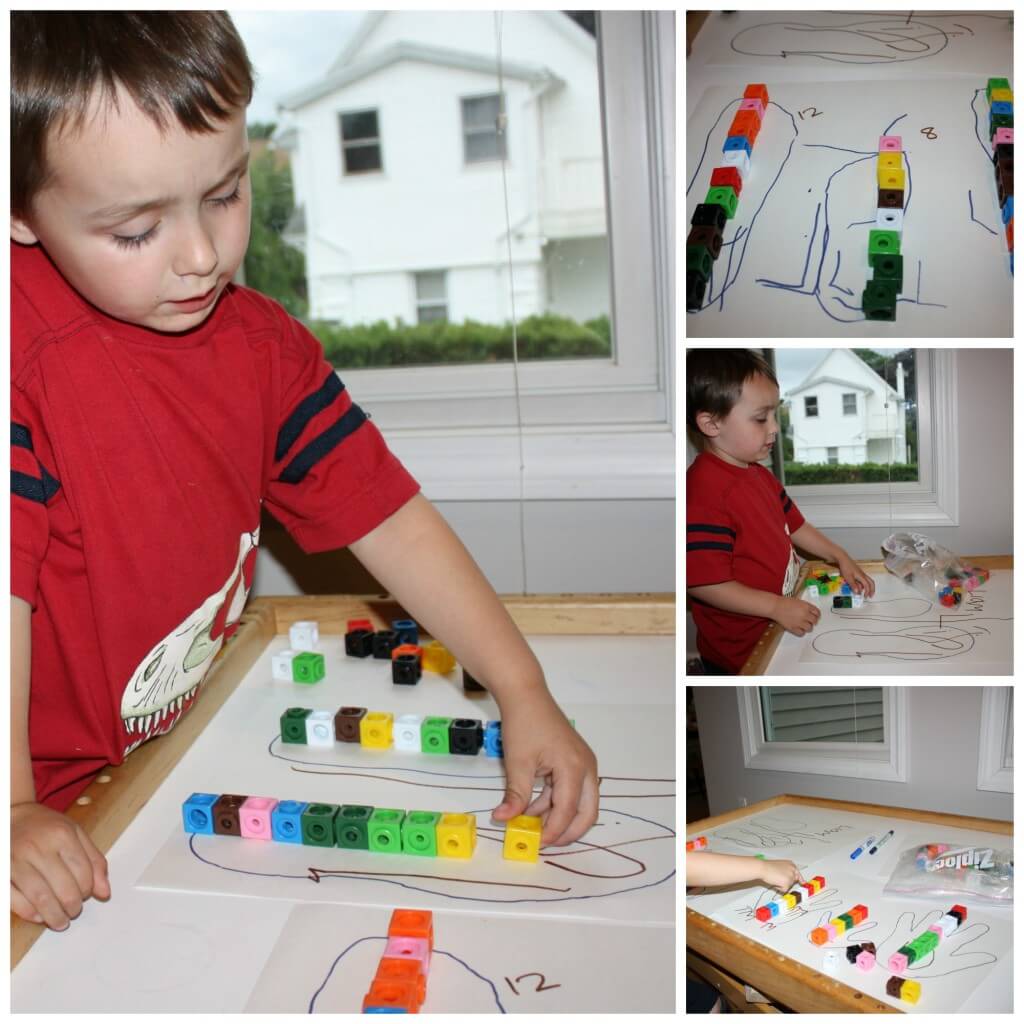
We traced our hands onto paper, and then starting at the bottom of each foot, hand or shoe and carefully lined up the unifix cubes until they got to the highest point.
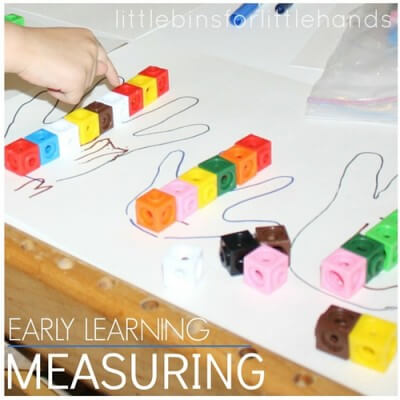
We talked a bit about looking for the highest point and although the top of the hand could be several places, we were looking for the highest, tallest part to line up our cubes and measure.
After you have finished lining up one page count the number of unifix cubes. You can write down how many you counted by each one. Repeat this same sequence for each hand, foot or shoe and then go back to compare results. Who had the longest hands or feet?
2. Height Chart
Create a height chart where children can measure their height periodically. Mark each child’s height on a wall chart and label the date. Let them compare their heights with their friends and observe their growth over time.
3. Water Play
Use measuring cups and containers of different sizes in a water table. Allow children to fill and pour water using measuring cups. Introduce terms like “full,” “empty,” “more,” and “less.”
💡 LOOK: water sensory bins!
4. Baking Together
Bake simple recipes that require measuring ingredients. Let children measure flour, sugar, and liquids using measuring cups and spoons. Discuss measurements like teaspoons, tablespoons, and cups. Compare the amounts of ingredients used (eg. more flour, less sugar).
5. Measuring Jars
Fill jars with different materials (beans, rice, water) and compare the volumes. Provide identical jars and different materials. Let children fill the jars and see how many scoops each material takes to fill a jar.
💡 LOOK: Volume Activity

6. Outdoor Measurement Hunt
Use nature items like leaves and sticks to measure and compare lengths. Have a scavenger hunt where children find items of different sizes and weights. Make sure to compare like for like; which leaf is longest?
7. Building Towers
Encourage children to build towers with blocks and count the number of blocks to find out how tall their towers are. Compare the heights of different towers. Discuss short and tall.
8. Measuring with String
Use string or yarn to measure objects and body parts. Cut the string to match the length of an object or body part (eg arm, leg). Compare the lengths of string pieces to understand different measurements.
9. Balance Scale
Use a simple balance scale to compare weights of different objects. Ask them to predict which object is heavier. Provide a variety of objects and have children use the balance scale to sort them into groups (e.g., light, medium, heavy) based on weight.
Use small, uniform items like marbles, beans, or blocks to measure the weight of larger objects. Place an object in one pan and add the small items to the other pan until the scale balances. Count the number of small items used and discuss the concept of units of measurement.
10. Playdough
Have children roll playdough into long, thin snakes. Compare the lengths and discuss which is longer or shorter. Flatten playdough into pancakes of different thicknesses. Use a ruler to measure the thickness and compare which pancake is thicker or thinner. Discuss the concept of thickness and thinness.
💡 LOOK: No Cook Playdough Recipe
Teach Measurement Through Storytime
Books are a great way to introduce the concepts of measurement to young children.
“Measuring Penny” by Loreen Leedy
This book follows a young girl named Lisa who receives a homework assignment to measure something in different ways. She chooses to measure her dog, Penny, using various units and methods, including length, height, weight, and volume.
“How Big Is a Foot?” by Rolf Myller
This story explains the concept of measurement and units by telling the tale of a king who wants to have a bed made for the queen. The king uses his own foot as a unit of measurement, which leads to some problems and a humorous lesson on the importance of standard units.
“Inch by Inch” by Leo Lionni
This book tells the story of a clever inchworm who measures various birds to avoid being eaten. The inchworm measures different parts of the birds, teaching the reader about length and units of measurement in a charming and creative way.
“Balancing Act” by Ellen Stoll Walsh
This story features two mice who are balancing on a seesaw. As more animals join them, they must figure out how to keep the seesaw balanced, introducing concepts of weight, balance, and comparison.
“Just a Little Bit” by Ann Tompert
An elephant and a mouse want to play on a seesaw, but the elephant is too heavy. They need help from other animals to balance the seesaw, teaching children about weight and the concept of balancing scales.
More Preschool Math Topics
Printable Preschool Pack
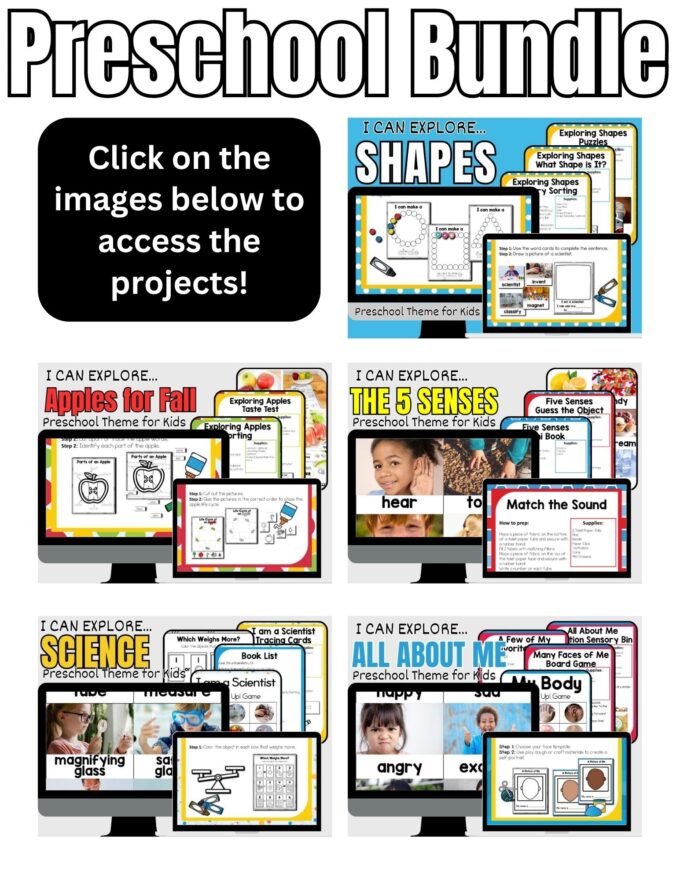
Get ready to explore this year with our growing Preschool STEM Bundle with 12 fun themes! Or grab the individual packs.
What’s Included:
There are ten fun preschool themes to get you started. This is an ” I can explore” series! You’ll find seasonal and non-seasonal themes appropriate to preschool learning throughout the year.
Each unit contains approximately 15 activities, with instructions and templates as needed. Hands-on activities are provided to keep it fun and exciting. This includes sensory bins, experiments, games, and more! Easy supplies keep it low cost, and book suggestions add the learning time.


Excellent way to explore measurement! I’ll be featuring it this week for Discover & Explore – thanks for linking up!