
The periodic table plays an essential role in understanding chemistry and the world around us. As students explore it, they discover how scientists organize and classify elements. These periodic projects below with printable periodic table, offer a fun and engaging opportunity to learn about the building blocks of our universe.

Fun Periodic Table Activities
Color The Periodic Table
In this project, students color and label their own periodic table to learn about how the elements are organized by their properties. Grab the free printable periodic table below to get started!
Have students color-code their periodic tables using different colors to represent different element groups. For example:
- Group 1: Alkali metals – Light green
- Group 2: Alkaline earth metals – Orange
- Groups 3: Transition metals – Light blue
- Lanthanides (Elements 57-71) and Actinides (Elements 89-103) – Purple and Dark Blue
- Group 17: Halogens – Yellow
- Group 18: Noble gases – Pink
- Metalloids (Along the zigzag line between metals and nonmetals, often found between Groups 13-16.) – Dark green
- Groups 14-16: Other Non-metals – Various colors
Optional: For an additional challenge, assign each student a specific element to research. Create a small fact card about the element. Include details such as where it is found, its use, and any interesting properties.
Element Scavenger Hunt
Apply understanding of the periodic table by setting up a scavenger hunt in which students find everyday objects that contain certain elements, such as aluminum in soda cans or copper in electrical wires.
Create An Element
Have students design an imaginary element. They can choose their element’s name, symbol, atomic number, and properties. Make sure that
Research Project
Ask students to pick one group (such as transition metals or noble gases) and research the characteristics and uses of elements in that group. They can present their findings as posters or slideshows.
Element Flashcards
Create flashcards with the element name on one side and key information (symbol, atomic number, and group) on the other. Use them for games like matching or quizzes.
Periodic Table Bingo
Make a bingo game using element names, symbols, or properties (e.g., atomic number, mass, group). Students mark off the elements as they are called out.
Periodic Table Puzzle
Turn the colored periodic table into a puzzle by cutting out groups or individual elements. Students can work to put it back together, reinforcing their knowledge of element positions.
Build a Periodic Table with LEGO
Use colored LEGO bricks to represent different element groups. Students build a 3D periodic table while learning about element families.
Element Trading Cards
Have students design trading cards for different elements, including facts like atomic number, mass, and uses. They can then trade and learn about the elements from each other.

How The Periodic Table Is Organized
The periodic table consists of rows (periods) and columns (groups). The table groups elements with similar properties together, which helps scientists understand chemical behavior.
- Group 1: Alkali Metals – Highly reactive metals like lithium (Li), sodium (Na), and potassium (K).
- Group 2: Alkaline Earth Metals – Slightly less reactive than alkali metals, includes elements like magnesium (Mg) and calcium (Ca).
- Groups 3-12: Transition Metals – Metals that are good conductors of heat and electricity, including iron (Fe), copper (Cu), and gold (Au).
- Lanthanides – Elements 57-71, often shown as a separate row below the main table, used in electronics and specialized alloys.
- Actinides – Elements 89-103, also shown as a separate row, includes radioactive elements like uranium (U) and plutonium (Pu).
- Group 13: Boron Group – Contains elements like boron (B) and aluminum (Al), with mixed properties.
- Group 14: Carbon Group – Includes carbon (C), silicon (Si), and lead (Pb), essential for both organic life and technology.
- Group 15: Nitrogen Group (Pnictogens) – Includes nitrogen (N), phosphorus (P), and arsenic (As), important in biological processes and industry.
- Group 16: Oxygen Group (Chalcogens) – Contains oxygen (O), sulfur (S), and selenium (Se), crucial for respiration and environmental processes.
- Group 17: Halogens – Highly reactive non-metals like fluorine (F), chlorine (Cl), and iodine (I), often used in disinfection and chemical processes.
- Group 18: Noble Gases – Inert gases like helium (He), neon (Ne), and argon (Ar), known for being stable and unreactive.
As students learn how elements are organized, they gain insight into matter’s building blocks and how the elements interact!
Free Printable Periodic Table Project

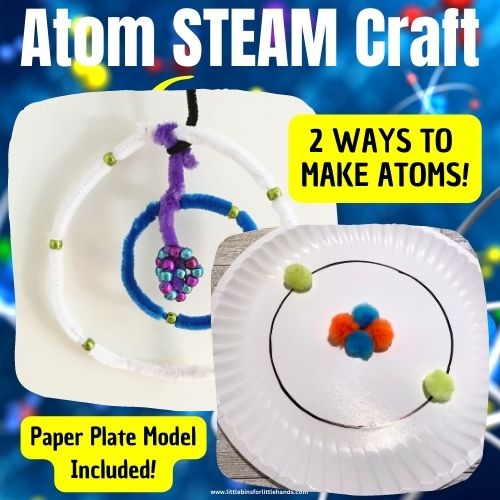
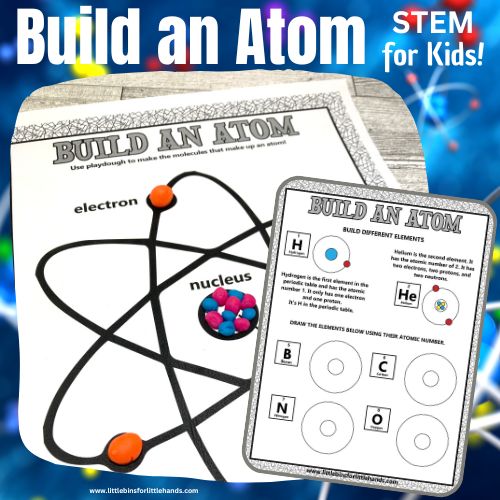
Extend The Learning: Atoms and the Periodic Table
Learning about atoms helps students understand the periodic table because it visually organizes elements, all composed of atoms. Here’s how it connects:
💡 Learn more about the structure of Atoms [here] and grab a free printable project!
- The atomic number (the number of protons) determines the arrangement of elements in the periodic table. Each element’s unique atomic structure defines its place as the table organizes elements by increasing atomic number.
- By learning that different atoms have different numbers of electrons, kids can understand why elements in the same column (group) on the periodic table behave similarly. For example, elements in Group 1 have one electron in their outer shell, making them highly reactive.
- Once students know about atoms, they can use the periodic table to predict the behavior of elements. For instance, elements in the same row (period) have increasing electron shells. This connection helps kids see patterns in reactivity, conductivity, and other properties.
More Fun Chemistry For Kids
💡 Explore all of our collection of chemistry activities [here].
- Physical Change Experiments
- Chemical Change Experiments
- What Is Chemistry?
- Chemical Reaction Experiments
- States of Matter
- What Is Phase Change?

Printable Science Projects Pack
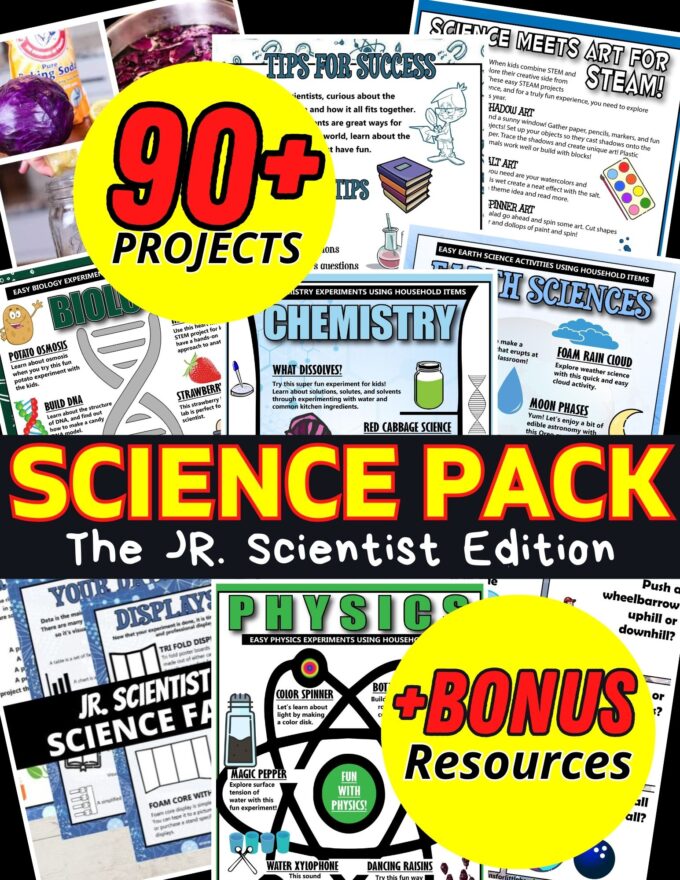
If you’re looking to grab all of our printable science projects in one convenient place plus exclusive worksheets and bonuses like a STEAM Project pack, our Science Project Pack is what you need! Over 300+ Pages!
- 90+ classic science activities with journal pages, supply lists, set up and process, and science information. NEW! Activity-specific observation pages!
- Best science practices posters and our original science method process folders for extra alternatives!
- Be a Collector activities pack introduces kids to the world of making collections through the eyes of a scientist. What will they collect first?
- Know the Words Science vocabulary pack includes flashcards, crosswords, and word searches that illuminate keywords in the experiments!
- My science journal writing prompts explore what it means to be a scientist!!
- Bonus STEAM Project Pack: Art meets science with doable projects!
- Bonus Quick Grab Packs for Biology, Earth Science, Chemistry, and Physics