
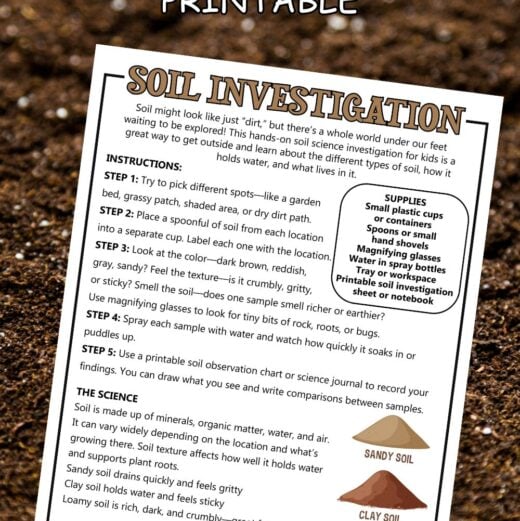
Looking for an easy spring science activity you can take outdoors? This hands-on soil investigation for kids is a simple way to explore what’s beneath our feet while learning about soil types, water absorption, and how soil supports plant life.
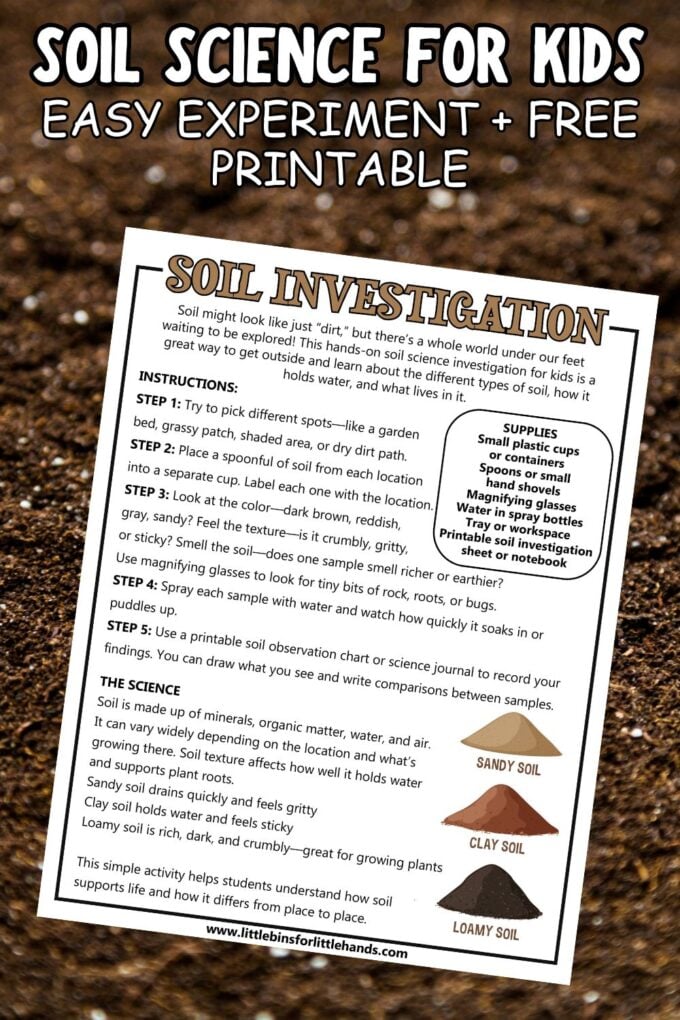
Perfect for spring STEM lessons, gardening themes, or outdoor learning days, this activity is quick to set up and packed with meaningful science.
👉 For more soil and earth science activities, make sure to browse the Spring science hub.
Simple Earth Science for Kids
Field: Earth Science—Soil & Ecosystems
Grades: K–4
Concepts Explored: Soil is composed of minerals, organic matter, water, and air; different soil types have varying textures and drainage properties; soil supports plant growth and ecosystems.
Supplies Needed
- Small plastic cups or containers
- Spoons or small hand shovels
- Magnifying glasses
- Spray bottle with water
- Tray or workspace
- Printable soil investigation sheet (see below)
How To Do a Soil Investigation
STEP 1: Choose a few different locations outdoors.
Try a garden bed, a grassy area, a shaded spot, or a dry dirt path.
STEP 2: Collect samples.
Place a spoonful of soil from each location into separate cups. Label each one.
STEP 3: Observe the soil.
Look closely at each sample:
- What color is it? (dark brown, reddish, gray, sandy?)
- How does it feel? (crumbly, gritty, sticky?)
- What does it smell like?
Use a magnifying glass to look for tiny rocks, roots, or living organisms.
STEP 4: Test water absorption.
Spray each sample with water and watch what happens.
- Does the water soak in quickly?
- Does it puddle on top?
STEP 5: Record your findings.
Use a science journal or printable observation chart to compare your samples.
Soil Science Explained
Soil may look like simple dirt, but it’s actually made of four important parts:
- Minerals (tiny pieces of rock)
- Organic matter (decayed plants and animals)
- Water
- Air
Different types of soil behave in different ways:
- Sandy soil feels gritty and drains water quickly
- Clay soil feels sticky and holds water longer
- Loamy soil is dark, crumbly, and best for growing plants
This matters because plants need the right balance of water and air in the soil to grow strong roots. Soil also provides nutrients and a home for tiny organisms that help plants thrive.
👉 In this activity, kids can see and feel these differences in real time.
Get Your Free Soil Investigation Printable
Make this activity even easier with a printable observation sheet!
It includes:
- Soil comparison chart
- Drawing section
- Reflection questions
👉 Grab your free printable here
Make It a Science Project
Take this activity further by turning it into a simple science project.
Try asking:
- Which type of soil absorbs water the fastest?
- Which soil looks best for growing plants?
- Does darker soil always mean healthier soil?
Test it:
Collect more samples and repeat the experiment to compare results.
Change one variable:
Try adding the same amount of water to each sample and measure absorption time.
👉 Learn about the scientific method for kids, including writing a hypothesis and choosing variables.
Extension Activities
Keep the learning going with these simple ideas:
- Plant Growth Test: Grow seeds in different soil samples and compare results
- Worm Habitat Exploration: Look for living organisms in soil and discuss their role
- Soil Layers Jar: Add soil and water to a jar, shake it, and observe how layers settle
More Spring Science Activities
Looking for more hands-on ideas?
Try these next:
- Water cycle in a bag
- Seed germination activities
- How plants grow experiments
- How rain forms (rain cloud model)
👉 You can also explore our full collection of spring science activities here.
Bring Spring Science to Life
Love simple, hands-on activities like this?
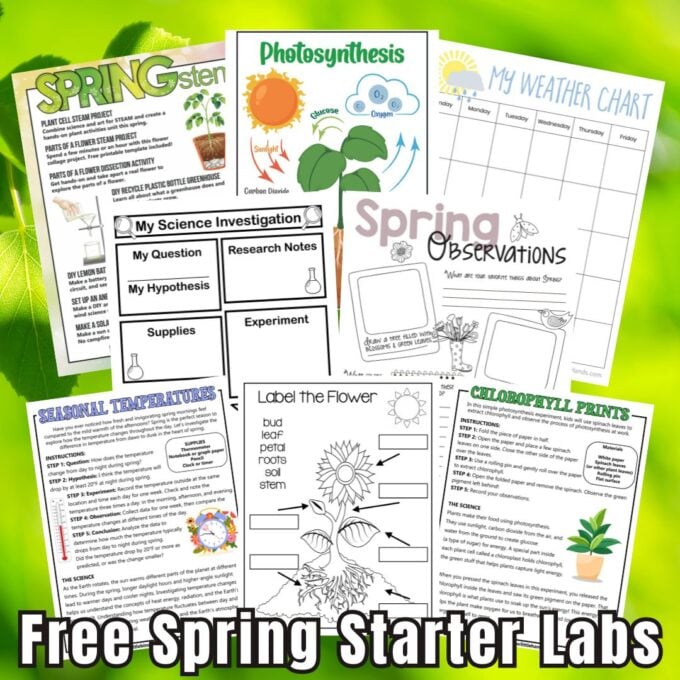
This soil investigation is just one of 30+ ready-to-go projects in our:
Inside you’ll find:
- Plant science activities
- Weather investigations
- Life cycle projects
- Earth science and engineering challenges
- Printable journal pages, guides, and visuals
Perfect for classrooms, homeschool, or at-home learning.
More Facts for Kids
- Healthy soil is full of living organisms like bacteria, fungi, and worms
- Soil helps filter water as it moves through the ground
- Different regions of the world have very different types of soil
- Farmers test soil to grow better crops
Final Tip
When comparing soil, order matters when adding water.
Start with the same amount for each sample so you can clearly see differences in absorption.