
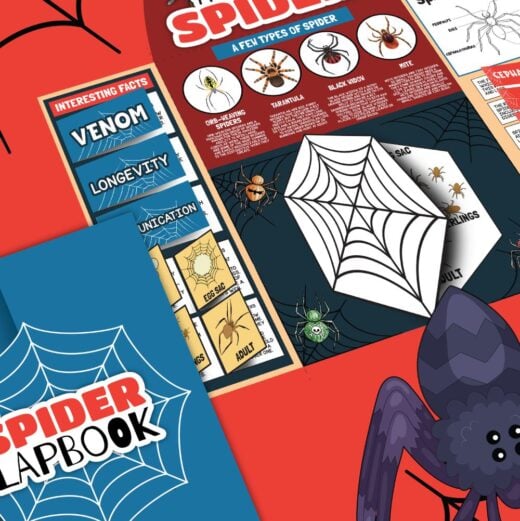
Get ready to learn all about spiders! With this Spider Lapbook activity, kids explore the fascinating world of arachnids. This hands-on project connects directly to life science, biology, and ecology, making it a perfect printable for home or classroom learning.

Spider Life Cycle Activity
Field of Science: Life Science, Biology, Ecology
Grades: 1–4
Concepts Explored: Animal life cycles, anatomy, food chains, and ecosystem roles
Kids learn how spiders grow and survive, how they contribute to maintaining balance in ecosystems, and why their unique adaptations enable them to be expert hunters.
Supplies Needed
- Printable Spider Lapbook (download below)
- Scissors
- Glue or tape
- Crayons, markers, or colored pencils
- Folder or cardstock for mounting
How to Make the Spider Lapbook
- Print all lapbook pages.
You’ll find pages on the spider life cycle, spider anatomy, types of spiders, and interesting facts. - Color each page.
Use crayons or markers to bring the spiders to life! Add detail to the webs, egg sacs, and spiderlings. - Cut out the pieces.
Trim along the dotted or solid borders. Each section (life cycle, anatomy, and facts) can be cut and layered onto your folder. - Assemble into a lapbook.
- Glue the Life Cycle diagram (Egg → Egg Sac → Spiderlings → Adult) to one section of the folder.
- Attach the Spider Anatomy diagram on the other side.
- Add the Interesting Facts panel and Types of Spiders page to complete the display.
- Label and decorate as desired!
- Review and discuss.
Talk about how each spider type differs, what its body parts do, and how it survives in its habitat.

Spider Science Information
Spiders are arachnids, not insects, and they play a vital role in the balance of nature. They’re invertebrates with no backbone and rely on an exoskeleton to protect their soft bodies.
Spider Life Cycle
A spider’s life begins as a tiny egg inside a silk egg sac, carefully spun by the mother. When the spiderlings hatch, they look like miniature adults. As they grow, they molt, shedding their outer layer multiple times until they reach full size.
🔎 Add a spider lifecycle playdough mat here.

Spider Anatomy
Spiders have two main body sections:
- Cephalothorax: where the legs, eyes, and mouthparts are located.
- Abdomen: where silk glands, the heart, and digestive organs are found.
They have eight legs, multiple eyes, and spinnerets for creating silk — used to spin webs, protect eggs, or trap prey.
Spiders and the Food Chain
Spiders play a crucial role in many food chains. They are predators, feeding on insects, mites, and even other spiders. By controlling insect populations, they help maintain healthy and balanced ecosystems.
In turn, spiders are prey for birds, frogs, and small mammals — showing how every organism connects through energy flow in a food chain. A simple example might look like this:
🌿 Plants → 🦟 Insects → 🕷️ Spider → 🐦 Bird
Spiders demonstrate the interdependence of organisms within ecosystems, making them a great way to teach young learners about producers, consumers, and decomposers in biology.
Free Printable Spider Lapbook
Get started here and grab the free Spider Life Cycle and Lapbook activity!
More Science Facts for Kids
- Most spiders have eight eyes, but not all see well.
- Spiders use vibrations and silk lines to sense movement.
- Orb-weaving spiders create the classic circular webs you see in gardens.
- Tarantulas can live for up to 30 years!
- Spider silk is one of the strongest natural fibers known.
Related Science Activities
- Honey Bee Life Cycle
- Frog Life Cycle Project
- Animal Life Cycle Activities for Kids
- Vertebrates and Invertebrates Worksheets
- Food Chains Worksheets
- Playdough Bug Life Cycle Mats
- Lapbooks for Kids


Printable Science Packs for Kids
Visit our SHOP for easy-to-print STEM and science lesson plans for the whole year. Or join us in the Little Bins Club.