
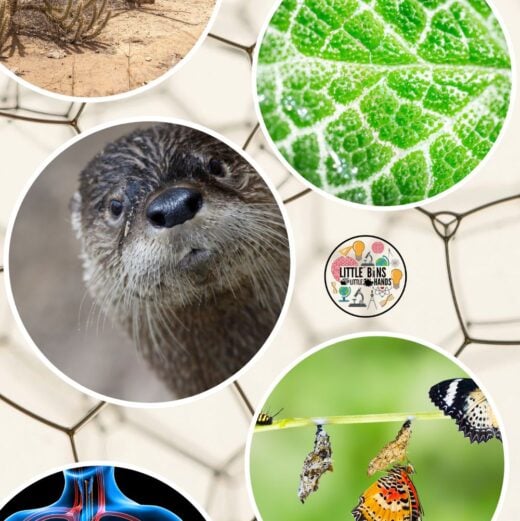
Explore the world of living things with these fun and easy life science activities for kids! Perfect for kindergarten through 5th grade, these biology projects include hands-on experiments, engaging printables, and real-world science kids can see in action. Whether you’re learning about plants, animals, or the human body, there’s something for every curious scientist here.

Life Science for Kids
Whether you’re teaching life science at home, building a homeschool life science curriculum, or looking for NGSS life science lessons for the classroom, make sure to bookmark this guide and resources. You’ll find plenty of ideas to round out your life science units for elementary students.
🔎 Find more biology experiments located [here].
Recommended Grade Level:
Kindergarten – 5th Grade (adaptable for younger or older students)
Core Life Science Concepts Covered:
- Living vs. non-living things
- Basic needs of plants and animals
- Structures and functions of organisms
- Life cycles of plants and animals
- Animal adaptations and behaviors
- Habitats and ecosystems
- Food chains and energy flow
- Human body basics
- Environmental interactions
NGSS Guiding Questions
These three simplified guiding questions help kids make sense of life science concepts:
- What is the phenomenon?
Something living is growing, changing, or interacting with its environment. - What evidence do I observe?
I can see seeds sprouting, animals moving, flowers blooming, or body parts working. - What can I conclude or explain?
Living things have structures and behaviors that help them survive, grow, and reproduce.
Plant Science Activities
Explore the amazing world of plants with these kid-approved projects.
🔎 Find more plant experiments and activities [here].
- Seed Dispersal Experiment: Test how seeds travel by wind, water, animals, and more.
- Seed Counting with Real Fruits: Slice open fruits and count how many seeds each has.
- How Leaves Drink Water: Watch colored water travel through celery or leaves.
- How Leaves Breathe: Discover stomata with a simple bubble experiment.
- Photosynthesis in a Bag (Transpiration): Observe oxygen release with a sealed leaf experiment.
- Parts of a Plant Activity: Label and build a plant with printable templates.
- Plant Life Cycle Activities: Hands-on ways to explore each stage of growth.
- Playdough Plant Cell Model: Create a 3D model using printable labels.
- Flower Dissection Project: Set up a mini science lab to dissect and label the parts of a flower.


Animal Science Activities
From life cycles to adaptations, explore the wild side of science.
🔎 Look through more animal activities [here].
- Animal Life Cycles: Butterfly, bee, frog, bat, spider, and more.
- Animal Adaptations Activities: Learn about camouflage, mimicry, and behaviors.
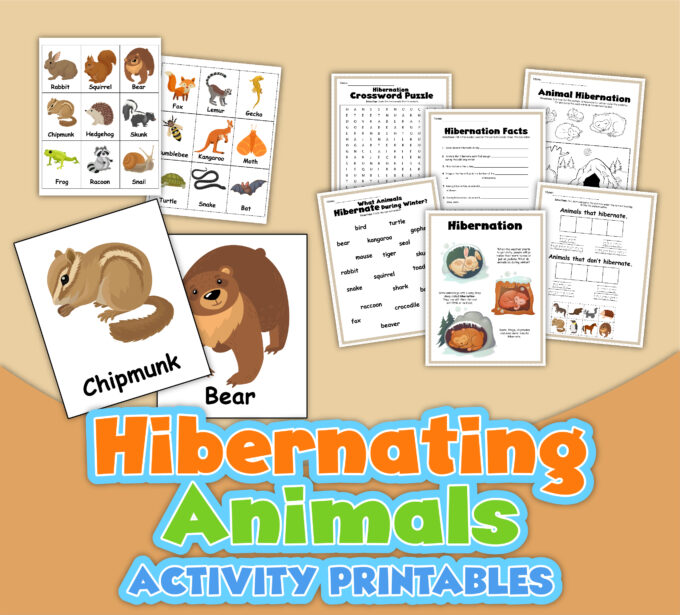
- Hibernation Activities: Explore why some animals sleep through winter.
- Animal Senses vs. Human Senses: Compare how animals use sight, smell, sound, and more. [coming soon]
- Animal Classification: Learn the groups—mammals, reptiles, birds, insects, etc.
- Reptiles Worksheets and Lapbook: Study cold-blooded animals with this hands-on learning pack.
- Vertebrates and Invertebrates Activity Pack: Explore the differences between vertebrates and invertebrates, including their backbones and body structures.
- Diurnal and Nocturnal Animals Activities: Discover when different animals are active.
- Plant and Animal Needs: Learn about what plants and animals needs to survive.


Habitats & Ecosystems
See how living things interact with their environments.
- Build a Habitat Diorama: Create a mini animal habitat from simple materials.
- Biomes Unit Study Pack: Explore deserts, forests, oceans, tundras, and more.
- Animal Migration Activities: Learn how and why animals travel across the globe.
- Winter Food Chains: Discover predator-prey relationships in seasonal habitats.
- Pollination Activity Guide: Learn about various pollinators and their role in the ecosystem.
- Decomposing Pumpkin Experiment: Observe the breakdown of organic matter over time.
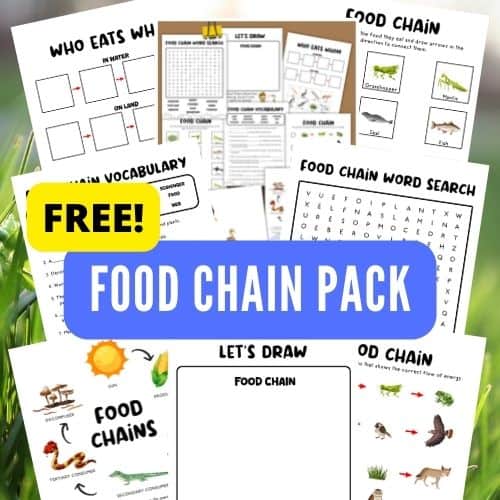
- Food Chains and Food Webs: Explore energy flow in ecosystems.
- Animal Shelter STEM Challenge: Build a shelter to withstand the elements for an animal.


Human Body Activities
Explore how the body works with these kid-friendly biology projects.
- Heart Rate Experiment: Learn how exercise affects your pulse.
- Reaction Time Test: Use a ruler to measure how fast your brain reacts.
- Lung Model Science Project: Build working lungs with balloons and a bottle.
- Make a Model Hand: Learn about muscles and tendons with a straw-and-string craft.
- Wingspan vs. Height Activity: Measure and compare body proportions.
- 5 Senses Science Activities: Explore how we see, hear, smell, taste, and feel.
- Digestive System in a Bag: Simulate the digestive process using sandwich bags and crackers. [coming soon]


Life Science Printables
Support your learning with ready-to-use printable packs:
- Biomes Unit Study Pack
- Plant Life Cycle Activities Pack
- Animal Adaptations Printables
- Vertebrates & Invertebrates Pack
- Reptiles Lapbook
- Diurnal vs. Nocturnal Animals Pack
- 3D Plant Cell Model
- 3D Animal Cell Model
- Plant and Animal Needs
👉 Need them all? Grab the All Access Pass to instantly grab hundreds of printable science and STEM activities for every season!
NGSS-Aligned Life Science for K–5
These life science activities support Next Generation Science Standards, including:
- K-LS1-1: Understanding plant and animal needs
- 1-LS1-1: Animal structures and behaviors
- 2-LS2-2: Seed dispersal and pollination
- 3-LS1-1: Life cycles of organisms
- 4-LS1-1: Internal and external structures of living things
- 5-LS2-1: Food webs and ecosystems
Frequently Asked Questions
What is life science for kids?
Life science is the study of living things like plants, animals, and people. Kids explore how living things grow, survive, and interact with their environment.
What are examples of life science topics in elementary school?
Common topics include plant parts and life cycles, animal habitats and adaptations, human body systems, ecosystems, food chains, and living vs. non-living things.
What grade level teaches life science?
Life science is typically introduced in kindergarten and explored through 5th grade. It forms part of the Next Generation Science Standards (NGSS) for K–5.
How do you teach life science to young kids?
Use hands-on activities, experiments, crafts, and nature exploration to help kids observe and understand the world of living things.
Is life science the same as biology?
Yes! Life science is a branch of biology. In K–5, the term “life science” is often used to make it more accessible to younger learners.
More Science Collections You’ll Love
We have fantastic science experiments to explore with kids, including many with free experiment sheets and mini packs! You’ll also find more printable pack options in our shop.
- Biology Activities for Kids
- Earth Science Experiments
- Physical Science Projects
- Science Fair Ideas for Elementary