
Explore these fun and educational water activities for preschoolers. These hands-on experiments are designed to teach concepts like buoyancy, absorption, and sound. They are perfect for young learners to engage with basic science principles and have fun.

Water Activities for Preschoolers
There are so many playful water science activities for preschoolers, and here are our top 10 easy-to-set up science experiments you can do at home or in the classroom.
🔎 This is a fantastic opportunity to include the scientific method and make predictions! Even the youngest scientist can get started!
🔎 Additionally, you can find a list of elementary and middle school water science experiments here. With a little extra adult assistance, many experiments can be enjoyed by preschoolers!
Water Play Sensory Bin
In this activity, preschoolers can explore water’s behavior by playing with various cups, spoons, and small water-safe toys in a water-filled shallow bin. Kids can scoop, pour, and move water around, allowing them to experiment with volume and capacity.
As they play, they’ll see how water takes the shape of any container it’s poured into. This experiment helps kids understand the fundamental properties of liquids and how water behaves when it’s moved from one container to another. Water, unlike solids, doesn’t hold its shape, which makes it a perfect medium for exploration.
Science Concepts: Liquid behavior, volume, capacity

Sink or Float
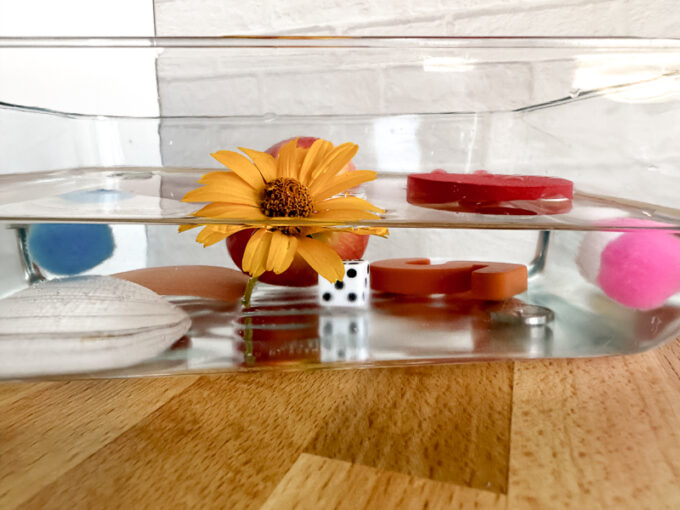
This simple experiment teaches preschoolers about density and buoyancy. Kids can predict whether different objects will sink or float in a large container of water. By dropping items like rocks, sponges, toys, and corks into the water, they can observe firsthand how certain materials sink while others float.
🔎 Grab our specially designed Preschool Science Pack to facilitate your next science activity, including sink or float!
This hands-on experiment introduces the concept that objects float when they are less dense than the water and sink when they are denser than the water. It’s a fun and interactive way for kids to learn about the properties of different materials and how they interact with water.
Science Concepts: Density, buoyancy
Color Mixing
Preschoolers can mix colors by adding primary food coloring to separate cups of water and watching them change when combined. Experimenting with red, blue, and yellow teaches kids about primary and secondary colors. Add paint and the printable from our Preschool Colors Pack for a quick art activity.
🔎 Add eye droppers or pipettes for a fun introduction to science tools (free printable here).
This activity introduces the basics of color theory while letting kids mix two colors at a time to create new hues. Blending red with blue to create purple or yellow with blue to make green is a fun and educational way to introduce young learners to color science.
- Concepts: Color mixing, primary and secondary colors

Ice Cube Melting Experiment
This activity demonstrates the states of matter by showing how ice (a solid) changes into water (a liquid) when it melts. Kids can place ice cubes on different surfaces and observe how long the ice melts.
Kids can grasp the concept of phase changes visually by timing how long it takes for the ice to melt. This experiment introduces the concept that solids, like ice, can transform into liquids when heated or exposed to warmer temperatures.
- Concepts: States of matter, phase change, temperature

Water Absorption with Various Materials
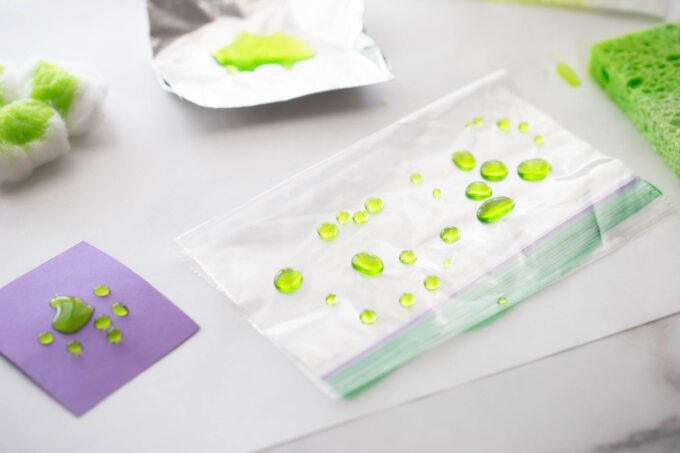
In this experiment, kids explore the concept of absorption by dripping water on different materials, such as sponges, cloth, paper towels, cotton balls, and plastic. By observing which materials absorb the most water, preschoolers can compare how different substances behave when exposed to water.
This activity teaches them about the properties of various materials and how water can be absorbed or repelled. It can also be connected to other concepts such as seasons and clothing and animal biology.
- Concepts: Absorption, material properties
Color Changing Flowers Experiment
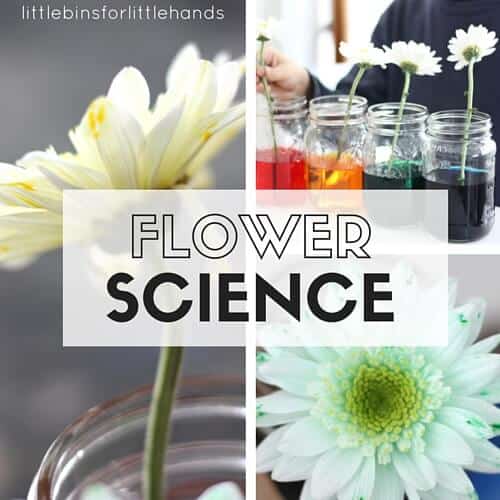
This activity introduces preschoolers to capillary action, where water is drawn from the roots to the flowers. Children can place white carnations or other white flowers in cups of colored water and watch as the petals change color over time.
🔎 Another example of this concept is walking water with paper towels.
As the flowers absorb the colored water, the color travels up the stems to the petals, demonstrating how plants take in water. It’s a colorful and visual demonstration of how plants move water and nutrients!
- Concepts: Capillary action, plant science, absorption
Oil and Water Drop Experiment
Preschoolers can experiment with the unique properties of oil and water by dropping food coloring into a bowl of water and adding a small amount of oil on top. The oil will float on top of the water, while the food coloring will mix with the water but not the oil.
This activity demonstrates that oil and water don’t mix because they have different molecular structures. It’s a great way to introduce kids to solubility and liquid properties while letting them see firsthand how different liquids behave when combined.
- Concepts: Solubility, liquid properties, density

Water Xylophone
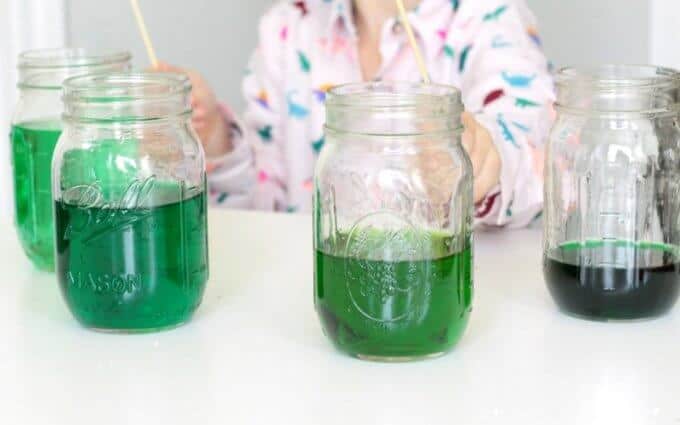
Kids can create their own water xylophone by filling several glass jars or cups with varying amounts of water. This is a fun introduction to sound and vibration. When they tap the jars with a spoon or stick, they’ll hear different pitches based on the amount of water in each jar.
This experiment teaches kids how vibrations produce sound and gives them a fun, hands-on way to explore how different amounts of water can create different sounds. This is a great way to incorporate music into water science!
- Concepts: Sound, vibration, pitch
DIY Water Wall for Outdoor Water Play
A DIY water wall is an interactive outdoor project that lets kids explore water flow and gravity. Kids can experiment with how water moves through different paths and angles by attaching plastic bottles, funnels, and PVC pipes to a board, fence, or wall.
They can pour water into the bottles and watch how it flows through the funnels and pipes, demonstrating the forces of gravity and how water can travel. This experiment introduces kids to engineering principles in a playful and hands-on way, and it’s a perfect outdoor water play activity.
- Concepts: Water flow, gravity, engineering

Simple Dissolving Candy Experiment
In this experiment, preschoolers can compare how different temperatures affect the dissolving process. Place a piece of candy, like Sweedish fish, conversation hearts, candy corn, or candy canes, in two bowls—one with warm water and one with cold water.
Watch as the candy dissolves faster in the warm water than in the cold water. This simple experiment introduces the concept of solubility and shows how heat can speed up the process of dissolving. It’s a fun and easy way for kids to observe how temperature affects the behavior of substances.
- Concepts: Solubility, temperature, dissolving

Bonus Water Science Activities:
- Make a Rain Gauge
- Does an Orange Float?
- Water Refraction
- Bending Water Static Electricity
- Water Cycle in a Bag
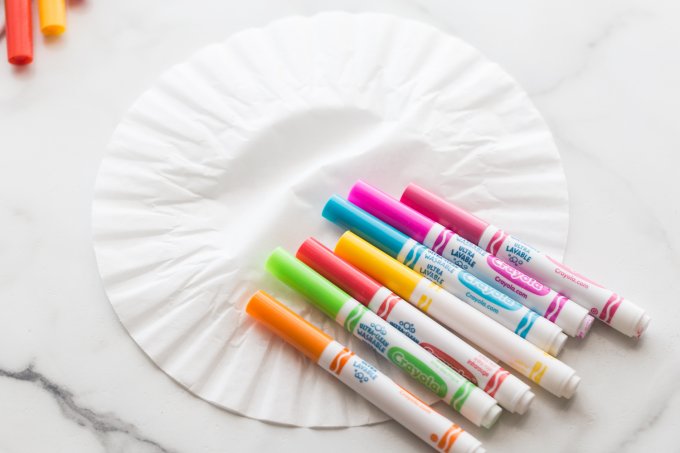
- Coffee Filter Flowers
- Shaving Cream Rain Cloud
Extra Water Activities Science Resources
Click the links below to explore more science activities and resources related to a specific science concept mentioned above!
- Density
- Buoyancy
- Color mixing
- States of matter
- Phase change
- Absorption
- Material properties
- Capillary action
- Plant science
- Gravity
- Engineering
More Preschool Topics To Explore
- Dinosaur Activities
- Space Theme
- Geology Activities
- Plant Activities
- Weather Theme
- Art Projects
- Ocean Theme
- 5 Senses Activities
Click here to get your FREE Printable Science Process Pack
Printable Preschool Bundle Theme Pack
Get ready to explore this year with our Preschool STEM Bundle! There are 20+ fun preschool themes to get you started. This is an ” I can explore” series. You’ll find even more sensory bin ideas!
Each unit contains approximately 15 activities, with instructions and templates as needed. Hands-on activities are provided to keep it fun and exciting. This includes sensory bins, experiments, games, and more! Easy supplies keep it low cost, and book suggestions add to the learning time.

What a wonderful collection of activities! I love the water displacement mind tornado in a bottle activities!
I want to share a freebie with you as a thank you as well!
http://www.teacherspayteachers.com/Product/Fine-Motor-Skills-FREEBIE-Circle-Time-Activities-1441256
Nice ideas. In summer hot weather it will great fun for kids. Really great fun ideas for toddlers. Kids generally love to play with water. So This water activities for toddlers must be great fun.