
Looking for a spooky and educational way to celebrate Halloween? Try making a flying bat paper airplane! This simple, hands-on STEM activity combines engineering, physics, and biology to provide a fun lesson on aerodynamics and bat flight.

Flying Bat Paper Airplane
Perfect for classrooms or home learning, kids will fold, test, and tweak their paper bat planes as they discover how wing shape and folds affect flight.
- Field of Science: Engineering, Physics, Life Science
- Grade Level: Grades 1–4
- Concepts Explored: Aerodynamics and flight. Energy and motion. Animal adaptations (bat wings)
Supplies Needed
- Black paper or cardstock
- Googly eyes (optional — adds fun weight)
- Glue stick (for eyes)
- Ruler
- Free printable instructions (below)
How To Make a Flying Bat Paper Airplane
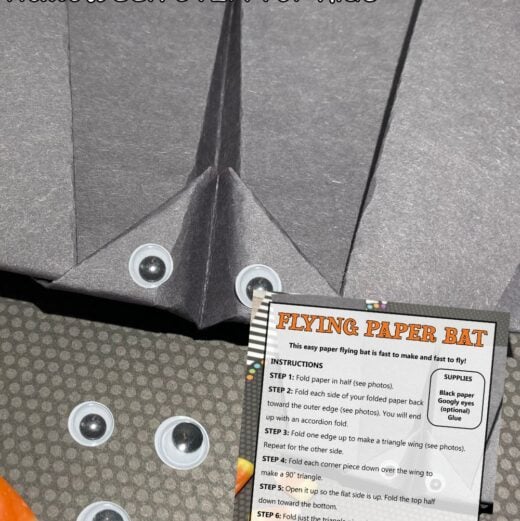
STEP 1. Fold a sheet of black paper in half.
💡 Tip: Use a ruler to press the crease for sharp folds.
STEP 2. Fold each side back toward the outer edge to make an accordion fold.

STEP 3. Fold one edge into a triangle to form the first wing. Repeat on the other side.

STEP 4. Fold each corner piece over the wing to create a 90° triangle.

STEP 5. Open the paper so the flat side faces up and fold the top half down.


STEP 6. Fold just the top triangle section back upward.

STEP 7. Flip over your bat and fold down the small triangle flap that’s sticking up.


STEP 8. Fold the sides into the middle, then fold down the flaps — leave a small groove for your fingers to hold.


STEP 9. Add googly eyes (optional) and let your bat take flight! Watch how it glides and flaps as it soars.
💡 Note: Eyes add fun but also extra weight — test both versions to compare flight patterns! It’s a fun way to introduce variables in science.

💡Want to send your bat further? Look at our paper airplane launcher model, which you can make!
The Science Behind the Flying Bat
Bat Anatomy and Flight
Real bats are incredible flyers! Their wings are made of a thin layer of skin stretched across elongated fingers, giving them flexibility and control. This design helps bats swoop and dive with precision.
Folding paper into a bat shape mimics this wing design — wider wings create more lift, while narrower shapes cut through air for more speed.
When kids make paper plane bats, they can get a simplified glimpse into how wing shapes can influence flight. Explore the bat’s anatomy and life cycle with a free mini-pack.

Understanding Lift, Drag, and Energy
When kids launch their paper bat airplanes, they’re exploring key aerodynamic forces:
- Lift: The upward force that helps objects stay in the air.
- Drag: The air resistance that slows an object down.
- Thrust: The push from your hand that propels the bat forward.
- Gravity: The downward pull that eventually brings it to the ground.
Throwing the paper bat gives it kinetic energy — the energy of motion. Different folds, weights, and throws change how far and how smoothly it flies.
💡 Want to take it further? Build our Paper Airplane Launcher STEM Project and test launch angles and distances
Vocabulary Words
- Lift: The upward force keeping something in the air.
- Drag: Resistance caused by air movement.
- Thrust: The push that moves an object forward.
- Kinetic Energy: Energy of motion.
- Aerodynamics: How air moves around objects.
NGSS Guiding Questions
| NGSS Question | Concept Focus |
|---|---|
| How do forces like lift and drag affect motion? | The balance of forces determines how far and high objects fly. |
| What happens when we change a design variable? | Altering folds, weight, or wing shape changes stability and speed. |
| How do living things inspire engineering designs? | Bat wings demonstrate real-world bio-inspired engineering. |
💡Learn more about these concepts with our Airplane Science Fair Projects!
Extension Activities
- Bat Wing Experiment: Test different paper types for better lift.
- Add Launch Data: Measure flight distance and time.
- Design Challenge: Who can design and build the farthest-flying or most stable bat?
- Wind Challenge: Use a fan to create different wind speeds and directions. How does the bat’s flight change with the wind? This can help demonstrate the effects of airflow on flight and the forces of lift and drag.
- Weight Testing: Add small weights (such as paper clips or the googly eyes) to different parts of the bat. How do these changes affect its flight? This can introduce kids to the concepts of mass, balance, and how weight distribution impacts lift and drag.

More Halloween STEM Activities
- Pumpkin Catapult STEM Challenge
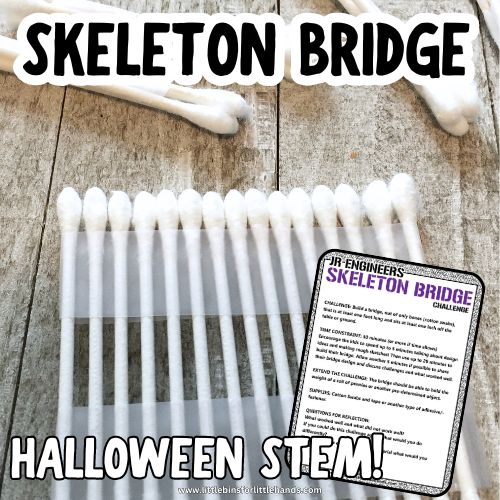
- Skeleton Bridge Engineering Challenge
- Dissolving Candy Corn Science Experiment
- Paper Airplane Flying Bat (Aerodynamics)
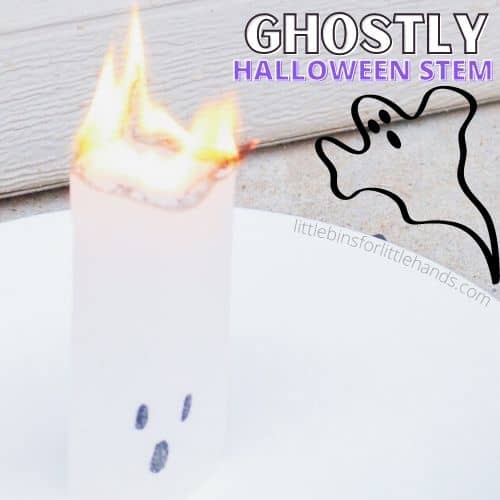
- Flying Tea Bag Ghost Experiment

Printable Science Packs for Kids
Visit our SHOP for easy-to-print STEM and science lesson plans for the whole year. Or join us in the Little Bins Club.