
How do different surfaces affect how far a toy car rolls? Let’s explore forces with friction, a key concept in physics, with a hands-on scientific model that kids can build at home, in a classroom, or a homeschool setting. Add the free printable to record your observations!

What Is Friction?
Friction is a force that happens when two surfaces rub against each other. Some surfaces, like smooth tiles, have less friction, allowing objects to slide easily. Others, like rough sandpaper, create more friction, slowing objects down.
💡Learn more about motion and force [here].
This experiment allows kids to create a friction model by testing how different surfaces affect a rolling toy car.
Recommended Grade Level:1st – 5th Grade. This makes a great science fair project, too!
Building a Friction Model
This experiment is an excellent example of a scientific model: a physical model, representing how friction works in real-world situations like:
- Car tires gripping different road surfaces
- An airplane landing on different runways
- Skiers sliding on snow vs. rough terrain
- A boat moving through water
- Bike tires on different surfaces (smooth pavement, gravel, mud)
Supplies:
- Toy car (a small model car works best!)
- Ruler (to measure distances)
- Books (to build the ramp)
- Cardboard (for the ramp surface)
- Tape
- Different surface textures (shelf liner, sandpaper, aluminum foil, fabric, corrugated cardboard, felt strip, and any other options you have available)
Friction Science Experiment Instructions
💡An incline ramp is also a simple machine!
Build the Incline Ramp: Stack books and place a cardboard strip on top to create an incline ramp. Tape it in place for stability.

Add Textured Surfaces: At the bottom of the ramp, place different materials like shelf liner, sandpaper, or fabric. These will act as test surfaces for friction.

Launch the Car: Place the toy car at the top of the ramp and let it roll onto each surface.
Measure the Distance: Use a ruler to measure how far the car travels on each surface.
Record & Compare: Write down your results on the Fun with Friction Observations Sheet (printable available below!).

The Scientific Method in Action
The scientific method is how scientists explore and understand the world. Kids will follow the scientific method in this friction experiment to investigate how surfaces affect movement.
💡Learn more about the Scientific Method, Variables, and Hypotheses.
- Ask a Question: How does friction affect the movement of a toy car on different surfaces?
- Make a Hypothesis: Predict which surface will slow the car down the most and which will allow it to roll the farthest.
- Test the Hypothesis (Experiment!): Follow the step-by-step instructions below to build a friction model and test surfaces.
- Record Data & Observe: Measure how far the car travels on each surface and write the results on the Friction Observation Sheet.
- Analyze & Draw Conclusions: Which surface created the most friction? Did your prediction match the results? Discuss why!

Friction Science Fair Project Idea
This Fun with Friction experiment is a solid science fair project idea, especially for elementary (1st-5th grade) and early middle school (6th grade) students. It follows the scientific method, involves hands-on testing, and connects to real-world applications in physics and engineering.
Ways to Expand the Project for a Science Fair
- Add a Mathematical Model – Graph the results to show trends.
- Change the Ramp Angle – Does a steeper ramp reduce friction effects?
- Use Different Car Types – Do rubber wheels vs. plastic wheels change the results?
- Test Wet vs. Dry Surfaces – Does water affect friction like on real roads?
- Compare Different Brands of Toy Cars – Do some cars roll better on rough or smooth surfaces?
How Does Friction Affect Motion?
Friction is a force that resists motion when two surfaces come into contact. Whether it’s a toy car rolling down a ramp, a bike tire on the road, or your shoes on the floor, friction plays a major role in how objects move.
💡Explore more about force and motion [here].
The Science Behind Friction & Motion
More Easy Science Experiments for Friction
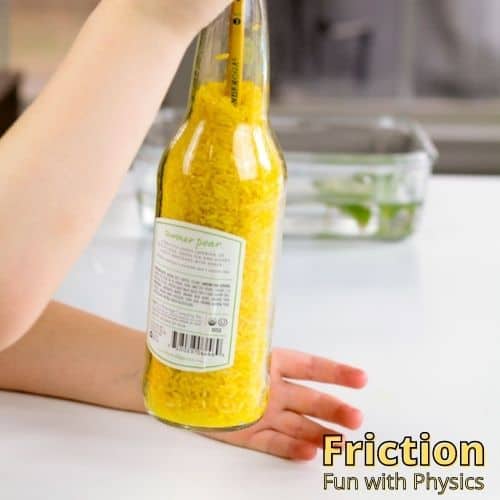
- Floating Rice using a chopstick or pencil, rice, and a bottle
- Slippery or Sticky Ice: Experiment with surface textures
- Toy Car Friction (Preschool Science Experiment)
- Motion and Force Projects for Kids: Learn more about force!


Helpful Science Resources
Here are a few resources to help you introduce science more effectively to your kids or students and feel confident presenting materials. You’ll find helpful free printables throughout.
- Printable Science Project Pack 👇
- Best Science Practices (as it relates to the scientific method)
- Science Vocabulary
- All About Scientists
- Free Science Worksheets
- DIY Science Kits
- Science Tools for Kids
- Scientific Method for Kids
- Citizen Science Guide
- Join us in the Club