

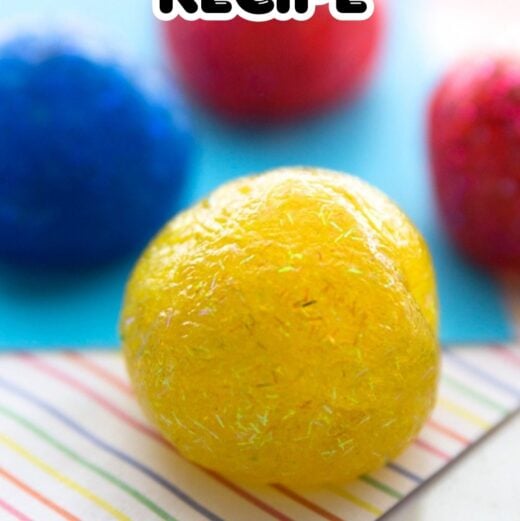
Can you make a bouncy ball from glue? This homemade bouncy ball recipe combines chemistry, polymer science, and sensory play into one hands-on STEM activity.
By mixing glue and a borax solution, you’ll create a stretchy polymer that can be rolled into a ball and bounced. Along the way, kids can explore polymers, cross-linking, elasticity, and material properties as they make their own toy.
How do you make a homemade bouncy ball?
A homemade bouncy ball is made by combining glue and a borax solution. The borax creates cross-links between the polymer chains in the glue, forming a flexible, rubbery material that can be rolled into a ball and bounced.
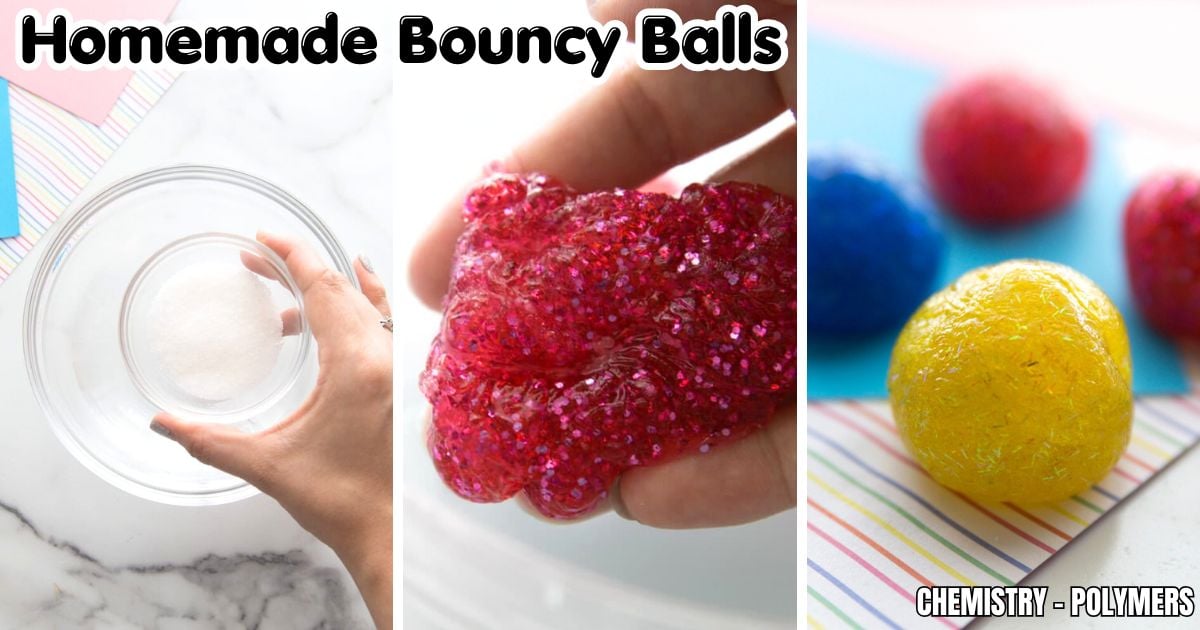
Homemade Bouncy Balls
- Field: Chemistry—Polymers
- Grades: 2–6
- Concepts Explored: Polymers, cross-linking, elasticity, material properties, non-Newtonian materials, chemical changes
👉 Looking for more hands-on chemistry activities? Visit our Kitchen Chemistry hub to explore reactions, polymers, mixtures, and material science using everyday ingredients.
How To Make A Homemade Bouncy Ball
This activity uses the same polymer science that makes slime possible, but with a firmer texture and more elasticity. As the polymer chains become more connected, the material behaves more like rubber and less like traditional slime.
👉 Want to learn more about polymers before you begin? Check out our Polymer Science for Kids guide.
Supplies
- 3 tablespoons clear school glue
- 1 tablespoon glitter (optional)
- Food coloring (optional)
- 2 tablespoons borax powder
- 1 cup warm water
- 2 spoons or craft sticks
- Small bowls
Instructions for Borax Bouncy Balls
STEP 1
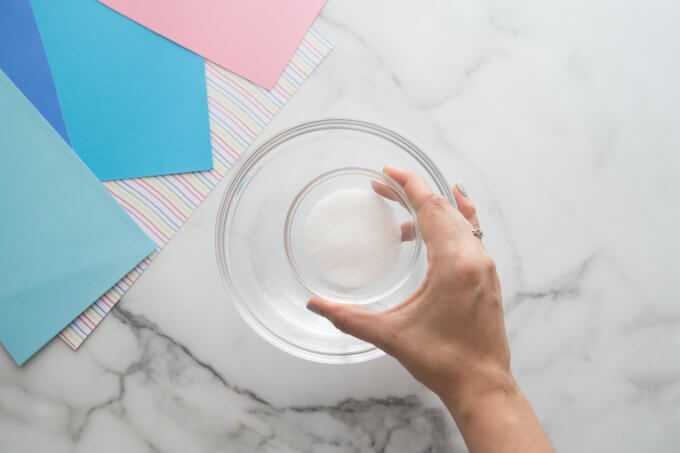
Combine the borax powder and water in a bowl. Stir until dissolved.
STEP 2
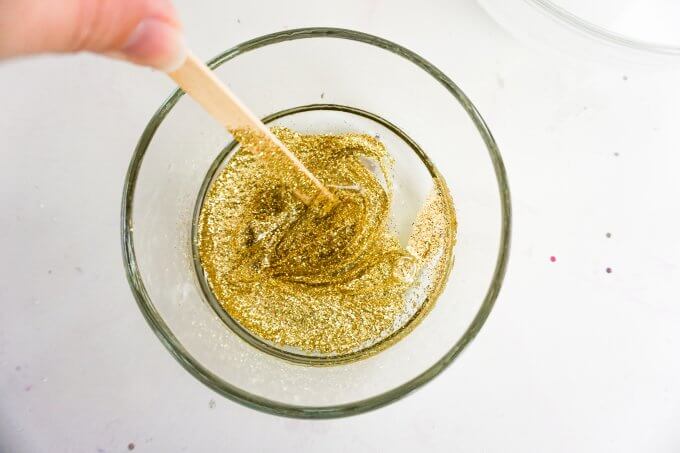
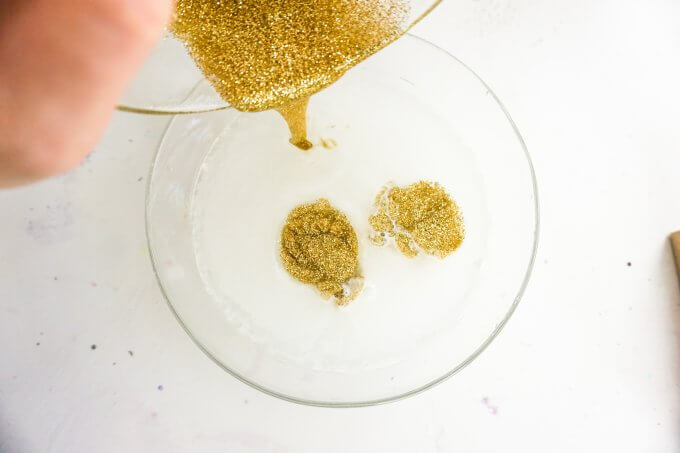
In a separate bowl, combine the glue, glitter, and food coloring.
STEP 3
Drop three small globs of the glue mixture into the borax solution.
STEP 4
Allow the mixture to sit briefly while the polymer reaction begins.
STEP 5
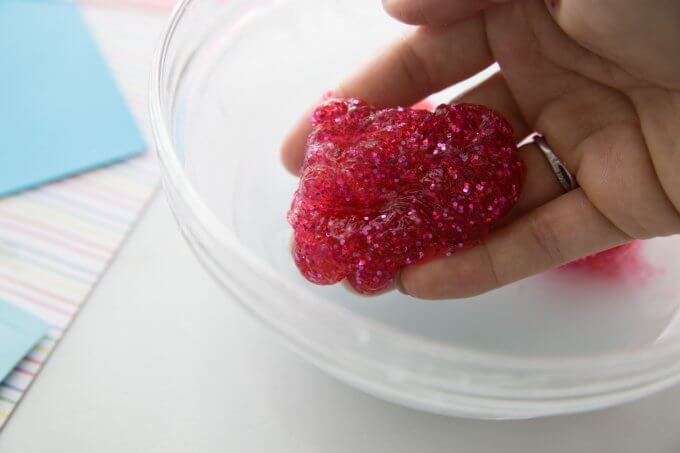
Use your hands to knead one blob at a time until it becomes firm and rubbery.
STEP 6
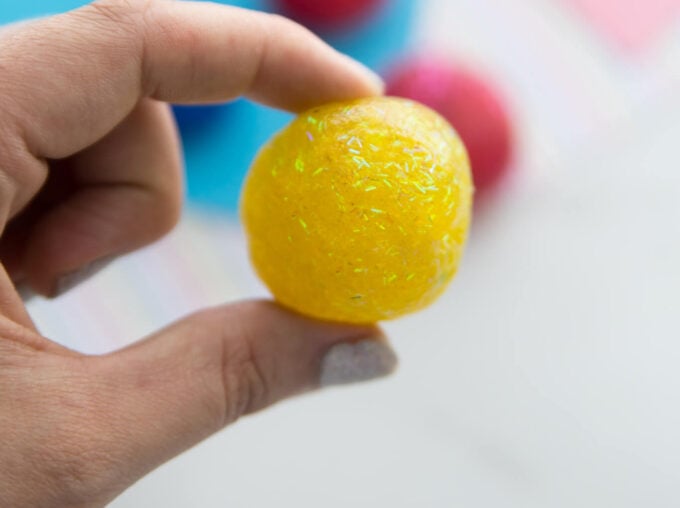
Roll the material between your palms to form a smooth ball.
STEP 7
Rinse the ball under cool running water to help firm the surface.
STEP 8
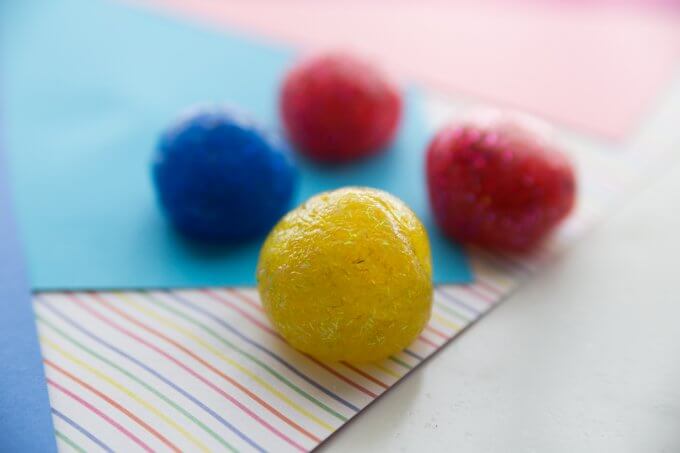
Test your homemade bouncy ball!
💡 Homemade bouncy balls are essentially a very firm polymer similar to slime. They may flatten slightly if left sitting for long periods but can usually be reshaped. Over time they will dry out and become brittle.
The Science Behind Homemade Bouncy Balls
Homemade bouncy balls are a great example of polymer science in action.
The glue used in this activity contains a polymer called polyvinyl acetate (PVA). A polymer is a material made of long repeating chains of molecules linked together.
When the borax solution is added, borate ions begin connecting the polymer chains. This process is called cross-linking.
As more cross-links form, the liquid glue changes into a thicker, more rubbery material. Instead of flowing like a liquid, the polymer chains form a flexible network.
This network gives the bouncy ball several important properties:
- Elasticity
- Flexibility
- Strength
- Bounce
The more tightly connected the polymer chains become, the firmer and bouncier the ball will feel.
This same polymer science helps explain why materials such as rubber bands, balloons, slime, shoe soles, and sporting equipment can stretch, bend, and bounce.
👉 Want to explore more everyday polymers? Visit our Polymer Science for Kids hub.
What Makes A Ball Bounce?
When a bouncy ball hits the floor, it changes shape for a split second.
As it compresses, energy is stored inside the material. When the ball returns to its original shape, much of that energy is released, pushing the ball back upward.
Materials with greater elasticity generally bounce higher because they return more energy after impact.
Try comparing your homemade bouncy ball to:
- A tennis ball
- A rubber ball
- A ping pong ball
- A marble
Which one bounces the highest?
Homemade Bouncy Ball Investigation
Turn this activity into a science experiment by testing one variable at a time.
Try investigating:
- Does more borax create a firmer ball?
- Does ball size affect bounce height?
- Which surface creates the highest bounce?
- Does adding glitter change the results?
- How does bounce height change after 24 hours?
Record:
- Your hypothesis
- Materials used
- Bounce height
- Texture observations
- Results and conclusions
Need a recording page? Grab our free Polymer Science Labs Guide for investigation sheets and additional polymer activities.
Free Polymer Science Labs Guide
Ready to explore polymers through hands-on science?
Grab our FREE Polymer Science Labs Guide packed with investigations that help kids discover how polymers stretch, bend, bounce, absorb water, and change shape.
Inside you’ll find:
✔ Polymer Science Labs activity guide
✔ 5-Day Polymer Science Lab Plan
✔ Polymer Hunt activity
✔ Polymer Investigation Lab
✔ Observation and recording pages
From slime science and plastic milk to gummy bear growth and bioplastics, these activities make chemistry and materials science easy to explore at home or in the classroom.
What Makes A Ball Bounce?
When a bouncy ball hits the floor, it changes shape for a split second.
As it compresses, energy is stored inside the material. When the ball returns to its original shape, much of that energy is released, pushing the ball back upward.
Materials with greater elasticity generally bounce higher because they return more energy after impact.
Try comparing your homemade bouncy ball to:
- A tennis ball
- A rubber ball
- A ping pong ball
- A marble
Which one bounces the highest?
Homemade Bouncy Ball Investigation
Turn this activity into a science experiment by testing one variable at a time.
Try investigating:
- Does more borax create a firmer ball?
- Does ball size affect bounce height?
- Which surface creates the highest bounce?
- Does adding glitter change the results?
- How does bounce height change after 24 hours?
Record:
- Your hypothesis
- Materials used
- Bounce height
- Texture observations
- Results and conclusions
Need a recording page? Grab our free Polymer Science Labs Guide for investigation sheets and additional polymer activities.
Free Polymer Science Labs Guide
Ready to explore polymers through hands-on science?
Grab our FREE Polymer Science Labs Guide packed with investigations that help kids discover how polymers stretch, bend, bounce, absorb water, and change shape.
Inside you’ll find:
✔ Polymer Science Labs activity guide
✔ 5-Day Polymer Science Lab Plan
✔ Polymer Hunt activity
✔ Polymer Investigation Lab
✔ Observation and recording pages
From slime science and plastic milk to gummy bear growth and bioplastics, these activities make chemistry and materials science easy to explore at home or in the classroom.
What Makes A Ball Bounce?
When a bouncy ball hits the floor, it changes shape for a split second.
As it compresses, energy is stored inside the material. When the ball returns to its original shape, much of that energy is released, pushing the ball back upward.
Materials with greater elasticity generally bounce higher because they return more energy after impact.
Try comparing your homemade bouncy ball to:
- A tennis ball
- A rubber ball
- A ping pong ball
- A marble
Which one bounces the highest?
Homemade Bouncy Ball Investigation
Turn this activity into a science experiment by testing one variable at a time.
Try investigating:
- Does more borax create a firmer ball?
- Does ball size affect bounce height?
- Which surface creates the highest bounce?
- Does adding glitter change the results?
- How does bounce height change after 24 hours?
Record:
- Your hypothesis
- Materials used
- Bounce height
- Texture observations
- Results and conclusions
Need a recording page? Grab our free Polymer Science Labs Guide for investigation sheets and additional polymer activities.
Bouncy Ball FAQ
Why does the homemade bouncy ball bounce? The cross-linked polymer network stores energy when the ball hits the floor and releases it as the ball returns to its original shape.
Is a homemade bouncy ball a polymer? Yes. The ball forms when polymer chains in the glue connect through a process called cross-linking.
What is cross-linking? Cross-linking occurs when molecules connect polymer chains together, creating a stronger and more elastic material.
Why does my bouncy ball flatten out? Homemade bouncy balls contain water and are not permanently cured. Over time they may lose shape, soften, or dry out.
Is this the same science as slime? Yes. Both slime and homemade bouncy balls are polymers formed through cross-linking. A bouncy ball simply has a firmer structure and greater elasticity.
Can I make a larger bouncy ball? You can, but larger balls often bounce less effectively because the material is softer in the center.
What type of science is this activity? This activity combines chemistry, polymer science, materials science, and physics through the study of elasticity and energy transfer.
Explore More Polymer Science
Continue your polymer investigations with:
- Plastic Milk Experiment
- Leakproof Bag Experiment
- Guar Gum Slime
- Gelatin Slime
- Strawberry DNA
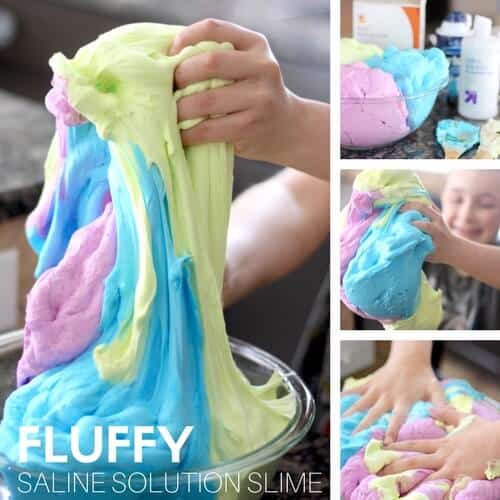
- Homemade Slime
👉 Looking for more hands-on science activities? Explore our Kitchen Chemistry hub for reactions, polymers, density experiments, and food science fun.

Explore More Kitchen Chemistry
Continue the fun with our Kitchen Chemistry Pack featuring printable experiments, reusable investigation pages, science explanations, and easy hands-on activities using everyday kitchen supplies.
Perfect for home or classroom science with activities focused on:
reactions, mixtures, crystals, surface tension, polymers, and color-changing chemistry.

One Comment
Comments are closed.