
Make science and engineering come alive with this fun robot hand project! This hands-on engineering activity teaches kids how muscles, tendons, and bones work together to move our fingers. Explore how the human body works while building your own working model!

Robot Hand STEM Activity
- Field of Science: Biology & Engineering
- Grade Level: Grades 2–6
- Concepts Explored: Muscles and tendons, levers and fulcrums, biomechanics, engineering design
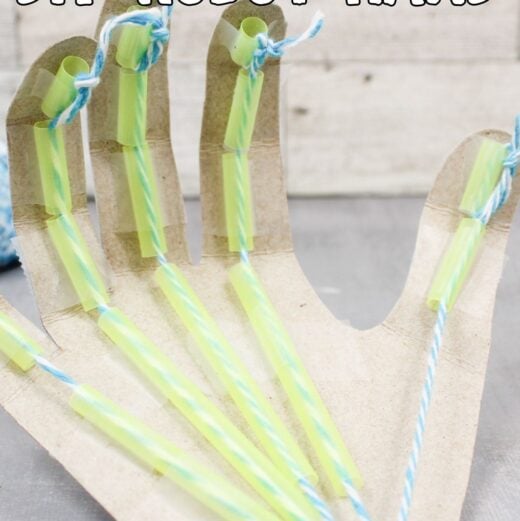
In this engineering project, kids build a human hand model using cardboard, straws, and string. The straws act like bones, and the string represents tendons. When you pull the strings, the “fingers” bend, just like how tendons pull on bones when muscles contract.
This activity also models how joints work as pivot points (fulcrums) in a lever system. It’s a great real-world example of how simple machines help us move and an excellent introduction to levers and force.
Simplified NGSS Alignment
- What do you notice? How does the string movement affect finger bending?
- What do you wonder? What would happen if the straws were spaced differently or if the string wasn’t tight?
- What does it remind you of? Your own hand and how your fingers move when you flex or extend them.
Supplies Needed
- Cardboard or sturdy cardstock
- Straws or plastic tubing
- Yarn or string
- Scissors
- Tape
- Pencil
- Colored paper (optional)
- Printable Instructions in the Library Club
- Complete Printable Human Anatomy Pack
How-To Instructions for Making a Robot Hand
Trace and Cut: Trace your hand on cardboard and cut it out.
Mark Joints: Mark finger joints where the fingers bend.

Add Bones: Cut straws into small segments and tape them along the fingers where the joints are.

Attach Tendons: Tape a piece of string to the fingertip straw segment. Thread the string through the remaining straw pieces.


Test and Adjust: Pull each string and observe how the fingers move. Adjust the tension for better control.
Pulling the string will simulate the movement of the tendons, causing the fingers to bend, just like how muscles contract and pull on tendons in the human hand to produce movement.

Free Engineering Design Process Guide

Robot Hand Science Information
Your robot hand demonstrates how tendons and muscles work together to move your bones. In your body, muscles contract and pull on tendons, which then move bones at the joints.
- The straws represent the bones of your fingers.
- The string acts like tendons.
- The joints act like fulcrums (pivot points) in a lever system.
- The force is applied when you pull the string, bending the fingers like real muscle movement.
This model shows biomechanics—how biological systems follow the rules of mechanics. It also teaches engineering design by encouraging kids to build, test, and improve their models.
More Science Facts for Kids
- Your hand has 27 bones!
- Each finger has three joints (except the thumb, which has two).
- Muscles that move your fingers are mostly in your forearm; tendons carry the force to the fingers.
- Robots use similar systems with pulleys and motors to create movement!
Related STEM Activities
- Simple Engineering Projects for Kids
- Lung Model Science Experiment
- Simple Machines Projects
- Reaction Rate Experiment
- Heart Model Science Experiment
- STEM Toys You Can Make





Printable Human Anatomy Pack
Join the Library Club Today!
Support Real Learning with Real Projects! When you join the Library Club Membership, you’re not just getting instant access to our complete library of art and STEM printables—you’re helping us keep hands-on, high-quality learning alive. Thoughtfully created resources made by real people who care about inspiring kids through creativity, curiosity, and connection.