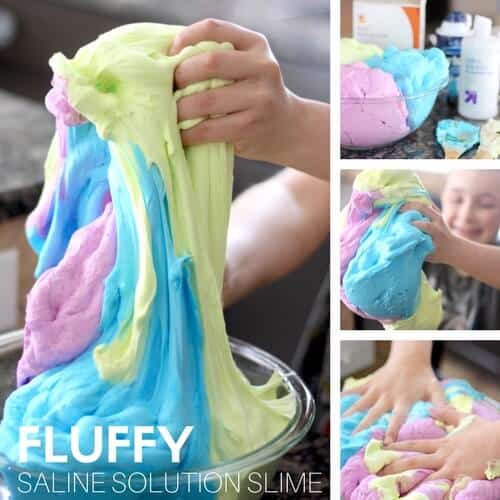

Discover 6 easy DIY STEM toys you can make with your kids! These hands-on projects are perfect for exploring science and engineering concepts through play, using simple materials at home or in the classroom.

DIY STEM Toys You Can Make with Your Kids
Looking for a fun way to engage your kids in STEM learning (science, technology, engineering, and math) while keeping their hands busy and their minds sharp? These DIY STEM toys are perfect for hands-on learning, and the best part is that they can be made from simple materials you probably already have at home.
Whether you have elementary or middle school students, these activities foster creativity and curiosity. Let’s explore exciting STEM projects [here]!
Add these Engineering Design Process Resources
Perfect for older kids! Applying the Engineering Design Process to these DIY STEM toys can add a deeper layer of learning for kids, helping them think like engineers while they create and experiment. Ask, imagine, plan, create, test, and improve.
I’ve included a 💡question (ASK) for each STEM toy to get the ball rolling. Learn more about the Engineering Design Process [free printable resources here].
You can also wrap up each STEM activity with our Questions for Reflection [free printable here].
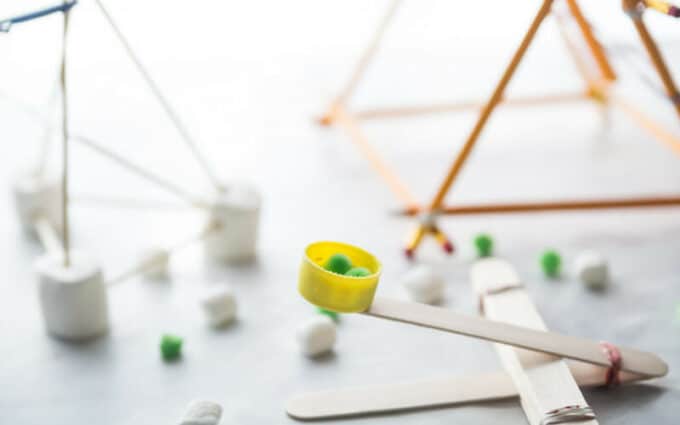
1. Catapult
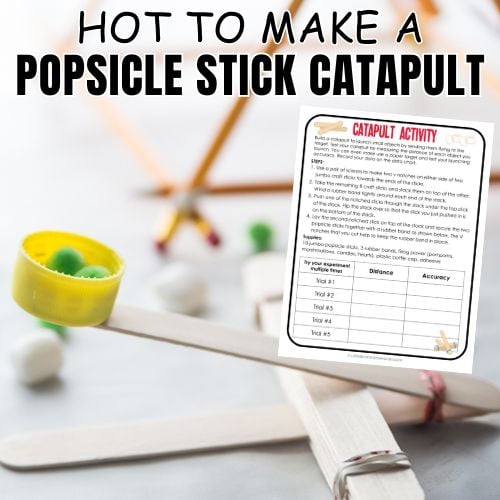
Building a popsicle stick catapult introduces kids to physics, specifically force and motion. This activity is ideal for elementary to middle schoolers curious about how things move. Kids can experiment with launching distances and angles using rubber bands, popsicle sticks, and a small object like a pom-pom.
- Potential Energy: The catapult stores potential energy when you pull it back.
- Kinetic Energy: When released, that energy is transformed into kinetic energy, propelling the object.
- Force and Angle: Experiment with how the force applied and the launch angle affect the distance the object travels.
💡Ask: What factors affect how far the catapult launches an object?
2. Marble Maze
Create a DIY marble maze with your kids to develop problem-solving skills and enhance hand-eye coordination. Start with our simple model and expand the idea to use cardboard, straws, and other materials. Kids can design a maze and challenge themselves to navigate it successfully. This activity is perfect for teaching basic engineering and spatial reasoning.
- Gravity: The marble moves through the maze due to the force of gravity pulling it downward.
- Friction: Different surfaces within the maze (like rough or smooth materials) will affect the marble’s speed due to friction.
- Problem-Solving and Engineering: Designing a functional maze involves critical thinking about structure and marble movement.
💡 Ask: What factors will make the marble move faster or slower through the maze?
3. Penny Spinner
A penny spinner is a simple, spinning toy that introduces young learners to balance and rotational motion. Kids can use a coin, a piece of paper, and a small straw to create a spinner and explore the forces that keep it in motion. It’s a great introductory activity for early elementary grades.
- Rotation: The penny spinner demonstrates rotational motion as it spins on a central axis.
- Balance: The spinner must be well-balanced for it to rotate evenly, teaching kids the importance of symmetry and balance in objects.
Ask: How does the shape or weight of the spinner affect its speed or duration of spin?
4. Air Cannon
Ready to experiment with air pressure? With simple materials like a plastic bottle and a balloon, kids can create a homemade air cannon that blasts small balls of air across the room. This activity is excellent for older kids who love science experiments and want to explore how air pressure works.
- Air Pressure: The air cannon creates a burst of air pressure inside the balloon. When released, that pressure pushes out and propels objects.
- Propulsion: The air blasts demonstrate how pressurized air can be used as a force to move objects.
💡Ask: What design will produce the strongest puff of air from the air cannon?
5. Toy Zip Line
Set up a toy zip line for your superhero toys! This activity is a fantastic way to learn about gravity and friction. Using string, a pulley system, or just a few simple household items, kids can send their favorite toys flying across the room while learning the basic physics principles.
💡Ask: What factors affect how fast the toy moves down the zip line?
- Gravity: The toy moves down the zip line because gravity pulls it toward the ground.
- Friction: The type of string used (rough vs. smooth) affects the speed of the toy due to the friction between the toy and the string.
- Force: The slope and tension on the string determine how fast or slow the toy moves.
6. Pom Pom Shooter
Pom-pom shooters are a fun and interactive way to learn about energy transfer. Kids can use a cup, a balloon, and some pom-poms to explore how stored potential energy transforms into kinetic energy when released. This activity is great for elementary students who want to get hands-on with science while having a blast.
- Potential Energy: When the balloon is stretched, potential energy is stored.
- Kinetic Energy: Upon release, the stored energy converts into kinetic energy, propelling the pom-poms forward.
- Energy Transfer: This activity demonstrates the concept of energy being transferred from the stretched balloon to the moving object (pom-pom).
💡Ask: How can you make the pom-pom shoot farther?

Making STEM Projects Fun!
Find fun ways to play with STEM below, including our “things that go” collection!
- How to Make Paper Airplanes
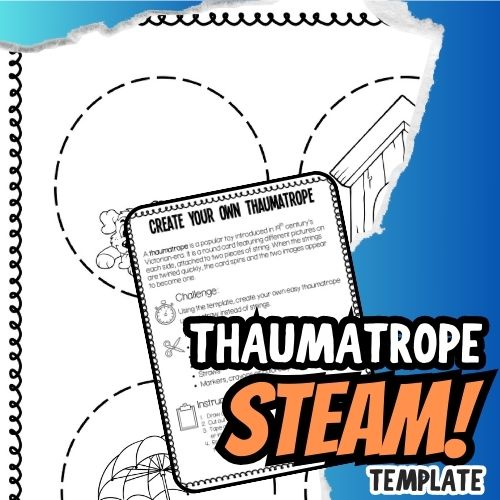
- Printable Thaumatropes for STEAM
- Paper Plate STEM Projects
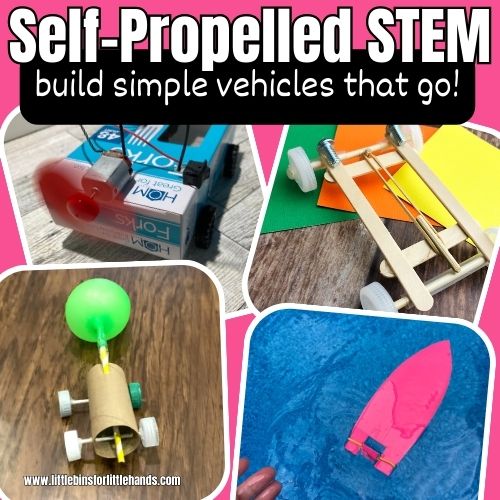
- Things that Go!
- Parachute Science Project
- Force and Motion Projects
- Make a DIY Pinwheel





Printable STEM Toy Pack
Grab all the instructions and templates in one convenient printable pack. Plus, we’ve added three bonus activities to add to the learning fun. Perfect for grades 2-5. Learn more about this printable STEM toys pack [here].