
This DIY snowball launcher STEM challenge is perfect for classroom use, snow days, winter break, or any time you want to explore STEM concepts with hands-on learning. Kids can use simple materials to test their engineering skills and learn about Sir Isaac Newton’s Laws while having a blast!

Snowball Launcher STEM Challenge
Have you ever wondered how far you can launch a snowball using everyday materials? This Winter STEM challenge invites kids to design, build, and test a snowball launcher. They’ll explore the first law of motion, the concept of opposite reactions, and the acceleration of an object while improving their problem-solving and creativity skills.
💡 Explore more Winter STEM Challenge Ideas here.
Recommended Grades: Perfect for kindergarten through middle school!
Supplies Needed:
- Craft sticks (jumbo and regular sizes, like popsicle sticks)
- Rubber bands
- Plastic spoons
- Cotton balls or mini marshmallows (for “snowballs”)
- Duct tape or heavy-duty tape
- Glue sticks or hot glue gun
- Small Paper or Plastic Cups
- Balloons
- Toilet Paper Tubes
Set Up A Snowball Launcher STEM Challenge
Time Frame: 45–60 minutes
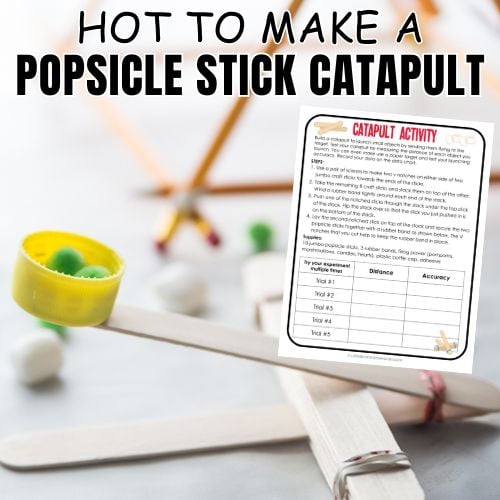
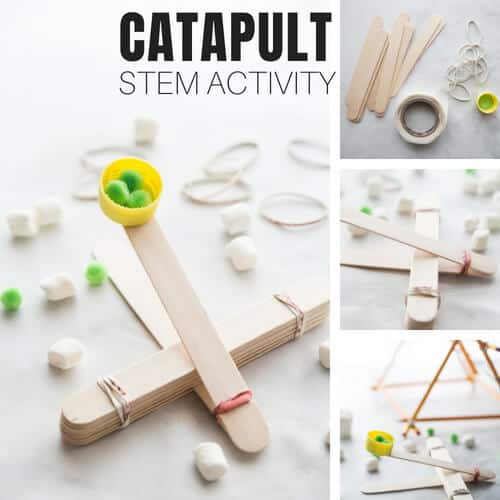
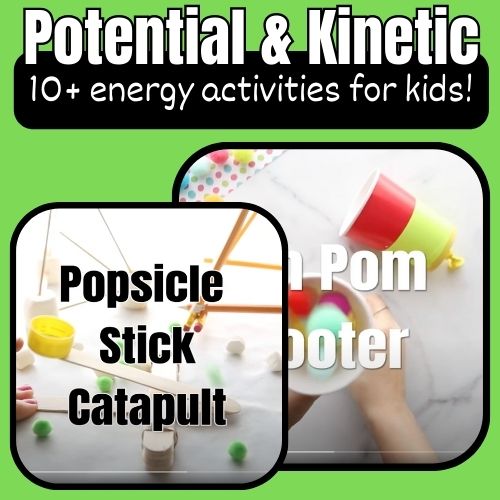
💡Use our popsicle stick catapult or snowball popper projects as examples to get started.
Step 1: Brainstorm & Plan
- Discuss how force and motion affect launching objects.
- Sketch your launcher designs and label parts like the round end of the spoon and where the rubber bands will stretch.
Step 2: Build Your Snowball Launcher
- Create a sturdy base using popsicle sticks and secure them with duct tape.
- Attach a plastic spoon to act as the “launcher arm,” making sure it can pivot.
- Reinforce the structure with glue sticks or a hot glue gun.
Step 3: Test Your Launcher
- Launch cotton balls or mini marshmallows as “snowballs.”
- Measure how far each snowball flies using a ruler or tape measure.
- Observe how the angle and tension of the spoon affect the velocity and distance.
Step 4: Improve Your Design
- Reflect on how your snowball launcher works.
- Experiment with adjusting the rubber bands or changing the angle to optimize performance.
STEM in Action: Learn About Newton’s Laws
- Newton’s First Law of Motion: A snowball at rest stays at rest until a force (the spoon) propels it.
- Newton’s Second Law: The acceleration of an object depends on the force applied.
- Newton’s Third Law: For every action (pulling the spoon), there is an equal and opposite reaction (snowball launch).
💡 Kids will also explore the concept of levers and how they reduce effort, making this activity a great introduction to simple machines. They can explore Newton’s Laws, Force and Motion, and Potential and Kinetic Energy!



Extensions & Variations:
- Distance Challenge: Whose snowball travels the farthest? Or highest to go over a “barricade!”
- Accuracy Challenge: Hit a target into a bucket or a marked spot!
- Design Challenge: Build a launcher with multiple arms to shoot two “snowballs” simultaneously.
- Incorporate a styrofoam snowball or different objects for a difficult challenge.

Wrap-Up Activity: Snowball Launch Showdown
Host a snowball-launching fun event where kids demonstrate their launchers. Reflect on what worked, celebrate creativity, and discuss how STEM (Science, Technology, Engineering, Math) played a role in their designs. You can add our STEM Questions for Reflection (free printable) as a wrap-up for the lesson.
More Winter STEM Activities:
💡 Make sure to look through all of our fun winter science activities:
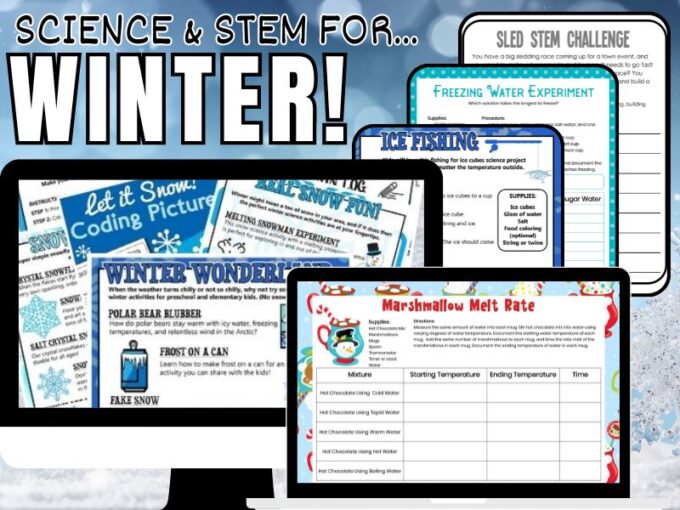
- Winter Snow Shovel Challenge: Design a tool to scoop up “snow” effectively.
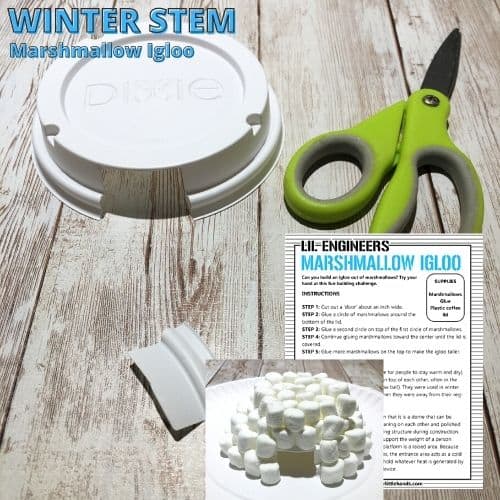
- Igloo Building Project: Create mini igloos with sugar cubes or mini marshmallows to learn about structures and insulation.
- Insulation Experiment: Test how animals stay warm by comparing different materials.
- Winter STEM Challenge Cards: Print these free cards and let kids explore, create, design, and build!


Printable Winter STEM Pack
Even if you don’t live in a snowy winter climate, there are many ways to explore the season!
WHAT’S INSIDE? You’ll find 200 Pages of Winter theme projects for science, STEM, and art!
- 25+ winter science activities and STEM projects for kids that are easy to set up and fit into the time you have available, even if it’s limited! NEW: Activity observation sheets.