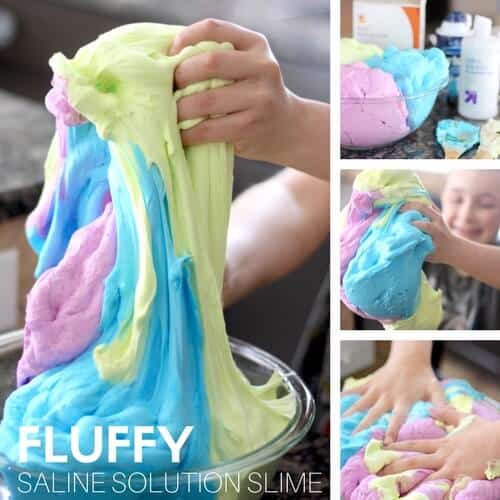

Create slime that magically changes color with heat and cold! This thermochromic slime recipe is a fun and easy way for kids to explore temperature and physical change. It uses simple slime ingredients and thermochromic pigment powder.

Thermochromic Slime
Field of Science: Chemistry and Physical Science
Grade Level: K-5
Concepts Explored: Thermochromism, polymers, states of matter, changes to temperature
This experiment demonstrates thermochromism, which is the ability of a substance to change color in response to temperature changes. When you add thermochromic pigment to slime, it responds to heat, like from your hands, by changing color.
Meanwhile, making slime is a chemical reaction where glue (a polymer) is cross-linked with sodium borate in the saline solution to create a stretchy, gooey substance.
Supplies
- 1/2 cup Washable School Glue (white or clear)
- 1/2 cup water
- 1/2 teaspoon baking soda
- 1–2 tablespoons saline solution (must contain sodium borates and boric acid, Target’s Up & Up brand)
- 1/2 teaspoon thermochromic pigment powder (color of your choice)
- Bowl and spoon
- Optional: Gloves and surface cover for easy cleanup
How to Make Thermochromic Slime
💡Read more about making our readers’ favorite, saline solution slime recipe here with video.
Watch the Video:
Mix Glue and Water:
Combine 1/2 cup of glue and 1/2 cup of water in a bowl. Stir until fully mixed.
Add Thermochromic Pigment:
Stir in 1/2 teaspoon of thermochromic pigment powder. Mix well to distribute the color-changing powder evenly.
Add Baking Soda:
Sprinkle in 1/2 teaspoon of baking soda and mix thoroughly. This helps firm up the slime.
Add Saline Solution:
Slowly add 1 tablespoon of saline solution while stirring. Keep adding a little at a time until the slime forms and pulls away from the sides of the bowl. You may need up to 2 tablespoons.
Knead Your Slime:
Remove the slime from the bowl and knead it with your hands until smooth and stretchy.

Test the Color Change:
Hold the slime in your hands or place it in warm or cool areas to watch the color transform! You can also test your color-changing slime using hot water and an ice cube.

Thermochromic Slime Science
What Is Thermochromism?
Thermochromism refers to the way some materials change color based on temperature. Thermochromic pigments contain molecules that react to heat by rearranging their structure, changing how they reflect light.
What Makes Slime Stretchy?
The glue contains long chains of molecules called polymers. When saline solution is added, the sodium borates and boric acid act as a cross-linker, binding the glue molecules together and turning the liquid into a semi-solid material we call slime.
Why Does the Color Change in Your Slime?
Thermochromic pigments have tiny molecules (often called leuco dyes) that change shape when heated or cooled. When the temperature gets warmer, the molecules rearrange, and that makes them reflect light differently, which changes the color. When it cools down, the molecules go back to their original shape, and the color changes back. It’s a great way to see temperature effects in real time!
Is The Color Change A Physical or Chemical Change?
So is there a chemical reaction? Nope! It’s a physical change because the molecules aren’t being broken apart or formed into something new. They’re just shifting shape due to heat.

Slime Facts for Kids
- Thermochromic pigments are also used in mood rings, color-changing mugs, and baby spoons.
- Some pigments change color around 88°F (31°C), close to skin temperature!
- Slime is a non-Newtonian fluid that behaves like both a solid and a liquid.
Make It a Slime Science Project
Turn this into a complete experiment by testing:
🔎 Learn more about setting up slime science fair projects here.
- Which temperatures make the color change faster?
- Does the type of glue (white vs. clear) affect the color intensity?
- How does the amount of pigment powder change the effect?
- Try chilling your slime in the fridge or warming it with a hairdryer (adult supervision).
- Use a chart to record temperatures and observe how fast the color changes!
Extension Activities
- Add a thermometer to measure the exact temperature that causes color changes.
- Make two batches of slime with different thermochromic colors and compare reactions.
- Try a slime layering experiment with hot and cold patches.

More Color Changing Science Experiments

Slime Science Project Pack
Looking for an exciting way to mix learning with hands-on fun? This Slime Project Pack turns ordinary slime-making into a science-packed adventure with activities that explore math, science, and literacy!