

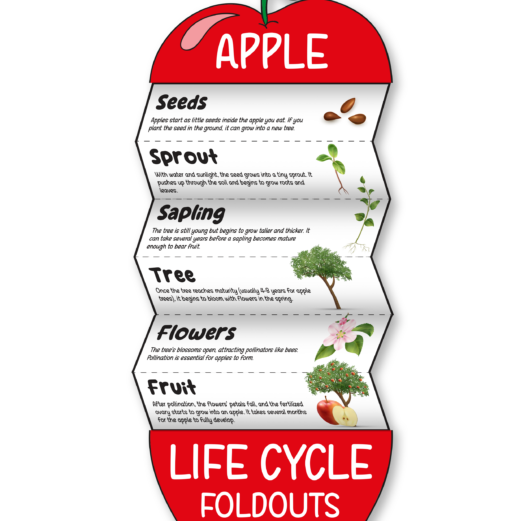
How do apples grow from tiny seeds into the fruit we pick from a tree? This printable apple growth activity follows the stages from seeds to sprouts, saplings, mature trees, flowers, and fruit.
Use the foldout for an easy, hands-on life science lesson on plant growth, pollination, and fruit development for a fall or apple theme.
Field: Life Science
Grades: K–3
Concepts: Plant growth, seeds, sprouts, trees, flowers, pollination, fruit development
How Do Apples Grow?
Apples grow through several stages as an apple tree develops.
The printable foldout follows this sequence:
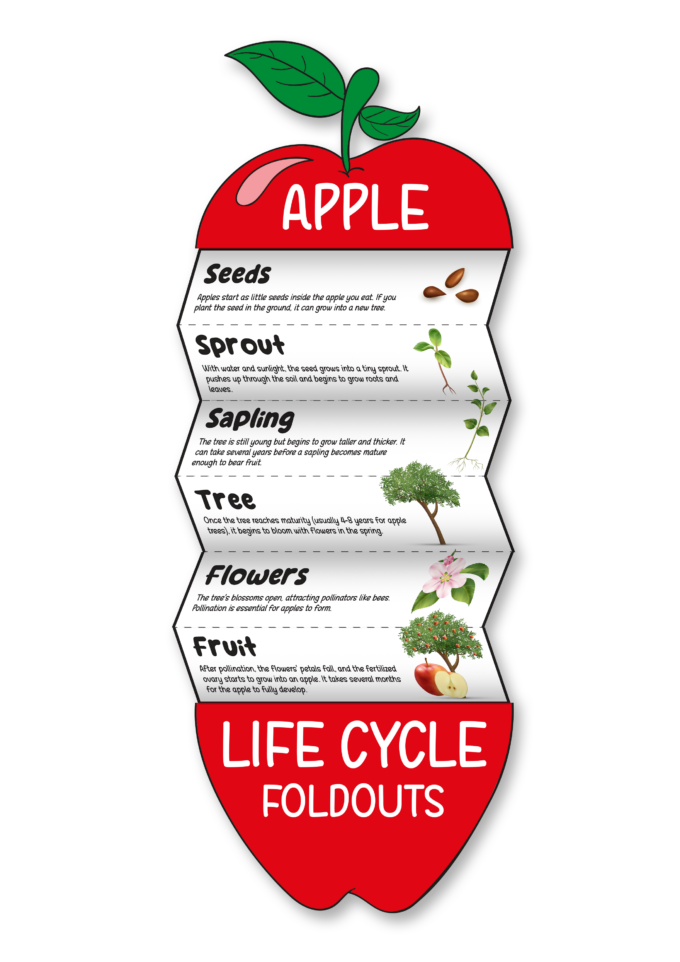
Seeds → Sprout → Sapling → Tree → Flowers → Fruit
Kids can use the foldout to see how a plant changes from a seed into a mature tree that produces apples.
Apple Growth Stages
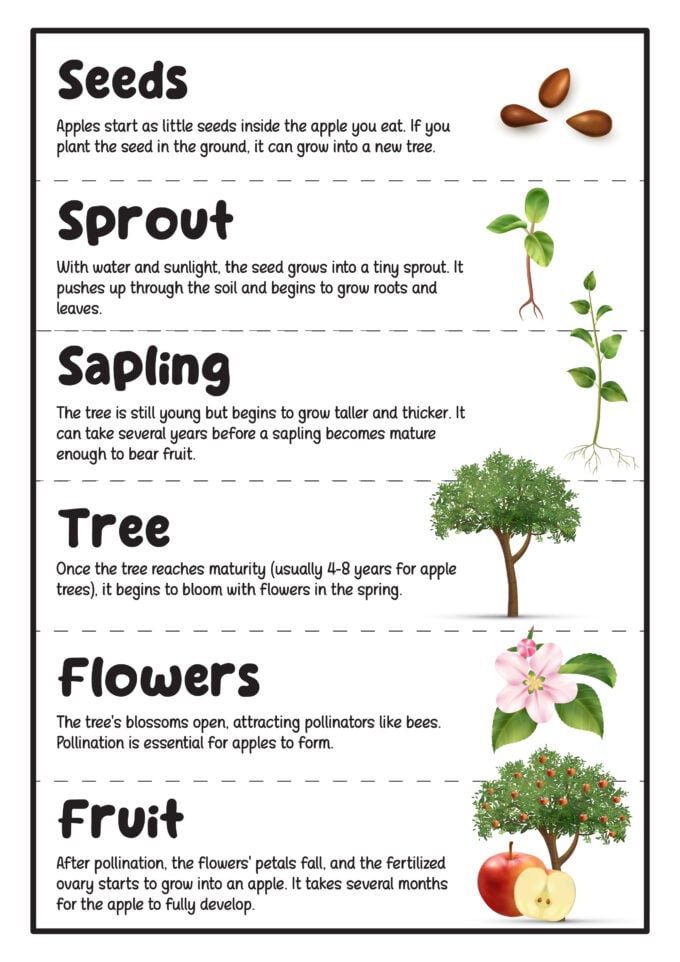
Seeds
Apples begin with seeds found inside the fruit. The printable starts with those seeds and shows that they can grow into a new tree.
Want to explore seeds further? Try the How Many Seeds? Investigation and compare seeds from apples and other fall fruits.
Sprout
With water and sunlight, the seed grows into a tiny sprout. Roots and leaves begin to develop as the plant pushes up through the soil.
Sapling
The young apple tree is called a sapling. It continues growing taller and thicker and can remain in this stage for several years before it is mature enough to produce fruit.
Tree
Once the tree reaches maturity, it can begin producing flowers. The printable notes that apple trees usually reach maturity in about 4 to 8 years.
Flowers
A mature apple tree blooms with flowers in spring. These blossoms attract pollinators such as bees, and pollination is essential for apples to form.
Fruit
After pollination, the flower petals fall and the fertilized ovary begins growing into an apple. The fruit continues developing over the next several months.
Free Printable Apple Growth Activity
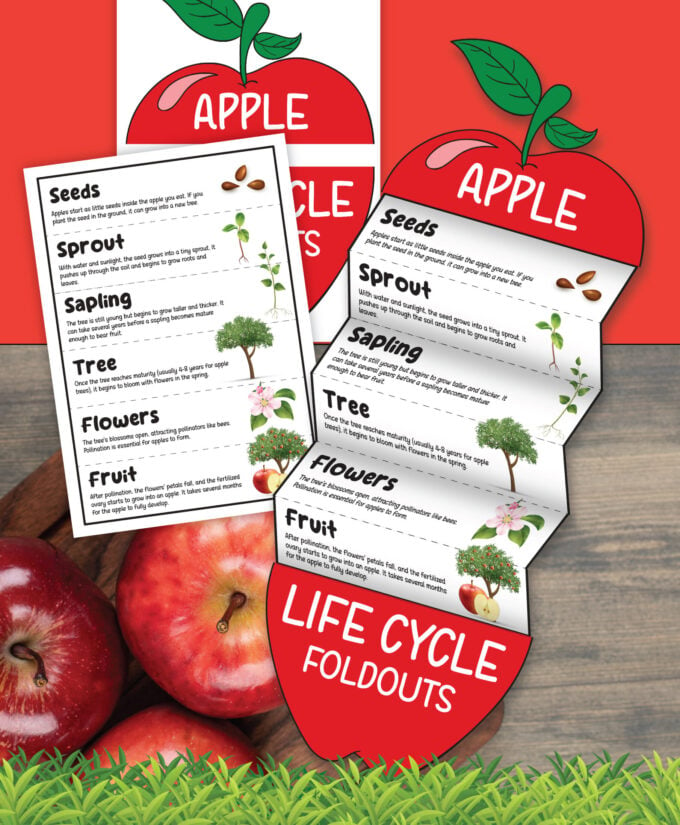
Use the Apple Life Cycle Foldout to follow the growth of an apple tree from seeds to fruit. The foldout shows each stage in order: Seeds → Sprout → Sapling → Tree → Flowers → Fruit
Use it with an apple unit, plant study, fall science lesson, or life science activity.
👉 Free Printable Apple Growth Activity here
Printable Apple Growth Activity
Use the foldout to help kids visualize each stage of apple growth.
The foldout includes:
- Seeds
- Sprout
- Sapling
- Tree
- Flowers
- Fruit
Kids can cut out the printable, fold along the lines, and open the apple to reveal each stage in order. For younger kids, focus on naming and sequencing the stages. For older students, ask them to explain what changes from one stage to the next and how flowers eventually become fruit.
Connect Apple Growth to Seeds
Apples are also an easy way to explore seeds during a fall life science unit. Cut open an apple and look at the seeds inside. Then compare your apple with other fall fruits.
👉 Try the How Many Seeds? Investigation to compare seeds from apples, pumpkins, cranberries, or other fruits.
Ask:
- Do all apples contain the same number of seeds?
- Are all apple seeds the same size?
- Which fall fruit contains the most seeds?
- What happens if a seed has the right conditions to grow?
How Do Apple Seeds Travel?
Seeds do not all stay next to the parent plant. Plants use different methods of seed dispersal to move seeds to new places. Some seeds travel by wind or water, while others animals carry.
Apple seeds are found inside a fleshy fruit, so animals can help move the seeds away from the parent tree.
👉 Try these Seed Dispersal Activities to compare how different plants spread their seeds.
Apple Growth and the Apple Life Cycle
Apple growth and the apple life cycle are closely connected, but they are useful to study in slightly different ways. This activity focuses on how the apple tree grows and develops:
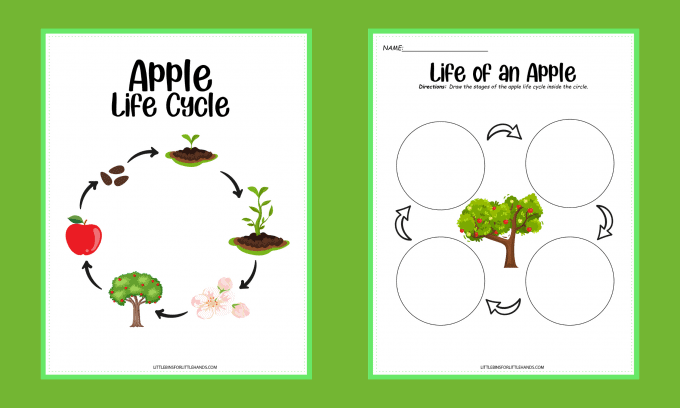
Seeds → Sprout → Sapling → Tree → Flowers → Fruit
👉 The Apple Life Cycle focuses more on the repeating cycle, where fruit contains seeds that can begin the process again.
Observe an Apple Tree
If you have access to an apple tree, use it as a real-life extension.
Look for:
- New leaves
- Flower buds
- Blossoms
- Tiny developing apples
- Growing fruit
- Ripe apples
- Seasonal changes
Kids can draw or write what they notice and compare their observations with the stages shown in the foldout.
🔎 You can also pair this with the Apple Observation Activity for more practice with observing, comparing, measuring, and recording findings.
From Apple Flower to Fruit
One of the most interesting parts of apple growth happens after the tree blooms.
Apple blossoms attract pollinators such as bees. After pollination, the flower petals fall, and the fertilized ovary begins developing into an apple.
This is a great place to connect apple growth to plant reproduction, pollinators, and fruit development.
👉 Learn more about pollinators here
Try a Sink or Float Extension
Once you cut the apple apart, use the pieces for a simple physics investigation.
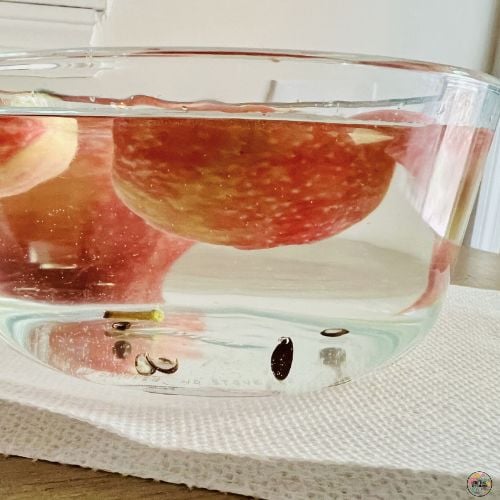
Test the whole apple, slice, peel, core, stem, and seeds to see which parts sink and which float.
👉 Try the Apple Sink or Float Experiment
Guiding Questions
Use these questions with the foldout or during a fall life science lesson:
- What is the first stage of apple growth?
- What happens when the seed begins to sprout?
- How is a sapling different from a mature tree?
- Why does an apple tree need flowers?
- What role do bees and other pollinators play?
- What happens to the flower after pollination?
- Which stage takes several years?
- Where do the seeds for a new apple tree come from?
- How might apple seeds move away from the parent tree?
Printable Apple Science and STEM Pack
Want more apple activities in one place?
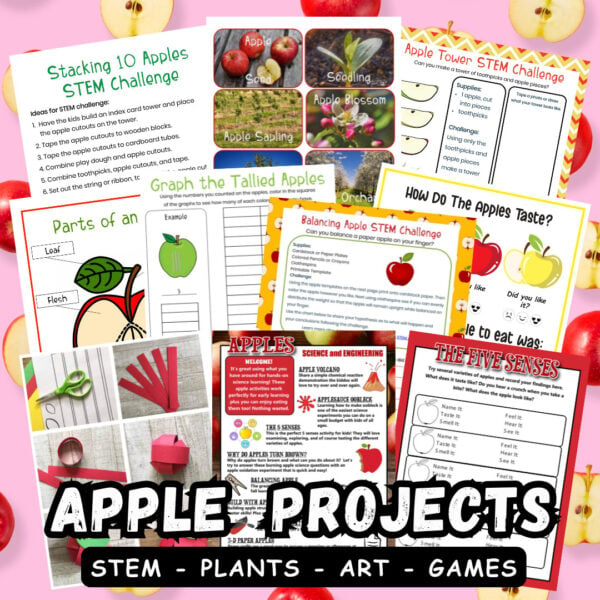
The Apple Science and STEM Pack includes more than 125 pages of apple-themed projects and printables for Kindergarten through elementary.
Inside, you’ll find apple science activities, STEM challenges, life cycle resources, observation pages, and additional printable activities for fall learning.
More Apple and Fall Life Science
Apple Life Cycle
Explore the repeating cycle from seeds to tree, flowers, fruit, and back to seeds.
Parts of an Apple
Explore apple anatomy, including the skin, flesh, core, seeds, stem, and leaves.
How Many Seeds? Investigation
Count and compare seeds found inside apples and other fall fruits.
Seed Dispersal Activities
Explore how seeds travel away from parent plants.
Fall Life Science
Find more seasonal activities about plants, seeds, life cycles, and living things.
Apple Observation Activity
Observe, compare, measure, and record what you notice about an apple.
More to Explore
Fall Life Science | Fall Science Experiments | Apple Science Experiments | Pumpkin Science Experiments


What fun ideas for playing and learning with apples! Thanks for sharing at the #LovetoLearnLinky. I will be featuring your post tomorrow. I hope you will stop by and link up again 🙂 -Katie
What a fun way to learn more about apples! I love how they were able to see all the different parts of the apple!
I have never thought of the science of apples. My daughter will love this for sure. I may even do it tomorrow to wrap up our fall theme.
What a great idea to separate each of the parts of the apple in a divided tray! We’ll be trying this!
This would be a hit with my preschoolers. There’s just something about getting to really look inside an apple that they love. Even though it’s a fruit they’re familiar with, it’s different when they’re looking at it like scientists!
Love this! Exploring apples is such a fun activity for kids! Great job!
A great book to accompany this activity! I love the hands-on approach to learning.
What a fun science experiment! My son is a big fan of his magnifying glass as well. Great idea using the tray to sort out all the parts.
I love how you all explored that the apple will still float even after being cut apart. actually I love the whole exploration of the apple. Fall happens to be one of our favorite seasons also.
The tray was a fun way to feature all the parts of an apple! I wonder if we included a few toys apples to the mix how they think they would sink or float. All great ways to incorperate science with apples. Thanks for sharing.
My toddler (2) absolutely LOVES ‘studying’ things with a magnifying glass! She enjoys checking out our apples, too!
We will have to do sink or float soon!
LOVE!! we need to dissect an apple like pronto! hehe
I love how you dissected the apple in the tray! We are loving the book Apples, Apples, Apples for this theme as well!
The magnifying glass and books are such a fabulous addition to this activity. I like how you separated each part into a different part of the tray!