
Plants don’t just sit still—they are busy moving water, making food, and helping the environment! In this easy transpiration experiment, kids will observe how water travels from the roots to the leaves and escapes through stomata, becoming part of the water cycle. This is a fun and hands-on way to explore basic botany and see plant science up close!

Plant Transpiration Experiment
Field of Science: Botany, Environmental Science
Grade Level: 2nd – 6th grade
Concepts Explored: Transpiration, water cycle, capillary action, stomata, plant structures
Importance of Transpiration in Plant Science
Plants are incredible living things that help shape the environment! They move water, make food through photosynthesis, and play a key role in the water cycle. Inside the plant, water travels from the roots, up the stem, and into the leaves through special tubes called xylem vessels.
Through transpiration, water escapes from tiny stomata (small pores) on the surface of the leaves, sending water vapor into the air. This process also helps cool the plant and creates the pulling force that moves water from the soil upward.
In this experiment, you’ll observe this normally invisible process right on a leaf!
Supplies Needed:
- Healthy plant with large leaves (indoor or outdoor)
- Clear plastic sandwich bag or zip top bag depending on leaf size
- String or twist tie
- Marker (optional for labeling)
- Notebook and pencil (for observations)

Easy Transpiration Experiment Instructions
Select a Leaf: Find a large, healthy leaf on your plant. If possible, choose a plant that’s well-watered and in sunlight.
Bag the Leaf: Gently place a plastic sandwich bag over the leaf and secure it with a twist tie or string around the plant’s stem. Make sure it is snug but not too tight.
Wait and Observe: Over the next couple of hours (or up to a day), water droplets will form inside the bag as water escapes from the leaf.
Record Observations: Write down when the water first appears, how many droplets you see, and if anything changes based on whether the plant is in sun or shade.

Plant Transpiration Science Information
What is transpiration?
Transpiration is when water moves up from the plant’s roots to the leaves and exits as water vapor through the stomata. These small pores on the surface of the leaves allow water vapor to escape into the air. This invisible process helps plants cool down and continue pulling water and nutrients up from the soil.
Why does the water move up?
Inside plants, a column of water is pulled upward through the plant’s xylem vessels by capillary action. This happens because of cohesion (water molecules pulling on each other) and adhesion (water sticking to the side of the vessel walls inside the plant). This pulling force is sometimes called transpiration pull.
🔎 Learn more about Capillary Action here.
How does this connect to the water cycle?
The loss of water through transpiration adds water vapor to the atmosphere, making it part of the water cycle just like water evaporating from oceans or bodies of water. Eventually, this water vapor cools, leading to condensation and precipitation.
🔎 Learn more about the Water Cycle here.
Transpiration + Photosynthesis:
Plants open their stomata to release water but must also take in carbon dioxide through those same pores for photosynthesis. Plants constantly balance their need to photosynthesize while limiting water loss, especially under various temperatures and high humidity conditions.
💡Fun fact: A large oak tree can release up to 100 gallons of water a day through transpiration! Learn more about the steps of photosynthesis here.
🌿 Did You Know?
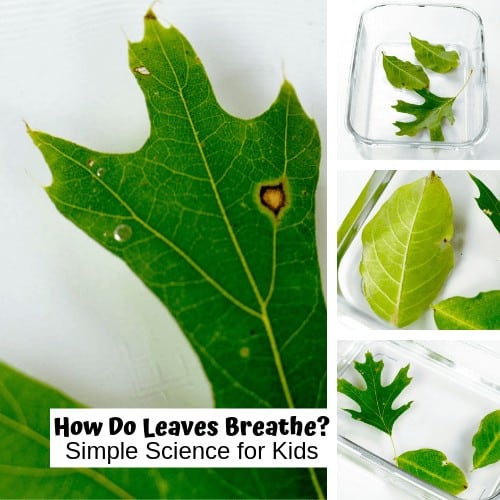
Plants don’t “breathe” like animals, but they do exchange gases! Through the same stomata where water escapes during transpiration, plants take in carbon dioxide (CO₂) and release oxygen (O₂) during photosynthesis.
So, while transpiration is like sweating, gas exchange is closer to a plant’s version of breathing — but instead of lungs, plants use tiny pores on the surface of their leaves!
Extension Activities
- Compare plants: Try this experiment on two different types of plants (broadleaf and needle-leaf).
- Change variables: Place one plant in complete darkness and another in continuous light. Which plant loses more water?
- Measure water loss: Weigh the plastic sandwich bag before and after to estimate how much water was released by the leaves.
- Try celery stalks in colored water: Place celery stalks in a small jar with food coloring to observe capillary action and see how water travels up through the celery’s stem and into the celery’s leaves.
Turn It Into a Plant Science Project
🔎 Use the scientific method to make this a complete science project!
- Question: How does sunlight affect how much water a plant loses through transpiration?
- Hypothesis: Example: “If a plant is in the sun, [then] it will lose more water than a plant in the shade.”
- Variables:
- Independent variable: Amount of sunlight (sun vs. shade)
- Dependent variable: Amount of water collected in the bag
- Controls: Same type of plant, same size leaf, same plastic sandwich bag, same observation time
- Test and Record: Try the experiment under different light conditions and record which plant shows more water droplets!

Related Plant Activities
- How Leaves Breathe Experiment
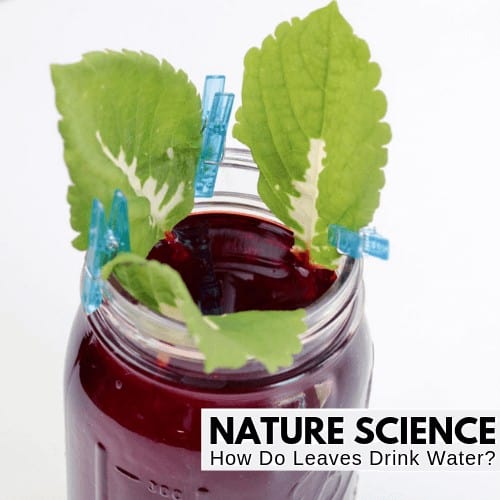
- How Leaves Drink Experiment
- Playdough Plant Cell Model
- 3D Plant Cell Model Printable
- Photosynthesis Steps Printable Project
- Photosynthesis Experiment with Chlorophyll
- Plant Growth Science Experiment
- Celery Food Coloring Experiment


Printable Plant Activities Pack
Explore 20+ Plant Activities for Kids! 🌱 Looking for fun and educational plant-themed activities? This comprehensive Plant Activity Pack is perfect for early elementary school grades, providing hands-on learning experiences that fit any skill level! These activities are ideal for classroom and at-home learning, whether for fall or spring science lessons.