
Learn how flowers grow with this simple, engaging flower life cycle lapbook printable. This hands-on activity helps kids explore plant growth step by step while building a meaningful science project they can keep and review.
Perfect for spring, this activity fits naturally into plant units, life cycle lessons, and interactive science notebooks.
👉 Use this alongside our Flower Lesson Plan for a full week of learning
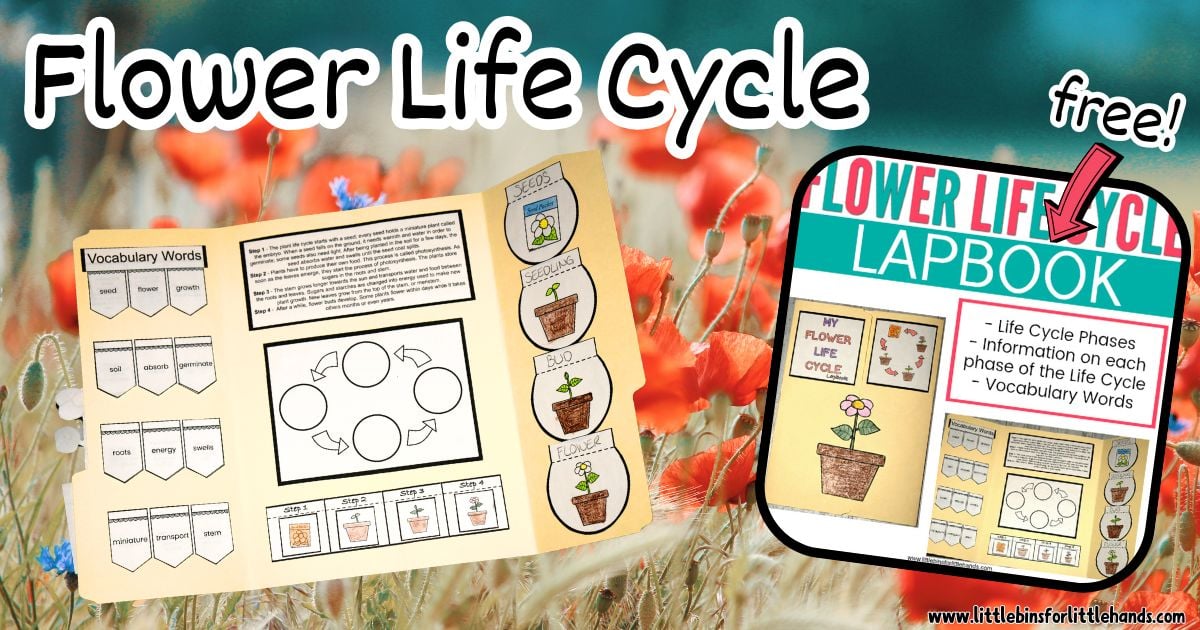
Flower Life Cycle Lapbook for Kids
Field: Biology—Plant Science
Grades: K–3
Concepts Explored: Life cycles, plant growth, germination, plant structure, basic plant needs
A plant’s life cycle shows how it grows and changes over time. Every flowering plant begins as a seed and goes through predictable stages as it develops.
Plants need four basic things to survive:
- Sunlight
- Water
- Air
- Nutrients from soil
When a seed gets the right conditions, it begins germination, which is the start of growth. Roots grow downward to absorb water, while the stem grows upward toward sunlight.
Leaves form and begin photosynthesis, the process by which plants make their own food. Eventually, the plant matures and produces a flower, which helps create new seeds.
👉 Pair this activity with a Parts of a Flower lesson to help kids understand how each plant structure supports the life cycle.
What Is a Flower Life Cycle?
Flowers grow through a repeating series of stages. These stages help kids understand how living things grow and reproduce.
The main stages include:
- Seed – contains a tiny plant inside
- Germination – the seed begins to sprout
- Seedling – a small plant starts to grow
- Mature Plant – the plant develops fully
- Flowering – the plant produces flowers and seeds
These stages repeat over and over, making the life cycle continuous.
👉 If you are studying multiple plants or animals, explore more in our Life Cycles Activities for Kids.
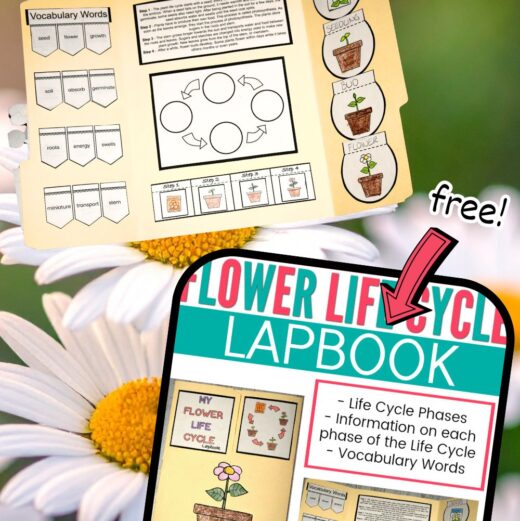
What’s Included in the Flower Life Cycle Lapbook
This printable lapbook gives students a complete, hands-on way to explore plant life cycles.
Inside the printable (based on the pages shown):
- Cover page for assembling the lapbook (page 1)
- Vocabulary cards with definitions like seed, germinate, absorb, and stem (pages 2–3)
- Cut-and-paste life cycle pieces to sequence the stages (pages 4–5)
- Step-by-step explanation of plant growth (page 6)
- Blank life cycle diagram for drawing and labeling (page 6)
These components build understanding through cutting, sorting, sequencing, and labeling, all of which are key early science skills.
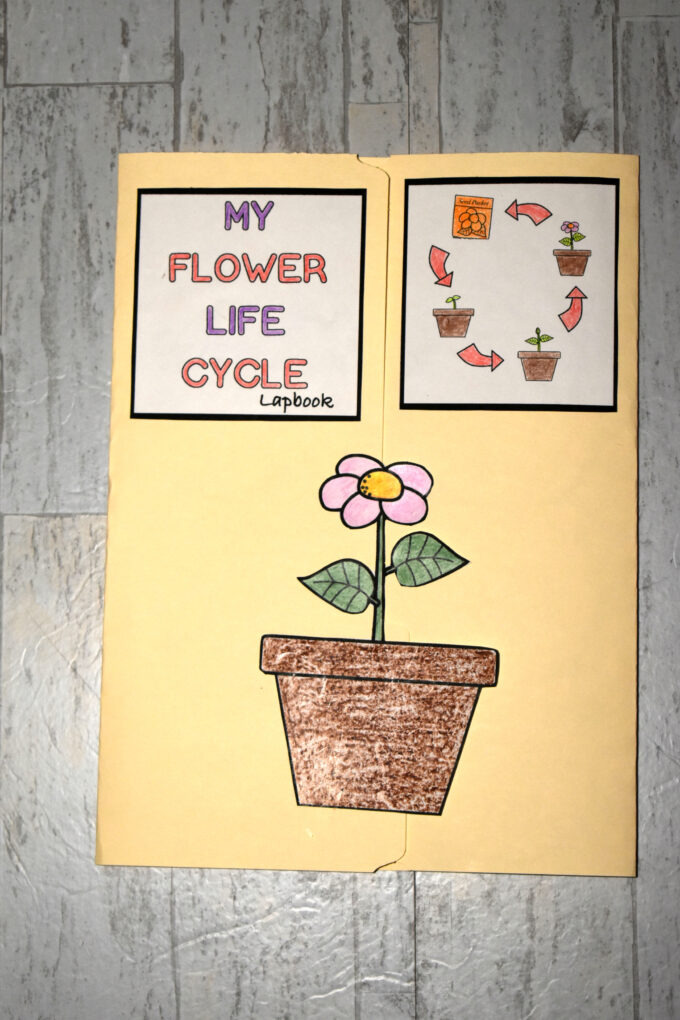
How to Make the Flower Life Cycle Lapbook
This activity is simple to set up and flexible for different learning environments.
1. Print the pages
Use regular paper or cardstock for durability.
2. Prepare the lapbook base
Fold a file folder or construction paper into sections.
3. Cut out the pieces
Students cut:
- Vocabulary tabs
- Life cycle images
- Diagram components
4. Assemble the lapbook
Glue each piece into the correct section:
- Match vocabulary words with definitions
- Place life cycle stages in order
- Add the diagram for drawing
5. Add labels and writing
Have students explain each stage in their own words to deepen their understanding.
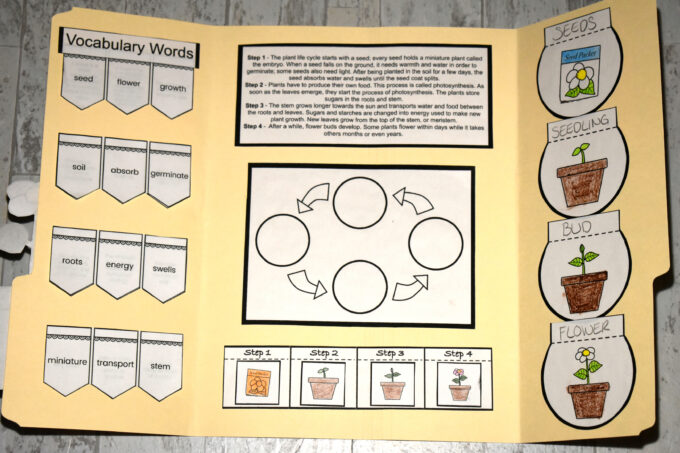
Flower Life Cycle Explained
This printable includes a clear explanation of each step (see page 6):
- A seed holds a tiny plant inside
- Water and warmth help the seed start growing
- Roots grow down and anchor the plant
- A stem and leaves grow upward toward sunlight
- The plant makes food using sunlight
- A flower develops and produces seeds
💡 This explanation connects directly to what students build in their lapbook, reinforcing learning through both reading and doing.
Vocabulary Words to Know
This lapbook introduces important science vocabulary in a kid-friendly way:
- Seed
- Germinate
- Absorb
- Stem
- Roots
- Growth
- Flower
Kids match each word to a definition and use them in the lapbook, helping them build confidence with scientific language.
Why Use a Lapbook for Life Cycles?
Lapbooks help students organize information in a visual and interactive way.
They are especially effective because they:
- Break big ideas into smaller, manageable parts
- Reinforce sequencing (a key science skill)
- Encourage hands-on engagement
- Provide a finished project that kids can revisit
I👉 Learn more about lapbooks and find more topics in our Lapbook Activities Hub.
Make It a Flower Science Project
You can easily extend this into a simple science project.
Try this:
- Plant seeds in cups or a garden
- Observe and record growth daily
- Compare how long each stage takes
- Draw or photograph changes
- Present the lapbook alongside real observations
This connects abstract concepts to real-world learning.
Extension Activities
Add more depth to your plant study with these activities:
- Seed germination in a jar or bag experiment
- Parts of a flower labeling worksheet
- Directed drawing of a flower
- Nature walk to observe plants in different stages
- Coffee filter flowers (art + science connection)
- Learn more about plant and animal needs
👉 For more seasonal learning ideas, visit our Spring Science Activities Hub.
How to Use This in a Lesson Plan
This lapbook works well at multiple points in a unit.
Use it as:
- A core activity during plant lessons
- A review project to reinforce learning
- A science center activity
- A take-home project
It pairs especially well with hands-on experiments and observation-based learning.
👉 See how we use this as part of a 7 Day Flower STEAM Unit for kids
Related Plant Science Activities
Spring is a fantastic time to explore plant science, including the life cycle of plants and flowers. You’ll find a wide variety of plant experiments and activities here.
- Plant transpiration experiment
- Plant cell models
- How leaves drink experiment
- How leaves breathe experiment
Grab Your Free Flower Life Cycle Lapbook
Ready to get started?
👉 Download the free printable flower life cycle and create a lapbook today.
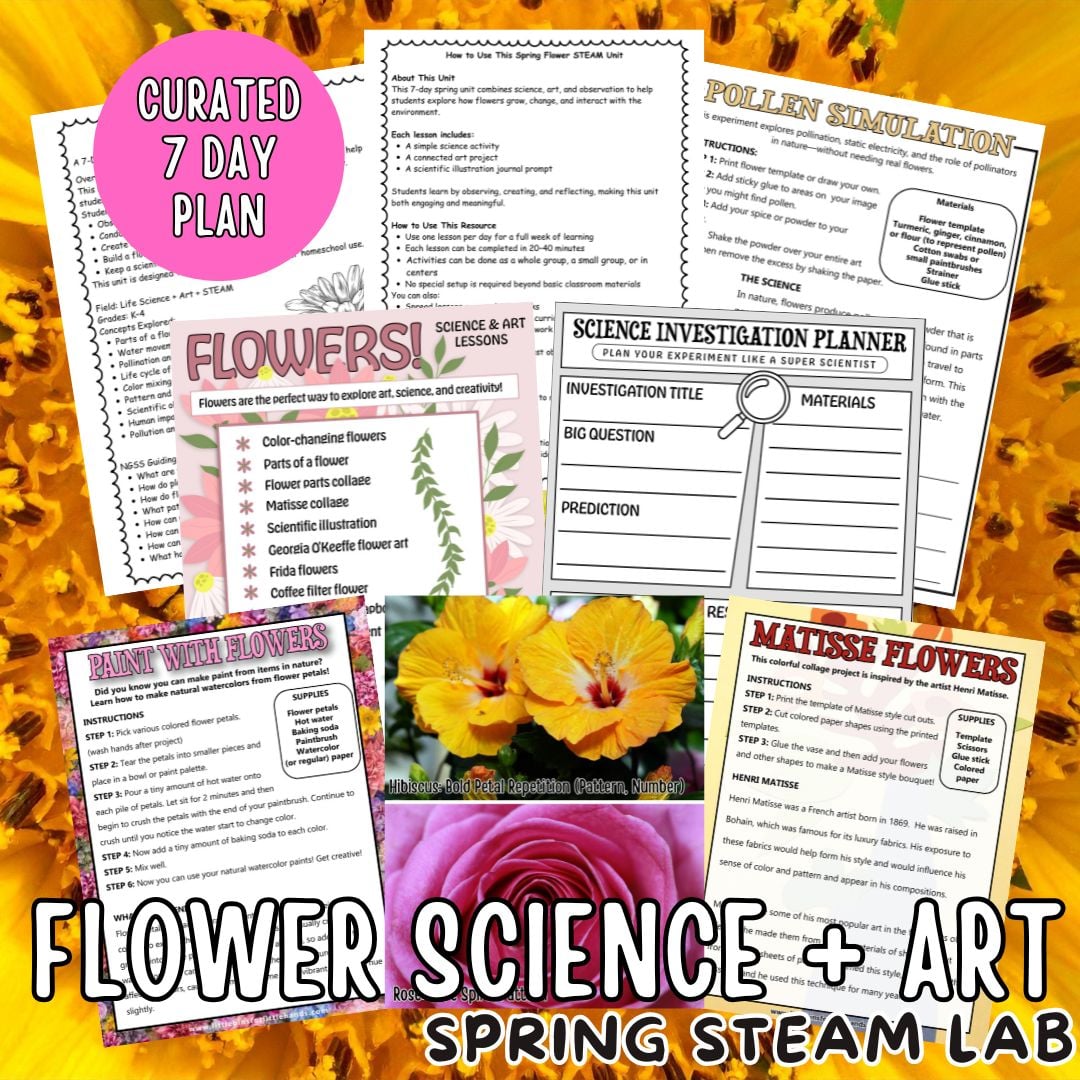
Flower STEAM Unit
If you want everything organized and ready to go, check out our Spring Flower STEAM Unit. It includes 7 complete lessons, guided journal prompts, print-and-go worksheets, famous artist flower projects, and environmental science connections.
👉 Take a closer look here