
What makes your fingerprints unique? In this easy Giant Thumbprint Experiment, kids will magnify their thumbprint on a balloon and compare it with others to discover how no two are alike. It’s a fascinating science experiment to explore the human body, anatomy, and forensic science!

Giant Thumbprint Experiment
Field of Science: Biology, Forensics, Human Anatomy
Grade Level: K–5
Concepts Explored: Fingerprints, individuality, skin patterns, biometrics, observation skills
Fingerprints are made of tiny ridges on your skin that form unique patterns—loops, whorls, and arches—before you’re even born. These ridges help us grip objects and are used in forensic science to identify people. This experiment makes your fingerprint larger than life, allowing you to explore its intricate details and compare it to others, just like scientists do.
Simplified NGSS Alignment
- What are we trying to find out? Whether everyone’s thumbprint is the same or different.
- What will we do? Create a giant thumbprint on a balloon and compare patterns.
- What will we measure or observe? Fingerprint shapes and differences between individuals.
Supplies Needed
- Light-colored balloon
- Ink pad
- Soap and water
- Printable Science Journal Page (Join the Library Club!)
- Complete Printable Human Anatomy Pack

How to Make a Giant Thumbprint
Gather materials: You’ll need an ink pad, a balloon (light colors work best), and some soap and water.
Ink your thumb: Press your clean, dry thumb into the ink pad and slowly roll it back and forth.
Stamp the balloon: Press your inked thumb onto a flat, uninflated balloon.

Clean up: Wash your thumb with warm soapy water.
Inflate the balloon: Blow up the balloon and tie off the end. Observe your enlarged thumbprint!
Analyze and discuss:
- Question #1: Do you think your thumbprint will look the same or different than others? Why?
- Question #2: What did you notice that was the same or different between your thumbprint and others?

Giant Thumbprint Science Information
Fingerprints are part of your body’s integumentary system, which includes skin, hair, and nails. The tiny ridges on your fingers are shaped by genetics and random movements in the womb, making each person’s print unique, even among identical twins. Forensic scientists use fingerprints to identify individuals, and biometric technology uses them for unlocking phones and securing information.
When you press your inked thumb onto a balloon and inflate it, the image stretches, allowing you to see loops, whorls, or arches. This simple activity provides kids with a hands-on introduction to human biology, forensic science, and pattern recognition. These are skills essential in real-life detective work and medical science.
More Facts for Kids
- Your fingerprints remain unchanged throughout your lifetime.
- The three main fingerprint patterns are loops, whorls, and arches.
- Koalas also have fingerprints, and they’re almost indistinguishable from human ones!
- Fingerprints help us hold things better by increasing friction between our skin and objects.
Free Secret Agent Printable Activity Pack

Make It a Science Project
Turn this into a comprehensive project by collecting prints from multiple individuals. Create a fingerprint classification chart (loops, whorls, arches) and tally how many of each type you find. Older kids can use a magnifying glass or phone camera to look closer and even try identifying matching prints!
💡Add the scientific method for extra hands-on learning opportunities.
Extension Activities
- Try inking other fingers and comparing patterns across your hand.
- Research how fingerprinting is used in crime investigations and technology.
- Create fingerprint art characters or animals using stamp pads and markers.
- Explore the anatomy of the skin and learn where your fingerprints are formed.
Related Science Activities
Human Anatomy and Body Science
- Robot Hand STEM Activity – Build a paper robot hand and learn how tendons control finger movement.
- DIY Heart Pump Model – Use jars, balloons, and straws to show how the heart works.
- Lung Balloon Model – Create a working model to show how our lungs expand and contract with air.
- Heart Rate Experiment – Measure how your pulse changes before and after exercise.
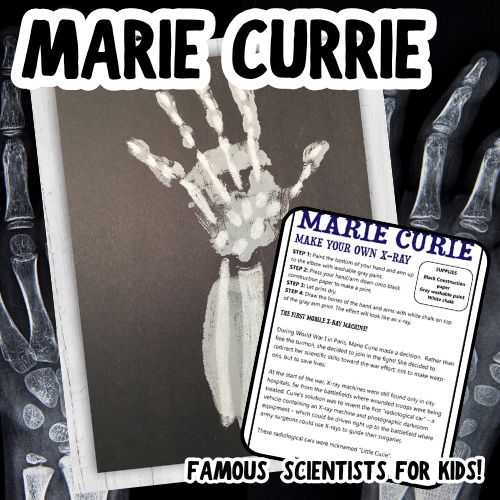
- X-Ray STEAM Art Project – Make realistic skeleton art and learn about bones and the skeletal system.
- Banana DNA Extraction Experiment – Smash a banana, add soap and alcohol, and pull out real DNA strands. A fun way to show that DNA is in all living things—even you!
- Wingspan Measurement Activity – Measure your arms from fingertip to fingertip and compare it to your height. Explore symmetry, data collection, and body proportions.





More Hands-On Science Activities
- Invisible Ink Science Experiment – Write secret messages and explore chemical reactions.
- Salt Painting Science – Learn about absorption and color mixing with salt and glue.
- Straw Pan Flute Experiment – Build a simple instrument to explore sound and vibration.
- Make a Homemade Barometer – Track weather changes with this DIY pressure experiment.
Printable Human Anatomy Pack
Join the Library Club Today!
Support Real Learning with Real Projects! When you join the Library Club Membership, you’re not just getting instant access to our complete library of art and STEM printables—you’re helping us keep hands-on, high-quality learning alive. Thoughtfully created resources made by real people who care about inspiring kids through creativity, curiosity, and connection.