
Solutions and dissolving experiments help kids explore how substances mix, spread, and interact! These hands-on chemistry activities use simple materials and create clear visual results. They are ideal for elementary science lessons at home or in the classroom.
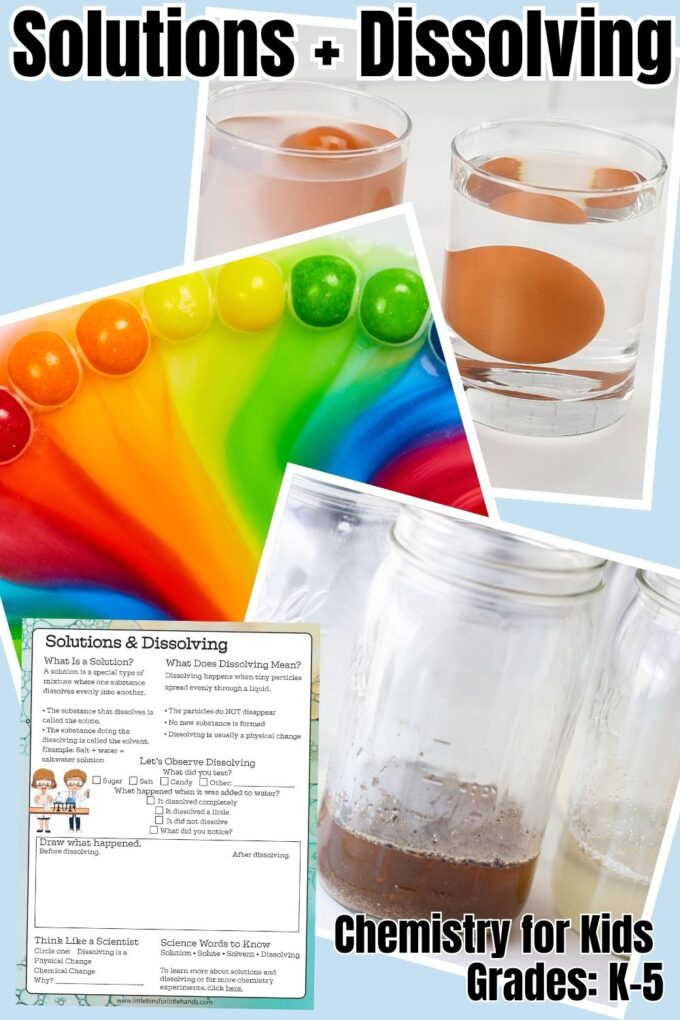
In this post, kids will learn what a solution is, what dissolving means, and how solutions are different from other mixtures—followed by easy experiments that build real understanding.
The Science Behind Solutions and Dissolving
A Solution (chemistry) is a special type of mixture in which one substance is evenly distributed throughout another. When a solid dissolves in a liquid, its particles break apart and spread so evenly that they can no longer be seen.
🔎 Learning about solutions helps students understand that changes can happen at the particle level, even when nothing dramatic appears to happen.
What Is a Solution? (Kid-Friendly Definition)
A solution is a special type of mixture where one substance dissolves completely into another and spreads evenly throughout.
- The substance that dissolves is called the solute
- The substance doing the dissolving is called the solvent
🔎 Example:
Salt mixed with water creates a saltwater solution. The salt is still present even though it cannot be seen.
What Does Dissolving Mean?
Dissolving happens when tiny particles of a substance break apart and spread evenly through another substance.
- The particles do not disappear
- No new substance is formed
- Dissolving is usually a physical change, not a chemical change
Supplies Needed
The exact supplies depend on the activity, but common materials include:
- Water
- Clear cups or jars
- Sugar, salt, candy, or food coloring
- Spoons
- Paper towels
- Gummy bears or eggs (for osmosis activities)
Easy Solutions and Dissolving Experiments
What Dissolves? Investigation
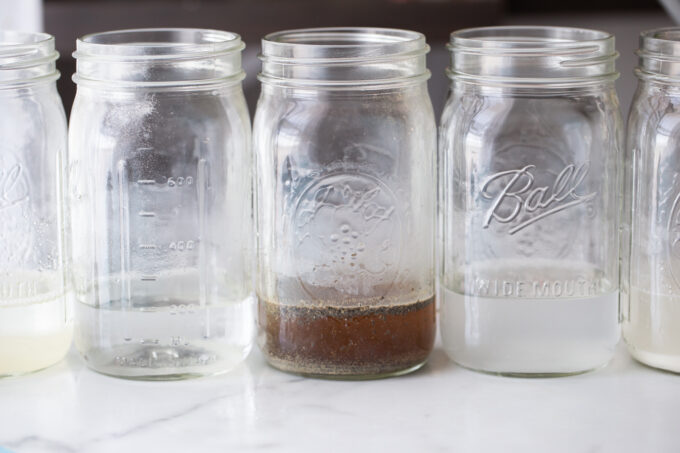
Test different solids to see which ones dissolve in water and which do not in this what dissolves in water experiment.
Concepts Covered: dissolving, solutions
Best For: Grades K–3
Sugar Cube Absorption Experiment
Liquid moves into a sugar cube and slowly breaks it down in this sugar cube absorption experiment.
Concepts Covered: absorption, dissolving
Best For: Grades K–3
Skittles Color Mixing Experiment
Candy colors dissolve and spread outward in water during the classic Skittles color mixing experiment.
Concepts Covered: dissolving, diffusion
Best For: Grades K–4

Dissolving Candy Canes
Candy canes dissolve faster in warm water than in cold water in this dissolving candy canes experiment.
Concepts Covered: dissolving rate, temperature
Best For: Grades K–4
Floating Egg in Salt Water
Salt dissolves in water to create a denser solution in the floating egg in salt water experiment.
Concepts Covered: solutions, concentration, density
Best For: Grades 2–5

Gummy Bear Osmosis Experiment
Gummy bears change size when placed in different solutions during the gummy bear osmosis experiment.
Want to go further? Explore more osmosis experiments for kids to see how water moves in and out of cells through solutions.
Concepts Covered: solutions, osmosis
Best For: Grades 3–5
Extension: From Dissolving to Crystal Growth
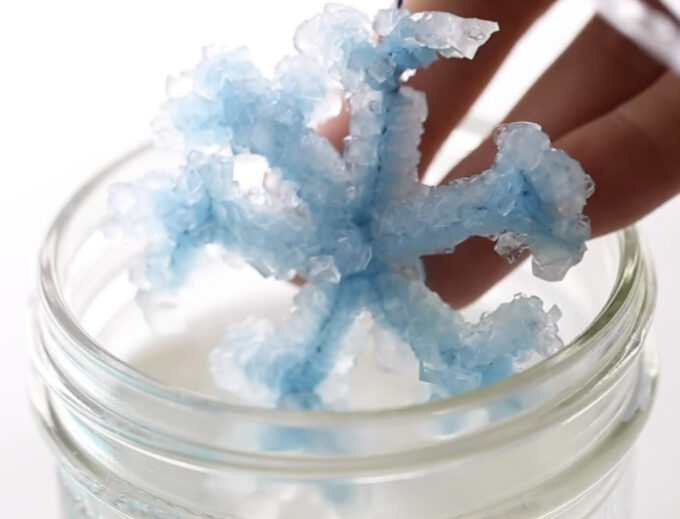
Once students understand dissolving and solutions, they can explore what happens when a liquid holds more dissolved material than it can keep.
Crystals form when a solution becomes saturated or supersaturated. Extra particles leave the solution as the liquid cools or evaporates. This shows that dissolving is a reversible physical change, and the particles never disappear — they rearrang
Concepts Covered: saturated solutions, supersaturated solutions, crystal growth, physical change
Best For: Grades 2–5
👉 Try growing crystal experiments, borax crystals, salt crystals, or sugar crystals to see this process in action.
Expanded Science Information: Solutions Made Simple
A solution forms when a solute dissolves evenly into a solvent. Even though the solute cannot be seen, it is still present—its particles are spread evenly throughout the solvent, creating a uniform mixture.
Important ideas for kids:
- Solutions are mixtures
- Dissolving does not create a new substance
- Many solutions can be separated again, such as by evaporating the liquid
💡 Tip: Stirring, heat, and time can affect how quickly something dissolves.
NGSS Guiding Questions
| Guiding Question | Student-Friendly Answer |
|---|---|
| What do you notice? | Some solids seem to disappear in water, colors spread evenly, and some substances dissolve faster than others. |
| What is happening? | The solute breaks into tiny particles and spreads evenly through the solvent, forming a solution. This is called dissolving and is usually a physical change. |
| Why does it matter? | Solutions help explain how materials mix in everyday life, such as drinks, cleaning products, and natural systems like oceans. |
- Field: Chemistry—Matter & Its Interactions
- Grades: K–5
- Concepts Explored: Solutions are mixtures in which a solute dissolves evenly in a solvent; dissolving is a physical change; the dissolving rate can change with temperature, stirring, and particle size; some materials dissolve while others do not; changes can be observed and measured.
Free Science Printable
Want to extend this activity with no extra prep? Download the free printable to help students observe, record, and reflect on what they learn during this activity.
More Facts About Solutions for Kids
- All solutions are mixtures, but not all mixtures are solutions
- Some solids dissolve better in warm water
- Some materials do not dissolve at all
- Solutions usually cannot be separated using filters
Make It a Science Project
Turn a dissolving activity into a science project by changing one variable at a time:
- Test hot vs. cold water
- Compare stirring vs. no stirring
- Try different solids
- Record observations in a simple chart
🔎 Apply the scientific method to get started! Write a hypothesis, choose variables, and more!
How Solutions Are Different from Other Mixtures
Solutions differ from other mixtures because the particles spread evenly and cannot be separated using simple tools like filters or magnets.
➡️ Start with mixtures and separating mixtures before introducing solutions for the best understanding.
Solutions and Dissolving FAQ
Is dissolving a physical change or a chemical change?
Dissolving is usually a physical change because no new substance forms and the process can often be reversed.
What is the difference between a mixture and a solution?
A solution is a special type of mixture where one substance dissolves completely and spreads evenly.
What is a solute and a solvent?
The solute dissolves, and the solvent does the dissolving.
Why does warm water dissolve faster?
Warm water gives particles more energy to move and spread.
Can everything dissolve in water?
No. Some materials dissolve, and others do not.
Related Chemistry Activities
- Separating Mixtures
- States of Matter Experiments
- Growing Crystals from a Solution
- Physical vs. Chemical Change
- Chemistry Experiments Hub
- Osmosis Experiments
🔎 Want even more hands-on ideas? Browse our full collection of science experiments and activities for kids.


Printable Elementary Science!
Want to do meaningful science — but not start a full unit yet? This starter lab provides quick, hands-on investigations across multiple science topics, allowing students to explore how science works before diving deeper into any one subject.
Perfect for regularly trying science without extensive planning. Grades: K–5.