
Looking for hands-on engineering activities that go beyond simple crafts and worksheets? These force and motion engineering activities help kids explore pushes and pulls, friction, gravity, airflow, energy, and motion. All while building, testing, measuring, and improving designs.
Whether you are teaching in the classroom, homeschooling, running a STEM club, or planning summer learning, these activities encourage kids to think like engineers as they solve real design challenges.
👉 Explore even more ideas in our Engineering Activities for Kids collection.
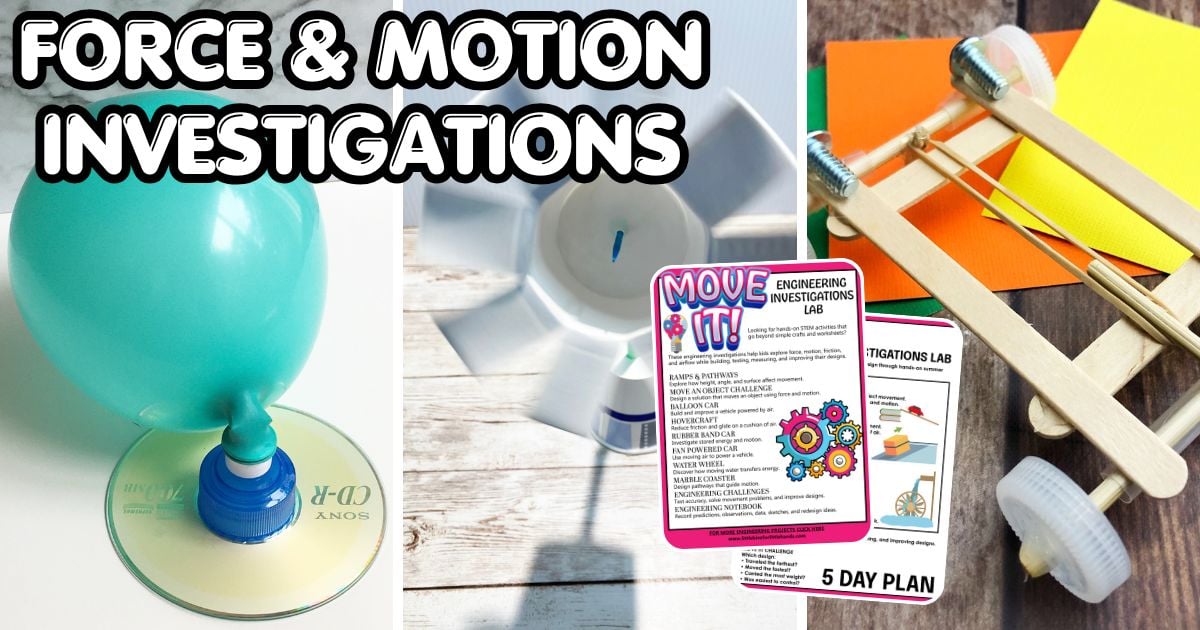
Top Force and Motion Engineering Activities
These force and motion engineering activities help kids investigate pushes and pulls, friction, gravity, airflow, and energy through hands-on STEM challenges. Perfect for classrooms, homeschool, STEM clubs, and grades 2–5.

Ramp Investigation
Explore how ramp height, angle, and surface materials affect movement. Test toy cars, marbles, or balls and compare results as you investigate how gravity and friction affect motion.
Learn More: Push and Pull Ramp Experiment
Move an Object Challenge
Can you move an object without touching it directly? Design a solution using force and motion concepts while testing different tools, pathways, and engineering ideas.
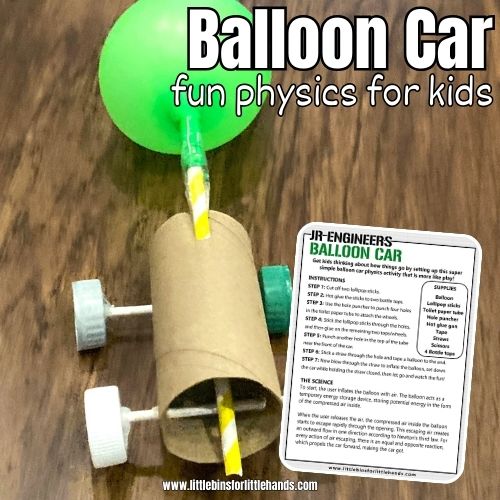
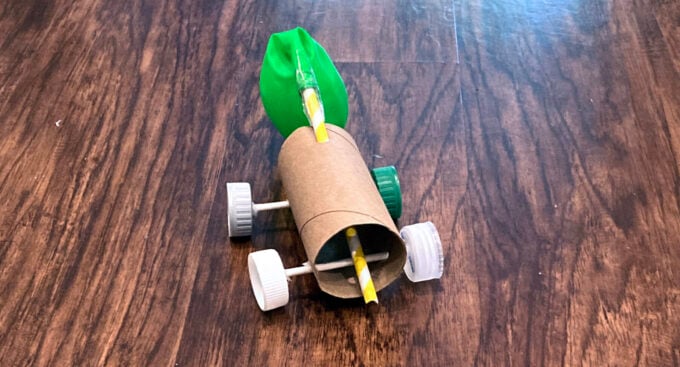
Balloon Car
Build an air-powered vehicle and discover how thrust creates motion. Experiment with different balloon sizes and car designs to see which one travels the farthest.
Learn More: Balloon Car STEM Project
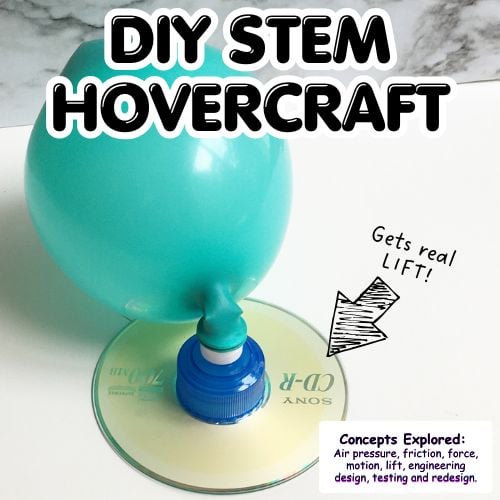
Hovercraft
Reduce friction and glide on a cushion of air. This simple engineering project demonstrates how air pressure can help objects move more easily across a surface.
Learn More: DIY Hovercraft
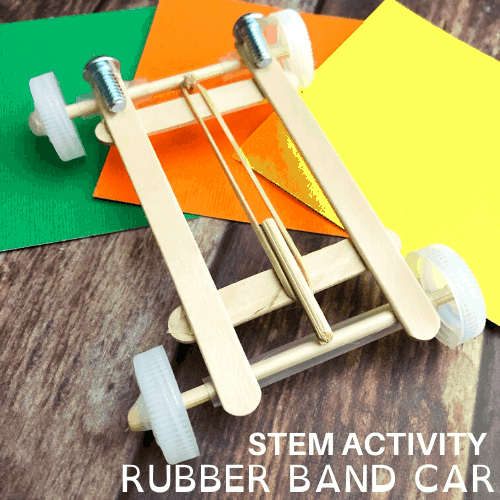
Rubber Band Car
Investigate stored energy and motion by building a vehicle powered by a stretched rubber band. Test different designs and compare performance.
Learn More: Rubber Band Car
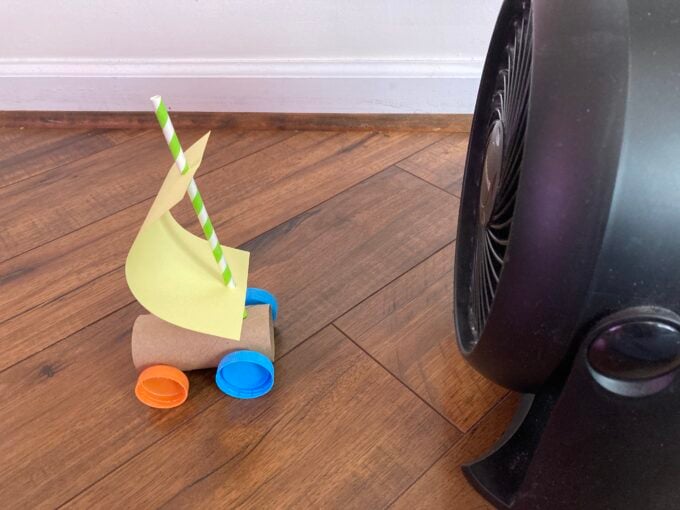
Wind Powered Car
Use moving air to power a vehicle while exploring force, motion, and engineering design. How far can you make your car travel?
Learn More: Wind Powered Car
Water Wheel
Discover how moving water transfers energy. Design and test a simple water wheel while learning how engineers use water power in the real world.
Learn More: Water Wheel Project
LEGO Car Challenge
Kids design a LEGO car, test it on a ramp, and then improve their design based on what they discover.
👉 Learn more: LEGO Car and Ramp Challenge
Marble Roller Coaster
Create pathways that guide motion using slopes, curves, and turns. Test and improve your design to keep the marble moving smoothly from start to finish.
Learn More: Marble Roller Coaster

What Kids Learn About Force and Motion
Force and motion are all around us. Every time an object starts moving, speeds up, slows down, changes direction, or stops, forces are at work.
These engineering activities give kids the opportunity to investigate those forces through hands-on testing rather than simply reading about them.
As students build ramps, vehicles, pathways, and moving systems, they explore:
Pushes and Pulls
Forces can make objects move, stop, speed up, slow down, or change direction.
Gravity
Gravity pulls objects toward Earth and affects how objects move down ramps, pathways, and roller coasters.
Read more: Gravity for Kids
Friction
Different surfaces create different amounts of resistance. Kids can compare how smooth and rough materials affect movement.
Air Resistance and Airflow
Balloon cars, hovercrafts, and wind-powered vehicles help kids investigate how moving air can both help and resist motion.
Potential and Kinetic Energy
Stored energy can be released to create motion. Kids observe energy transfers in activities such as rubber band cars and moving vehicles.
Read more: Potential and Kinetic Energy for Kids
Engineering Design
Students learn that successful designs rarely happen on the first attempt. Testing, collecting observations, and making improvements are important parts of the engineering process.
These concepts become much easier to understand when students can see, measure, and test them in action.
Think Like an Engineer
Engineers rarely create a perfect design on the first try. Instead, they follow a process of asking questions, imagining solutions, planning designs, creating prototypes, and improving their work through testing and observation.
Every activity in this collection encourages kids to use the engineering design process as they:
- Ask questions about how things move
- Imagine possible solutions
- Plan a design
- Create and test a prototype
- Improve their design based on results
As students compare distances, measure performance, and redesign their projects, they begin to think like real engineers. Learn more about the Engineering Design Process for Kids and how to use it with STEM challenges.
5-Day Force and Motion STEM Plan
Want to turn these activities into a complete STEM unit?
Day 1 — Pushes and Pulls
- Ramp Investigation
- Move an Object Challenge
Concepts: Force, motion, gravity, testing variables
Day 2 — Friction and Rolling
- Surface Investigation
- Hovercraft Challenge
Concepts: Friction, surfaces, motion
Day 3 — Stored Energy
- Rubber Band Car
Concepts: Potential energy, kinetic energy, engineering design
Day 4 — Air Creates Motion
- Balloon Car
- Wind Powered Car
- Water Wheel
Concepts: Airflow, force, motion, energy transfer
Day 5 — Engineering Challenge Day
- Marble Roller Coaster
- Improve a favorite design from the week
Concepts: Pathways, gravity, testing, redesign
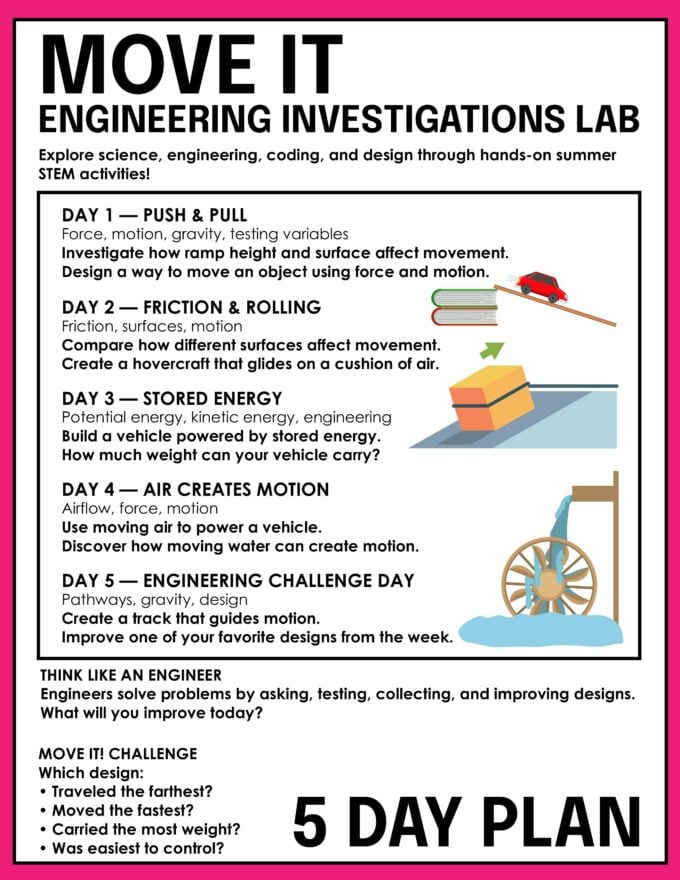
Free Move It! STEM Starter Guide
Ready to get started?
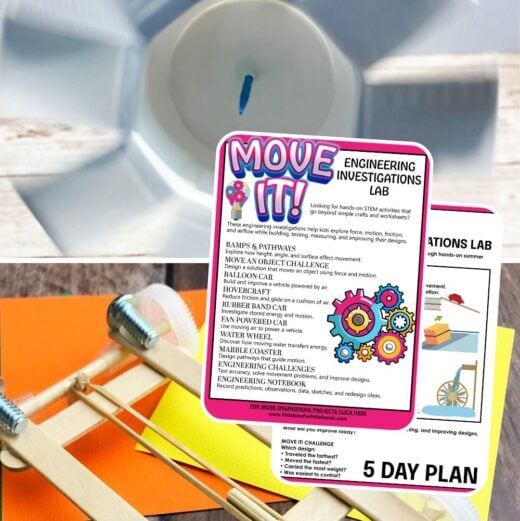
Grab the free Move It! STEM Starter Guide and get a preview of the engineering investigations, a 5-day STEM plan, and printable investigation planner pages that help students think like engineers.
Engineering Challenge Questions
One of the most important parts of engineering is testing and improving designs. Encourage students to compare results and look for ways to improve their projects.
Try asking:
- Which design traveled the farthest?
- Which design moved the fastest?
- Which design carried the most weight?
- Which design was easiest to control?
- Which surface created the most friction?
- Which design solved the challenge most effectively?
- What would you change if you tested it again?
These simple questions help students analyze results, communicate their ideas, and think critically about the relationship between design choices and performance.
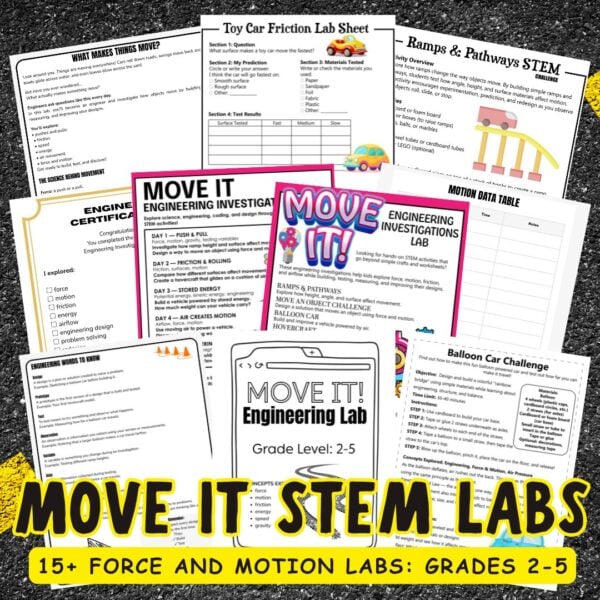
Get the Complete Move It! Engineering Investigations Lab
The Move It! Engineering Investigations Lab provides a complete collection of force and motion engineering challenges for grades 2–5.
Perfect for classrooms, homeschool groups, STEM clubs, makerspaces, and summer learning.
Inside you’ll find:
- Ramp investigations
- Move an Object challenges
- Balloon cars
- Hovercrafts
- Rubber band cars
- Wind powered cars
- Water wheels
- Marble roller coasters
- Engineering notebook pages
- Investigation planners
- STEM reflection sheets
- A complete 5-day engineering plan
👉 Grab the Move It! STEM labs here
More STEM Resources
Explore more hands-on ideas here:
- Engineering Activities for Kids
- Engineering Projects for Kids
- Engineering Design Process for Kids
- Force and Motion Worksheets (K-2)
- Physics Experiments for Kids
- Potential and Kinetic Energy for Kids
- LEGO STEM Activities
FAQ
What are force and motion engineering activities?
These activities combine physical science and engineering by encouraging kids to build, test, measure, and improve designs that move.
What age group are these activities best for?
Most activities work well for grades 2–5, with simple modifications for younger or older learners.
Do I need special STEM supplies?
No. Most projects use common materials such as cardboard, balloons, tape, paper tubes, toy cars, rubber bands, and recycled materials.
Can these activities be used in a classroom?
Yes. They work well for classrooms, homeschool groups, STEM clubs, makerspaces, and summer camps.
What skills do kids learn from engineering investigations?
Students practice problem-solving, critical thinking, observation, communication, creativity, measurement, and perseverance.
How is this different from a science experiment?
Science experiments often focus on answering a question, while engineering investigations focus on designing, testing, and improving a solution to a problem.