Try out 15 awesome balloon experiments that make science pop! Balloon science is a fun and hands-on way to explore physics, chemistry, and engineering with simple materials and big reactions!

Balloon Experiments for Kids
Balloons are a fun and simple way to explore powerful scientific concepts. These experiments allow kids to observe cause and effect, practice predicting outcomes, and explore how energy and matter behave—all in a playful way.
Field of Science: Physics, Chemistry, Engineering
Grade Level: Kindergarten through 5th Grade
Concepts Explored: Air pressure, static electricity, chemical reactions, density, motion and force, sound energy, and fermentation.
💡 Whether you’re testing balloon air pressure, launching a balloon rocket, or making a balloon float—or sink!—Try a balloon science experiment for kids at home or in the classroom.

1. Balloon Powered Car
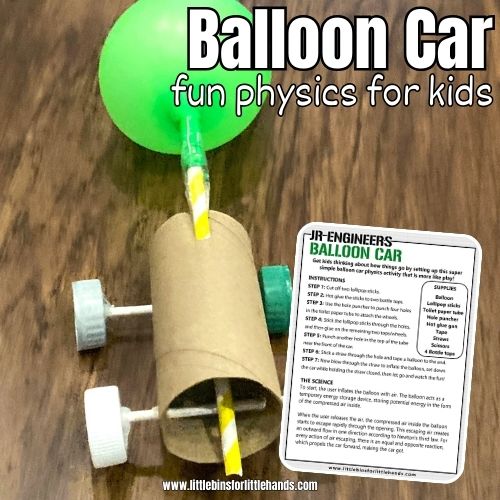
Build a balloon-powered car using recycled materials and race it! The balloon’s air creates thrust, pushing the car forward—an awesome look at Newton’s Third Law of Motion.
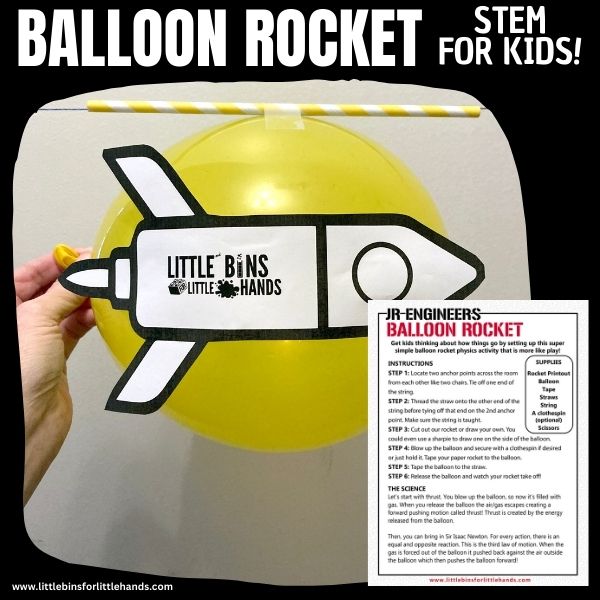
2. Balloon Rocket
Run a string between two chairs and thread a straw on it. Tape a blown-up balloon to the straw and let it go. The air escaping the balloon pushes it along the string like a rocket launch!
3. Screaming Balloon
Trap a hex nut or coin inside a balloon and swirl it around. The object bounces off the inside, creating a screeching sound—a cool demonstration of sound energy and vibrations.
4. Soda Balloon Experiment
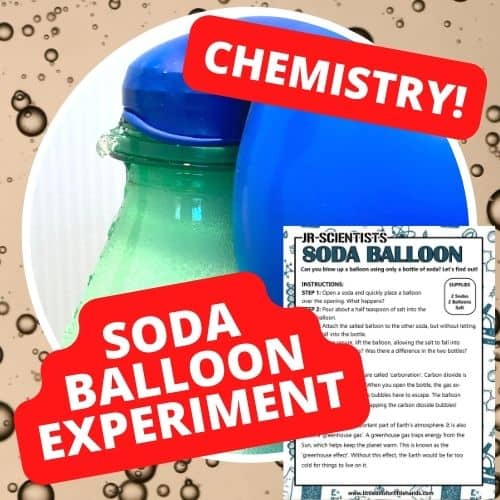
Pour soda into a bottle and stretch a balloon over the top. Drop in Pop Rocks or mints and watch the balloon inflate from the released carbon dioxide gas!
5. Rolling Can Balloon
Rub a balloon on your hair or fabric to build up static electricity. Hold it near an empty aluminum can and watch it roll—thanks to the balloon’s electric charge attracting the can!
6. Bending Water
Charge a balloon with static electricity, then hold it next to a stream of water. The water bends toward the balloon because the static charge pulls on the water molecules.
7. Yeast Balloon Experiment
Mix sugar, warm water, and yeast in a bottle and place a balloon over the opening. Over time, the balloon inflates from the carbon dioxide released during fermentation!
8. Electric Cornstarch
Make oobleck (a non-Newtonian fluid) from cornstarch and water, then use a static-charged balloon to see how the particles move in response. A fun way to combine slime and electricity!
9. Balloon in a Jar Air Pressure Experiment
Place a deflated balloon inside a jar and stretch the opening over the rim. Try inflating it—it won’t budge much. Poke a hole in the jar and try again. It inflates easily! Why? The trapped air was resisting expansion, and now it can escape.
10. Balloon Density Experiment
Fill one balloon with air and one with water. Drop both into a bin of water. The air-filled balloon floats because it’s less dense, and the water-filled balloon sinks because it’s more dense!
11. Butterfly Static Electricity Experiment
Cut out a tissue paper butterfly and lay it flat. Rub a balloon on your hair or clothing to create static electricity, then hold it above the butterfly. Watch its wings rise and “flutter” up to meet the balloon! A fun way to visualize static charge and attraction.
12. Balloon DIY Hovercraft
Make a DIY hovercraft by attaching a balloon to a pop-top bottle cap glued onto a CD or plastic lid with a hole in the center. Inflate the balloon, seal the cap, then open it on a smooth surface. The escaping air reduces friction and lets the hovercraft glide!


Balloon Science Experiment Information
Balloons are lightweight and flexible, making them perfect for exploring scientific principles:
- Air pressure is the force exerted by air molecules. It can inflate balloons, hold them in shape, or even prevent inflation, like in the balloon-in-a-jar experiment.
- Chemical reactions can create gases that blow up balloons without breath! These reactions let kids observe cause and effect in action.
- Density explains why some things float and others sink. Swapping out what’s inside the balloon lets kids explore the effects of mass and volume.
- Static electricity occurs when electrons build up on the balloon’s surface. It can attract, repel, and even move objects, like butterflies or rolling cans!
- Motion and thrust are revealed when balloons launch cars and rockets by pushing air in one direction to move in another.

Balloon Science Experiment for Preschoolers
Preschoolers thrive with hands-on, visual, and cause-and-effect activities, so here are practical and playful balloon science experiments that are perfect for their age level (even Kindergarten, too):
Balloon Bouncing on Different Surfaces
What to do: Blow up a balloon and let kids bounce it on carpet, tile, wood, and fabric.
What they learn: Explore how surfaces affect movement and friction.
Extension: Ask, “Which surface made the balloon bounce more?”
Balloon Blow-Up with Vinegar & Baking Soda (Simple Version)
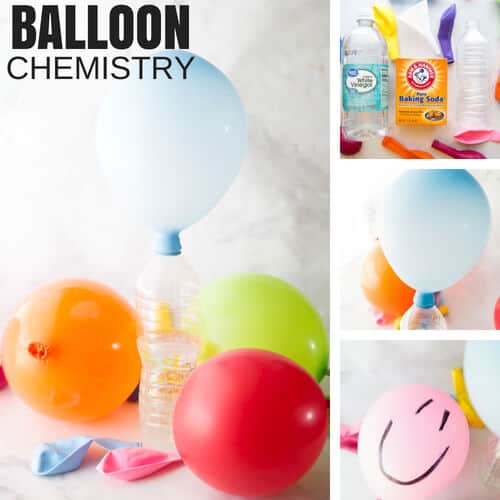
What to do: Use a small water bottle. Help kids spoon baking soda into a balloon. Pour vinegar into the bottle and stretch the balloon over the top. Lift the balloon so the baking soda drops in and watch it inflate!
What they learn: Chemical reaction creates a gas (CO₂)!
Tip: Pre-measure ingredients and offer lots of guidance.
Balloon Painting
What to do: Dip a small balloon in paint and stamp it on paper.
What they learn: Explore textures, pressure, and patterns.
STEAM Twist: Talk about shapes, colors, and how pressing gently vs. firmly changes the print.
Balloon and Fan Experiment
What to do: Blow up a balloon and set it on a smooth surface (like a table or floor). Use a small fan or blow gently to move it.
What they learn: Introduces force and motion.
Variation: Try pushing the balloon with a straw or paper fan.
Balloon Experiment with Hair
What to do: Rub the balloon on a sweater or hair and slowly bring it near your child’s hair.
What they learn: Static electricity! The hair lifts and moves.
It’s silly and magical—kids love seeing their hair stand up!
Balloon Sink or Float (Density Intro)
What to do: Fill one balloon with air and one with water, then drop them in a tub of water.
What they learn: Some things float, some sink!
Tip: Let kids try other objects too—soft vs. heavy.
More Balloon Science Facts for Kids
- Latex balloons can stretch up to five times their size!
- Balloons expand when warmed because the air inside expands.
- Air takes up space—even if we can’t see it.
- A balloon filled with helium will float because helium is lighter than air.
Related Science Experiments and Activities
- Static Electricity Science Activities
- Chemical Reaction Science Projects
- Fun with Density for Kids
- Newton’s Laws Projects
Printable Science Projects For Kids
If you’re looking to grab all of our printable science projects in one convenient place plus exclusive worksheets and bonuses like a STEAM Project pack, our Science Project Pack is what you need! Over 300+ Pages!