

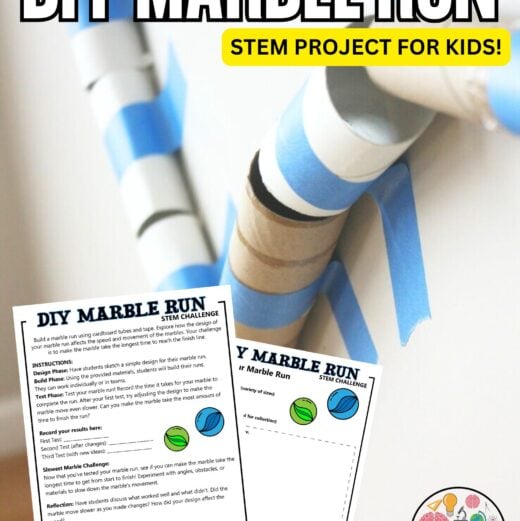
This easy STEM challenge uses recycled materials you probably already have at home and encourages kids to design, build, test, and improve their own marble run.
The best part? Every marble run is different, which means endless opportunities to experiment, solve problems, and think like an engineer.
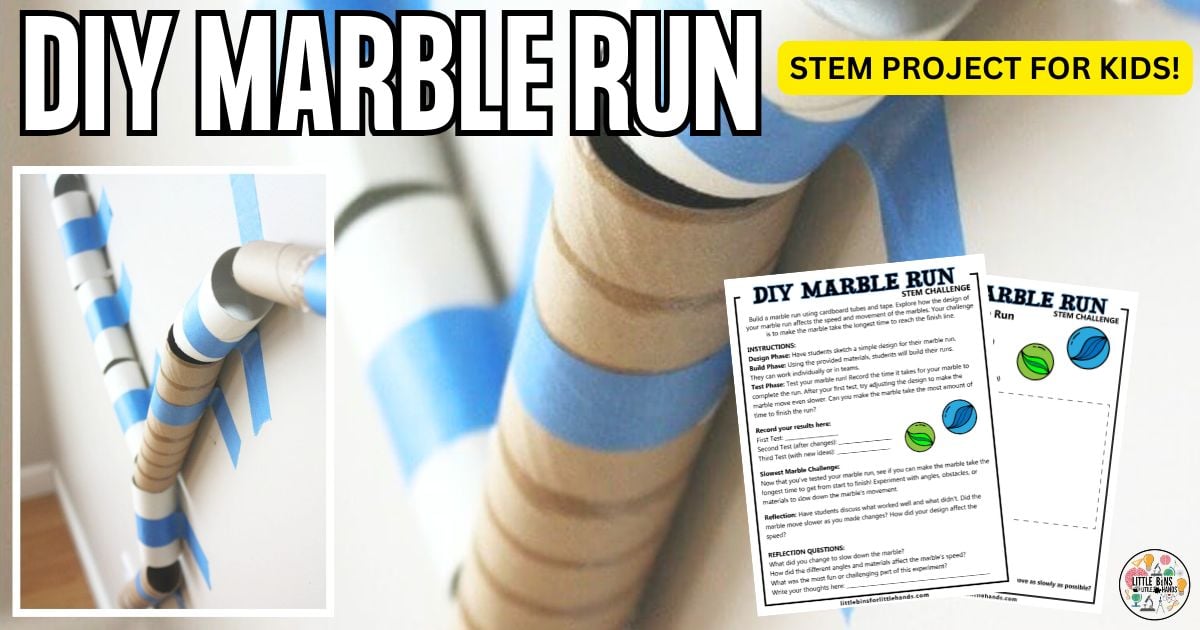
The Science Behind It
A cardboard marble run is a simple STEM challenge that uses cardboard tubes, tape, and marbles to explore gravity, motion, energy, and engineering. Kids design, build, test, and improve their own marble run while learning through hands-on experimentation.
- Grade Levels: 3-8
- Field of Science: Physics, Engineering, Force and Motion
- Concepts Explored: Gravity and motion, Potential and kinetic energy, Momentum, Engineering design, Problem-solving skills, Cause and effect, Testing and improving a prototype
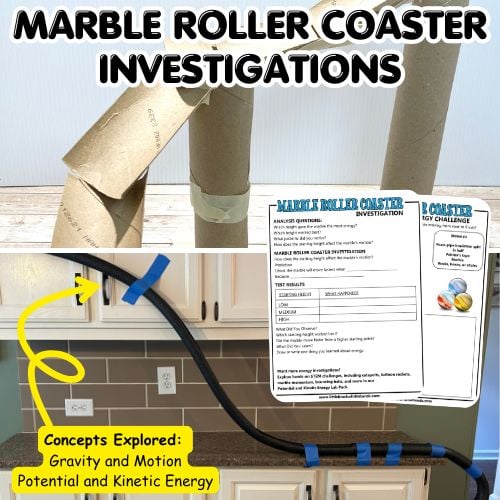
👉 Looking for more marble fun? Try our Marble Roller Coaster STEM Project
Supplies
- Cardboard tubes (toilet paper rolls, paper towel tubes, wrapping paper tubes, etc.)
- Painter’s tape
- Scissors
- Marbles or small balls
- Container for catching marbles
Optional Materials
- Paper cups
- Paper plates
- Small boxes
How To Build A Cardboard Marble Run
STEP 1: Design Your Marble Run
Before you start building, think about how your marble will travel from start to finish.
Ask yourself:
- Where will the marble begin?
- Where will it end?
- How steep should the track be?
- Will there be turns, tunnels, or obstacles?
STEP 2: Build The Track
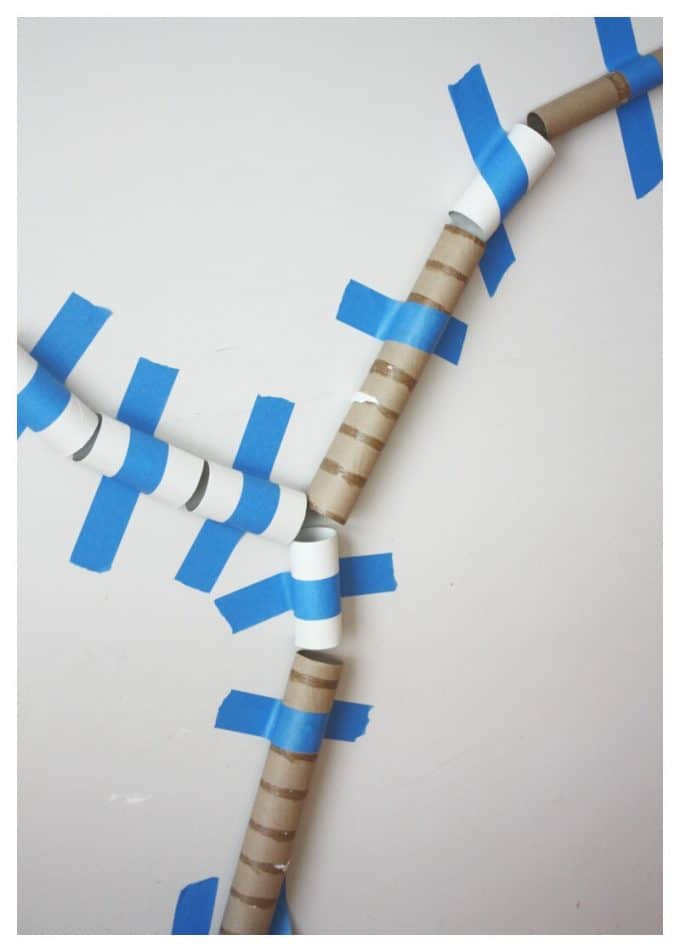
Use painter’s tape to attach cardboard tubes to a wall, refrigerator, door, bookshelf, or large piece of cardboard.
Connect the tubes to create a path for the marble to follow.
STEP 3: Test Your Marble Run
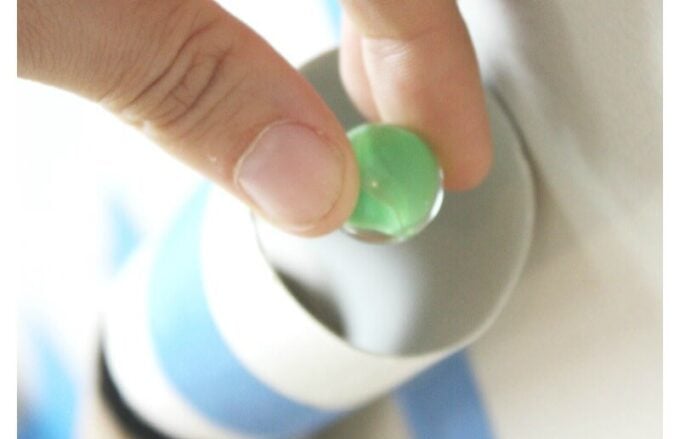
Place a marble at the top and watch what happens.
- Does it reach the end?
- Does it get stuck?
- Does it move too fast?
- Does it jump out of the track?
STEP 4: Improve Your Design
Make adjustments and test again.
Engineers rarely get a design perfect on the first try. Testing, redesigning, and improving are all part of the process.
💡 STEM Tip: We love building marble runs on a blank wall because it’s easy to change the height and angle of each tube. No wall available? Try a refrigerator, a door, a bookshelf, or even a large, flattened cardboard box.
Marble Run Ideas
Once you have a basic track working, try adding:
- Paper cup funnels
- Cardboard ramps
- Tissue box tunnels
- Spiral sections
- Marble jumps
- Recycled packaging pieces
- Multiple pathways
The more creative the design, the more opportunities kids have to test and improve their ideas.
Think Like An Engineer
Engineers solve problems through trial and error. Learn how to incorporate the engineering design process to extend the project learning.
As you build your marble run, ask:
- What happens if the angle is steeper?
- What happens if the tubes are longer?
- How can I make the marble travel farther?
- Which design works best?
- What changes improve the marble’s motion?
👉 Want more building challenges? Explore our Engineering Projects for Kids collection.
The Science Behind A Marble Run
A marble run is a fun way to explore physics through play.
🔎 Looking for more hands-on science? Explore our Force and Motion Activities, Potential and Kinetic Energy Activities, and Physics Experiments for Kids.
Marble Run Challenge Ideas
Ready for another challenge?
- Build the longest marble run possible.
- Add three turns.
- Create a marble jump.
- Design a spiral section.
- Build a marble catcher.
- Create a run that takes 10, 20, or 30 seconds to finish.
FAQ
Why does the marble move faster on steeper ramps? A steeper ramp allows gravity to pull the marble downward more strongly, increasing its speed.
Why does my marble stop before reaching the end? The track may be too flat, the connections may not line up smoothly, or friction may be slowing the marble down.
What materials can I use besides cardboard tubes? Paper plates, cups, cardboard strips, pool noodles, craft sticks, and recycled packaging materials all work well.
What age is this activity best for? This activity works well for grades 3-8 with adult assistance as needed. However, younger kids will enjoy assisting with the building and exploring with the marble run!
Is a marble run an engineering activity or a science activity? It can be both. Build and improve the design as an engineering challenge or test different variables to create a science investigation.
More Marble Run and Physics Activities
More Marble Run Activities
- Marble Roller Coaster Energy Investigation
- Pool Noodle Marble Run
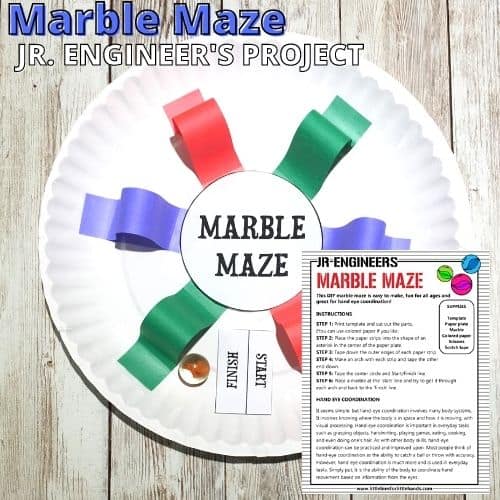
- Marble Maze
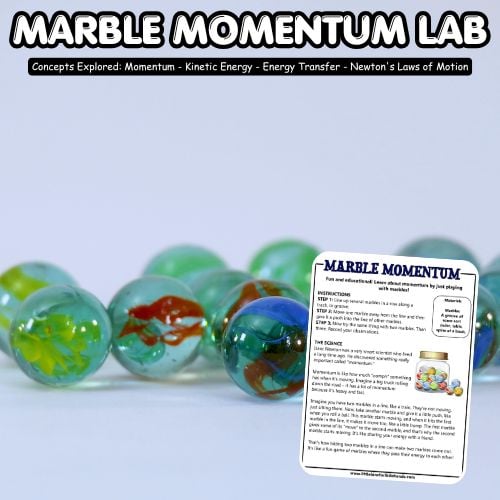
- Marble Momentum Experiment

Energy Activities
Force and Motion Activities
Explore More Physics
👉 From energy and motion to sound and engineering, discover dozens of hands-on Physics Experiments for Kids that make science fun and engaging.


Free Marble Run Challenge Sheet
Want to take this activity further? Download our free Marble Run Challenge Sheet and encourage kids to plan, build, test, and improve their own marble run designs while exploring gravity, motion, and engineering.
Explore More Force and Motion Activities
If your kids enjoyed this cardboard marble run, they’ll love experimenting with ramps, motion, speed, gravity, and energy through hands-on STEM activities.
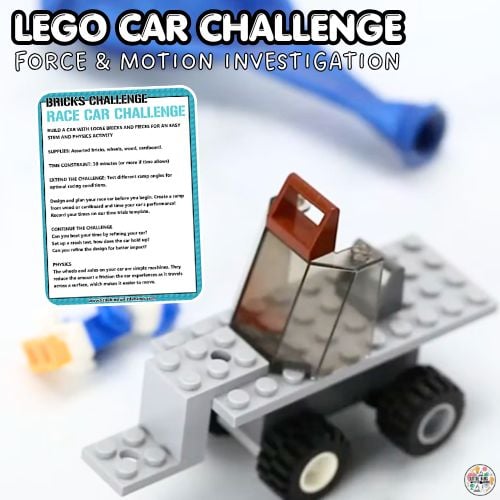
From balloon rockets and LEGO ramp challenges to moving cars and energy investigations, our Force and Motion Activities make physics fun and engaging for kids.
👉 Explore More: Force and Motion Engineering Activities for Kids
Looking For More Engineering Challenges?
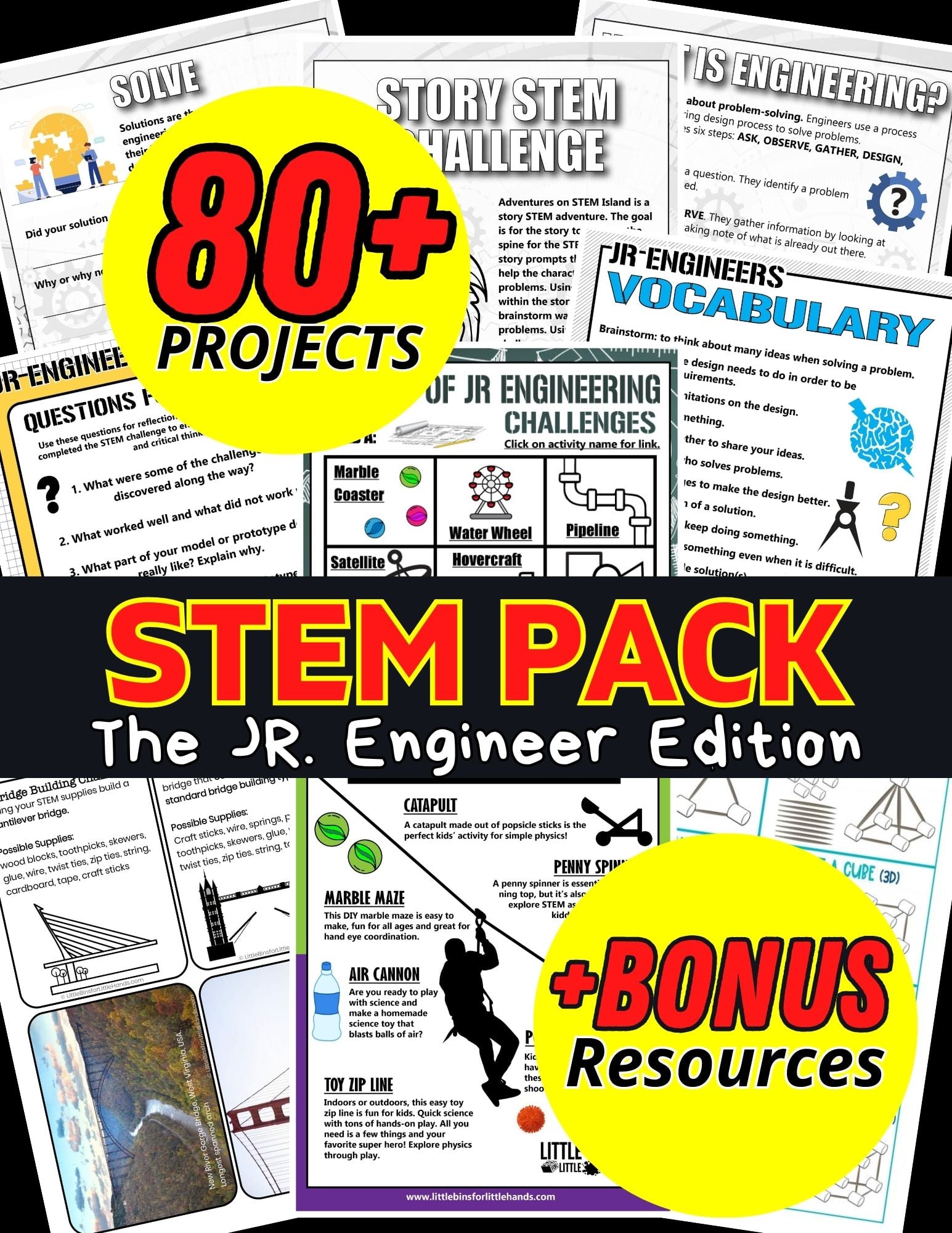
Our Engineering Projects Pack includes 80+ hands-on STEM challenges that encourage creativity, problem-solving, and critical thinking with everyday materials.
Want more hands-on STEM ideas that actually work?
Our Classic STEM & Engineering Projects Pack includes 50+ favorite experiments and engineering challenges with printable journal pages, instructions, and easy-to-find supplies. Perfect for classrooms, homeschool, and curious kids who love to build and test ideas.





We have a box with all this stuff at home. I’m going to add this to our stash of ideas. It looks like lots of fun.
✿April✿
✿Grade School Giggles✿
i love marble runs that i have a million at home!!!!!!!!!!!!!!!!!!!
THIS IS AWESOME