
Ecosystems for Kids: Activities, Food Chains & a DIY Ecosystem
An ecosystem is more than a collection of plants and animals. Living things interact with one another and with nonliving parts of their environment, including water, soil, air, rocks, sunlight, and temperature.
These ecosystem activities for kids make those connections easier to see. Explore living and nonliving things, habitats, food chains, food webs, biodiversity, and energy flow, then build a simple ecosystem in a jar to observe some of these relationships firsthand.
Field: Life Science
Grades: 3–6
Concepts: Ecosystems, ecology, habitats, biomes, food chains, food webs, producers, consumers, decomposers, biodiversity, biotic and abiotic factors
What Is an Ecosystem?
An ecosystem includes a community of living organisms and the nonliving environment around them. Plants, animals, fungi, water, soil, sunlight, and air can all be part of an ecosystem.
Ecosystems can be very large, like an ocean or desert, or small enough to explore in a schoolyard, garden, pond, or even a jar.
- Living parts, or biotic factors, include plants, animals, fungi, and microorganisms.
- Nonliving parts, or abiotic factors, include water, sunlight, air, soil, rocks, and temperature.
What do living things need? Plants and animals depend on resources in their environment to survive. Explore our Plant and Animal Needs Activities to compare what living things need, including water, air, food, light, shelter, and space.
For younger students who need more practice with this idea, start with our Living and Non-Living Things Activities before moving into more complex ecosystem relationships.

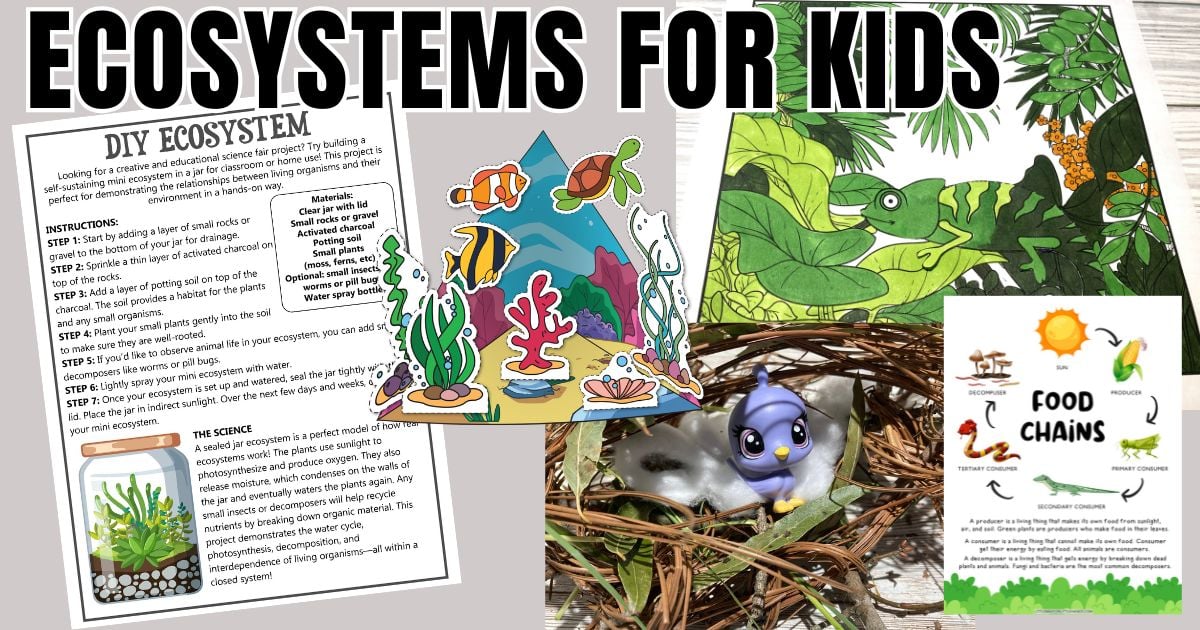
Build a DIY Ecosystem in a Jar
A mini ecosystem in a jar is an easy way to create a scientific model of an ecosystem and observe changes over time.
Supplies
- Clear jar with a lid
- Small rocks or gravel
- Activated charcoal
- Potting soil
- Small plants such as moss or small ferns
- Spray bottle with water
- Optional small decomposers such as worms or pill bugs
How to Make an Ecosystem in a Jar
- Add a layer of small rocks or gravel to the bottom of the jar for drainage.
- Sprinkle a thin layer of activated charcoal over the rocks.
- Add potting soil.
- Plant your small plants in the soil.
- Add small decomposers if desired.
- Lightly spray the ecosystem with water.
- Seal the jar and place it in indirect sunlight.
- Observe your ecosystem over the next several days and weeks.
The Science Behind the Ecosystem
A jar ecosystem can model several processes happening in a natural ecosystem.
Plants use sunlight during photosynthesis. Water released by plants can condense on the inside of the jar and eventually return to the soil. Decomposers help break down organic material and recycle nutrients.
This one activity can help kids explore:
- Photosynthesis
- The water cycle
- Decomposition
- Plant needs
- Living and nonliving components
- Interdependence
- Scientific models
- Observation over time
Free DIY Ecosystem Printable
Grab our free DIY Ecosystem in a Jar printable with the project directions plus an observation page.
The observation sheet asks kids to track plant growth, condensation, water movement, organism adaptations, and sketch what they observe.
Observe a Real Ecosystem
You don’t need to build an ecosystem to investigate one.
🔎 Choose a schoolyard, garden, park, forest, pond, or other natural area and look closely at what is there.
Our printable Ecosystem Journal encourages kids to record the weather, plants, animals, insects, soil, rocks, and water sources they observe. Kids can also look for interactions such as animals feeding, pollinators visiting flowers, predator-prey relationships, and organisms using plants for shelter.
💡 Revisit the same area later and look for changes in plant growth, weather, seasons, or animal activity.
👉 For more ways to investigate relationships between organisms and their environment, explore our Ecology Activities for Kids.
Habitats, Biomes, and Ecosystems
These three terms are closely related but describe different ideas.
- A habitat is the place where an organism lives.
- An ecosystem includes living organisms, their environment, and the interactions between them.
- A biome is a much larger region characterized by its climate and typical plants and animals.
Explore our Biomes for Kids activities to compare environments such as:
- Forests
- Grasslands
- Deserts
- Freshwater ecosystems
- Oceans
- Polar regions

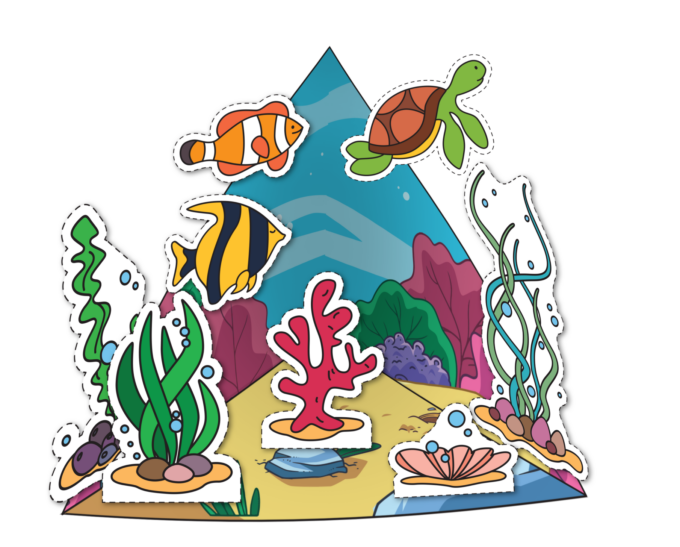
The Ecosystems Pack introduces both terrestrial ecosystems, such as forests, grasslands, and deserts, and aquatic ecosystems, such as freshwater and marine environments.
👉 Make this Ocean Diorama
Food Chains
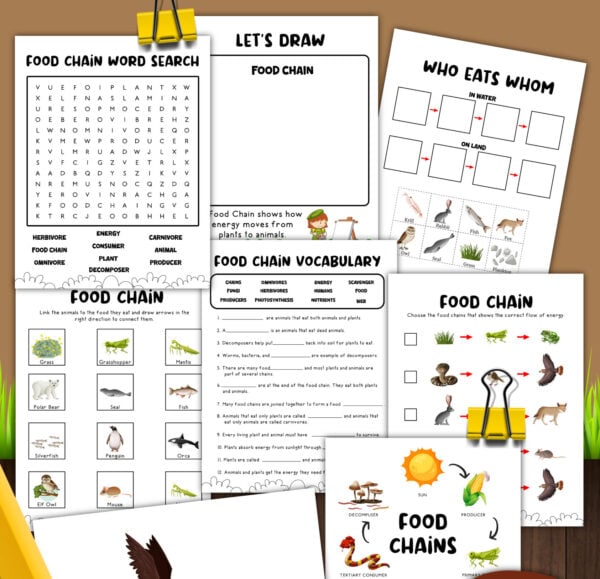
A food chain shows one pathway through which energy and nutrients move from one organism to another.
🔎 A simple food chain might look like: Plant → Grasshopper → Frog → Snake → Hawk
Food chains introduce several important roles within an ecosystem.
- Producers make their own food, usually using energy from sunlight.
- Consumers get energy by eating plants or other animals.
- Decomposers break down dead organisms and help return nutrients to the ecosystem.
👉 Use our Food Chain Activities to build, sequence, and compare simple examples. Our Winter Food Chain is a great example of a hands-on mobile model.

Food Chains vs. Food Webs
A food chain shows one pathway of energy movement.
A food web connects many food chains together and shows how organisms in an ecosystem can depend on multiple food sources and interact in different ways.
Ask:
- What organism starts this food chain?
- Which organisms are consumers?
- Does an animal have more than one possible food source?
- What might happen if one organism disappeared?
These questions help kids move from memorizing a food chain to thinking about how an ecosystem actually works.
Energy in an Ecosystem
For older elementary students, an energy pyramid is another useful model.
Producers form the base of the pyramid, followed by primary, secondary, and tertiary consumers. Less usable energy is available as you move upward through the pyramid.
Younger students can simply focus on the big idea:
🔎 Energy begins with the Sun, moves to producers, and then flows through an ecosystem as organisms eat one another.
Explore Animals in an Ecosystem
Animals are a great entry point for investigating how organisms fit into ecosystems.
Animal habitats. Explore how habitats provide animals with food, water, shelter, and space.
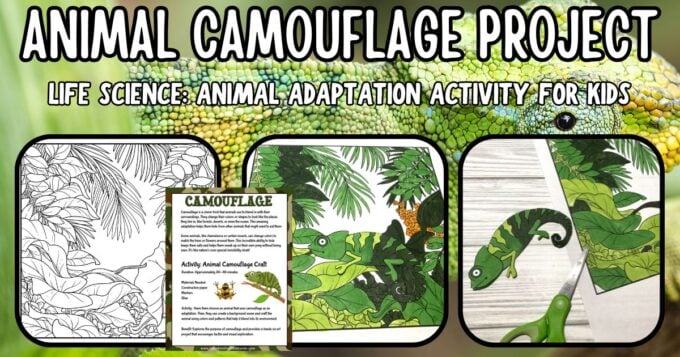
Animal adaptations. Look at body structures and behaviors that help animals survive in particular environments. Our Animal Adaptations Activities include hands-on ways to explore features such as camouflage, insulation, beaks, and other survival adaptations.
Animal classification. Use our Animal Classification Activities to organize animals by shared characteristics and compare groups found within different ecosystems.
Vertebrates and invertebrates. Compare animals with and without backbones and investigate the diversity of animal life within an ecosystem.
Endangered animals. Extend ecosystem science into biodiversity and conservation with our Endangered Animals Activities and printable pack. Explore what can happen when habitats change or populations decline.
These connections help kids see animals as part of a larger system rather than studying each animal in isolation.
Biodiversity
Biodiversity refers to the variety of living things within an area.
An ecosystem with many different plants, animals, fungi, and microorganisms can contain a wide range of relationships.
Have kids compare two environments.
Ask:
- Which plants do you notice?
- Which animals live there?
- How many different types of organisms can you find?
- What does each organism need from its habitat?
- How might changing one part affect something else?
This also creates a natural connection to endangered species, habitat loss, adaptations, and conservation.
Types and Layers of Ecosystems
Different ecosystems can also contain distinct layers or zones.
Forest ecosystems can include the canopy, understory, and forest floor. Each layer receives different amounts of sunlight and provides habitat for different organisms.
⭐️ Our Ecosystems Investigation Pack includes a Forest Layers STEAM Project.
Freshwater ecosystems can contain shallow areas near the shore and deeper regions where less light reaches.
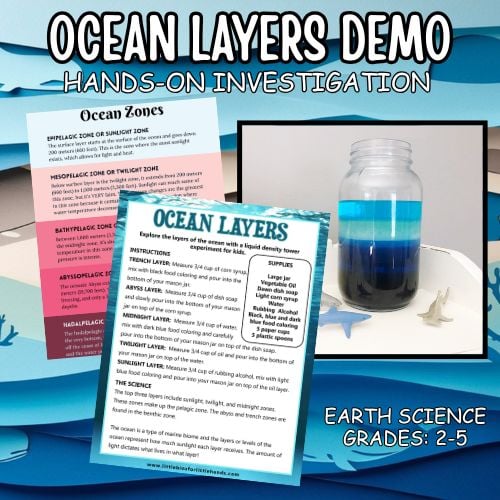
👉 Ocean ecosystems can be explored by comparing the sunlight, twilight, and midnight zones and the organisms adapted to each. Learn more about the Ocean Layers here.
Think Like a Scientist
Ecosystem science is especially useful for practicing observation and scientific modeling.
Kids can:
- Observe organisms over time
- Record changes
- Identify living and nonliving components
- Compare ecosystems
- Create food chain and food web models
- Look for patterns
- Use evidence from observations
- Ask how changing one part could affect another
👉 Visit our Observation Activities for Kids, Science Tools for Kids, and Scientific Models for Kids for more ways to build these investigation skills.
Guiding Questions
Use these questions with an ecosystem model, a nature observation, a food chain, or a food web.
- What living things do you notice?
- What nonliving parts are important here?
- How do organisms get what they need?
- Which organisms are producers?
- Which organisms are consumers?
- Where do decomposers fit?
- How does energy move through this ecosystem?
- What relationships can you observe?
- What might happen if one part of the ecosystem changed?
- How could you use a model to represent this ecosystem?
Printable Ecosystem Activities
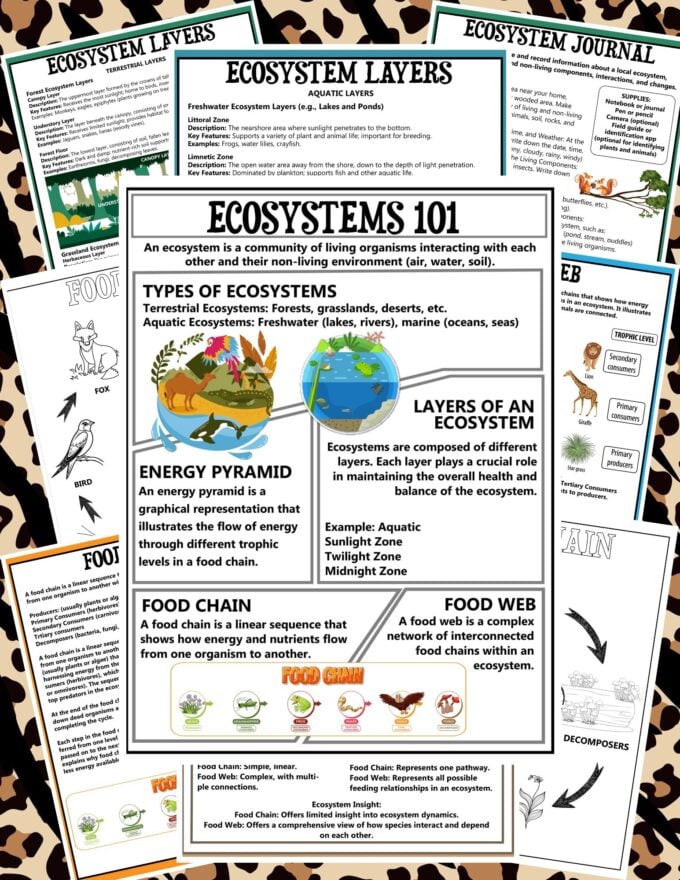
Our Understanding Ecosystems Pack gives kids a deeper look at ecosystem science with:
- Ecosystem overview pages
- Terrestrial and aquatic ecosystems
- Ecosystem layers
- Food chains
- Food webs
- Food chain vs. food web comparison
- Producers, consumers, and decomposers
- Energy pyramid
- Ecosystem journal
- Vocabulary
- Review activities
- DIY ecosystem project
The pack moves from basic ecosystem concepts into more detailed topics such as biodiversity, food webs, trophic levels, and energy flow.
For an even broader study of our planet and its systems, explore our Earth Studies Pack.
You can also find the Ecosystems Pack and our other printable science resources inside the All-Access Pass.
FAQ
What is an ecosystem for kids? An ecosystem includes living organisms and the nonliving parts of their environment interacting together.
What is an easy hands-on ecosystem activity? Build an ecosystem in a jar or investigate a local outdoor area and identify its living and nonliving components.
What is the difference between a habitat and an ecosystem? A habitat is where an organism lives. An ecosystem includes the organisms, the environment, and the interactions between them.
What is the difference between a food chain and food web? A food chain shows one pathway of energy transfer. A food web shows many interconnected feeding relationships within an ecosystem.
What grades are these ecosystem activities for? The activities work especially well for grades 3–6. Younger students can focus on habitats, living and nonliving things, and simple food chains, while older students can explore food webs, biodiversity, energy pyramids, and more complex ecosystem interactions.
More to Explore
- Life Science Activities
- Plant Science Activities
- Animal Activities for Kids
- Earth Science Activities
- Second Grade Science Activities
- Third Grade Science Activities